
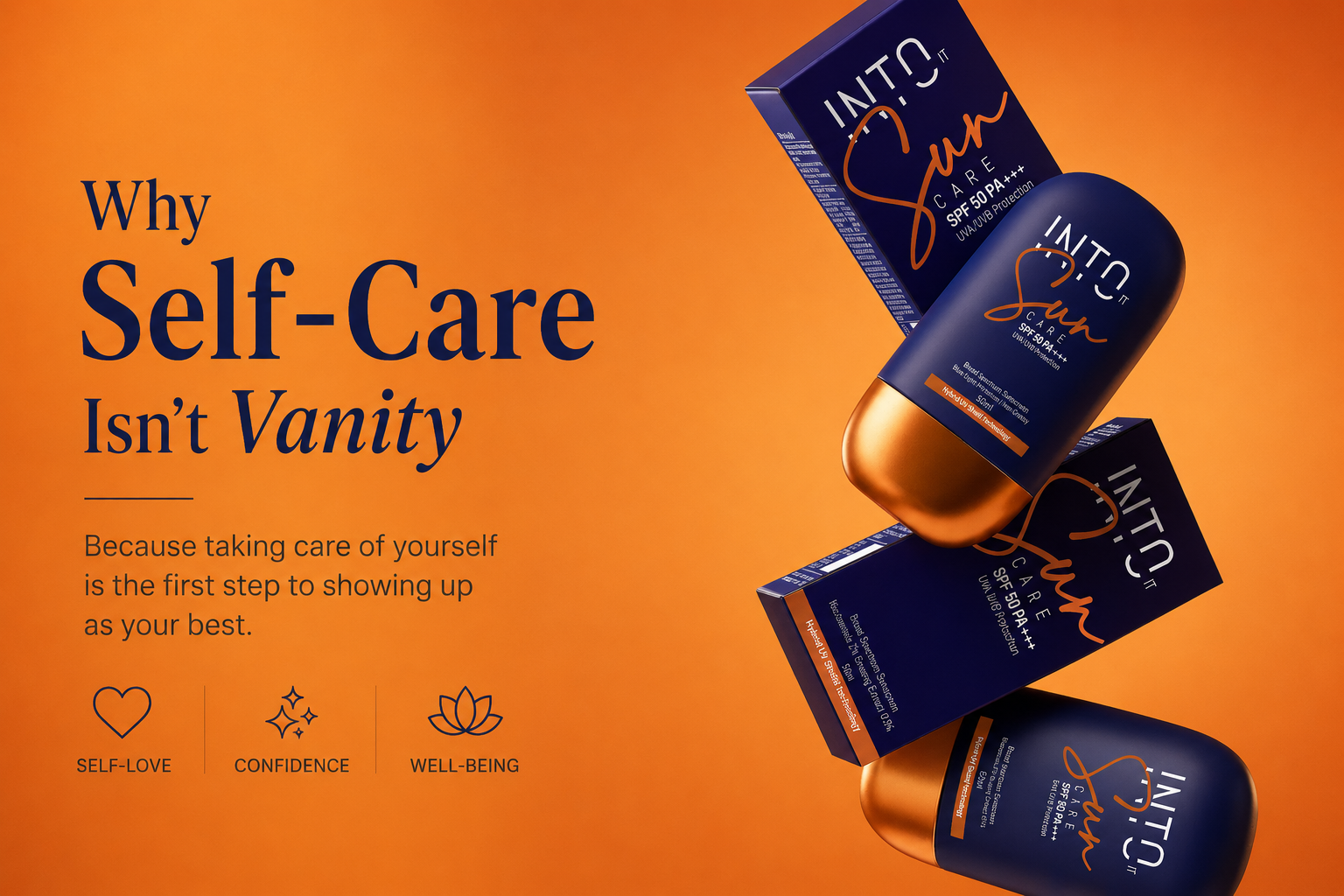
Why Self-Care Isn't Vanity
For a long time, taking care of your appearance carried an unspoken accusation for men: that it meant you were vain, self-absorbed, or somehow less serious about the things that actually mattered. This idea has been quietly costing men more than just better skin. It has been part of a broader pattern where men avoid attending to their own wellbeing, physical or mental, because doing so felt at odds with what they had been taught masculinity required.
That pattern is shifting, and the data behind why it needed to shift is worth understanding properly, not as a marketing angle, but as a genuinely important conversation about what self-care actually does and why dismissing it as vanity has real costs.
The Stigma Was Never About Skincare
To understand why self-care for men is not vanity, it helps to understand what the stigma was actually protecting.
Research into traditional masculinity norms consistently identifies a pattern where men avoid behaviours associated with vulnerability, including seeking help, expressing emotion, or investing visible effort into self-care, because these behaviours conflict with deeply ingrained ideas about what masculine identity requires. A systematic review of literature on this topic found that many men avoid seeking professional support, whether for mental health or otherwise, due to feelings of embarrassment or fear of being perceived as weak, a reluctance commonly tied to masculine identity rather than to any practical barrier.
This same research found that this inability to seek support, whether from friends, family, or professionals, creates a cycle where issues remain unaddressed and often worsen over time. Multiple studies have also found a direct link between rigid traditional masculinity norms and engagement in risky coping behaviours, including substance use, as men attempt to manage stress and anxiety through means that feel more compatible with masculine identity than openly addressing the underlying issue.
This is the actual context that "skincare is vanity" exists within. It is not really a statement about moisturizer. It is one small expression of a much larger pattern where men have been discouraged from any visible act of self-investment, physical or psychological, because that investment has been culturally coded as weakness.
What the Research Actually Shows About Self-Care
Mental Health Attitudes Are Already Shifting
A broad 2023 survey by Men's Health found that 95 percent of men now say mental health is as important as physical health, and that most men, particularly younger cohorts, are taking proactive steps for their mental wellbeing. This represents a significant shift from previous generational attitudes, and it provides important context for understanding men's self-care more broadly: the same forces driving more openness about mental health are also driving more openness about physical self-care.
Research using newer assessment tools, including what researchers call the "Man Box" scale, measuring adherence to rigid traditional masculinity, has found that men who cling most tightly to extreme versions of these norms report significantly worse outcomes. One study found 19 percent higher suicidal ideation among men strictly adhering to Man Box ideals compared to those who did not. This is sobering data, and it directly undermines the idea that rejecting rigid, stoic, self-denying masculinity in favour of visible self-care and emotional openness represents some kind of weakness. The actual evidence points the other way.
Grooming as a Documented Stress-Reduction Mechanism
Beyond the broader cultural shift, there is a more specific and direct line of evidence connecting grooming routines to measurable psychological benefit.
Research on the psychology of grooming describes the relationship between personal care routines and mental wellbeing as both intricate and well-documented, noting that grooming routines can function as a meaningful act of self-care. In a world where stress and pressure are constant, dedicating focused time to personal grooming provides a structured pause, a moment of mindfulness that allows attention to shift toward one's own wellbeing rather than away from it.
This same body of research identifies a specific mechanism: the act of self-care can signal to the brain that one is worthy of care and attention, which is associated with improved mental health outcomes over time. Grooming practices, including skincare routines, have also been described as inducing a meditative state for many people, helping to alleviate anxiety and promote relaxation through the focused, repetitive, tactile nature of the routine itself.
The Confidence-Behaviour Connection
This connects to something covered in more depth elsewhere in this content series, but it is worth restating here specifically in the context of vanity versus genuine wellbeing. The relationship between how a man feels about his appearance and how he shows up in his interactions, his eye contact, posture, willingness to engage, is not superficial. It reflects a documented psychological mechanism where self-investment produces a form of self-respect that influences behaviour well beyond the mirror.
This is fundamentally different from vanity, which implies an excessive or disproportionate preoccupation with appearance for its own sake. What the research actually describes is something closer to baseline self-maintenance, a habit that supports psychological functioning rather than one that exists purely for external validation.
Why This Conversation Matters Specifically in India
India's relationship with men's grooming and self-care carries its own specific cultural weight, separate from but related to the broader global pattern.
Men's grooming in India has historically been positioned as either entirely unnecessary, something only women needed to think about, or as an indulgence associated with vanity, frequently coded in ways that questioned a man's masculinity for showing visible interest in his own appearance or wellbeing. This has meant that Indian men, even more than in some other markets, have been slower to adopt routine self-care, not due to a lack of interest, but due to a more entrenched stigma actively discouraging it.
The market data reflects a meaningful shift already underway. Men's skincare and grooming consideration has grown substantially in recent years as younger Indian men increasingly reject the most rigid traditional expectations around masculinity, mirroring the broader generational pattern documented globally. This shift is happening alongside, not separately from, growing openness among Indian men around mental health, suggesting these are connected rather than parallel trends.
For Indian men specifically, taking up a consistent skincare routine is not adopting a foreign or feminine practice. It is participating in a broader, evidence-supported reframing of what basic self-maintenance looks like for men, one that is increasingly recognised as supporting genuine wellbeing rather than representing some kind of frivolous indulgence.
The Practical Difference Between Vanity and Self-Care
It is worth being precise about this distinction rather than simply asserting that self-care is good and vanity is bad without explaining the actual difference.
Vanity is characterised by an excessive, often anxious preoccupation with appearance, frequently driven by external validation, comparison, or insecurity, and often disconnected from genuine wellbeing. It can become compulsive, time-consuming in disproportionate ways, and emotionally costly rather than beneficial.
Self-care, including a basic skincare routine, is a structured, time-bounded habit oriented toward genuine physical and psychological maintenance. A five-minute morning and evening routine is not a disproportionate investment of time or attention. It does not require external validation to feel worthwhile. It is closer in spirit to other forms of basic self-maintenance that nobody questions, brushing your teeth, exercising, eating reasonably well, none of which are typically labelled vanity despite all of them involving attention to one's own body and appearance to some degree.
The actual evidence reviewed throughout this guide supports skincare and grooming specifically as falling into the second category: a brief, structured, low-cost habit associated with measurable stress reduction, improved self-regard, and behaviours that support rather than undermine genuine engagement with the world.
What This Means for Building a Routine
Understanding that self-care is not vanity changes how the habit itself should be approached. It is not something to feel embarrassed about or to treat as an indulgent extra. It is closer to a basic maintenance habit that happens to also support psychological wellbeing through the mechanisms described above.
This does not require an elaborate routine to capture the benefit. A simple, consistent morning and evening routine, cleanse, treat, protect, takes under ten minutes total across the day and is sufficient to provide both the physical skin benefits covered throughout the rest of this content series and the structured, mindful pause that the psychological research associates with grooming as a stress-reduction practice.
The INTOIT Claytox Cleanser, INTOIT 6x Complex Face Serum, and INTOIT Maximalist Moisturizer together form exactly this kind of routine: simple enough to maintain consistently without becoming a disproportionate time investment, substantive enough in their formulation to deliver genuine physical results, and structured enough to provide the daily, deliberate pause that supports the psychological benefit documented in the research above.
A Note on Mental Health
This guide has referenced research on masculinity norms, suicidal ideation, and mental health avoidance because that context is genuinely important to understanding why dismissing self-care as vanity has real costs, not because skincare is presented here as a solution to serious mental health struggles.
A consistent grooming routine can be a genuinely helpful part of a broader pattern of self-care and may contribute to reduced day-to-day stress for many men. It is not a substitute for professional support if you are experiencing persistent low mood, anxiety, or thoughts of self-harm. If that describes your experience, please reach out to a mental health professional or a trusted person in your life. Taking that step is not weakness either, and it deserves the same reframing this guide has applied to grooming and self-care more broadly.
Common Questions About Self-Care and Vanity
Isn't spending money and time on skincare still a form of vanity by definition?
Not based on the time and intent involved. A basic three-step routine takes under ten minutes a day and is oriented toward genuine skin health and a brief, structured moment of self-attention, not toward an anxious or excessive preoccupation with appearance. The amount of money spent is also not the determining factor. A reasonably priced, consistent routine reflects sensible maintenance, the same way budgeting for regular exercise or basic healthcare does, rather than indulgence.
Why has men's grooming specifically carried more stigma than other forms of self-care?
This connects to the broader research on traditional masculinity norms, which specifically code vulnerability, including visible self-investment and care, as conflicting with expected masculine stoicism and self-reliance. Grooming, being visibly tied to appearance, has historically been an easy target for this stigma, even though, as the evidence in this guide shows, the underlying behaviour pattern, structured self-care, is genuinely supportive of wellbeing rather than something to be ashamed of.
Is this shift in attitudes actually happening in India, or mostly in Western markets?
The data shows meaningful movement in India specifically, not just globally. Indian men's grooming and skincare engagement has grown substantially in recent years, and this is occurring alongside increasing openness about men's mental health in Indian contexts as well. While Indian cultural attitudes toward masculinity carry their own specific history and texture, the underlying generational shift toward rejecting rigid, self-denying masculine norms in favour of genuine self-care appears to be occurring in India as it is globally, even if the pace and specific cultural framing differ.
Does a basic skincare routine actually reduce stress, or is that overstated?
The research describes grooming routines as capable of inducing a meditative, focused state that can help alleviate anxiety for many people, similar in mechanism to other brief, structured, repetitive self-care activities. This is a genuine, documented psychological mechanism, though it should be understood as a modest, supportive contributor to daily wellbeing rather than a significant standalone stress-reduction intervention. It is one small, accessible habit among many that can meaningfully support how a day feels, not a replacement for addressing more significant sources of stress directly.
How do I start taking self-care more seriously without it feeling indulgent?
Start with the basics, framed as maintenance rather than indulgence: a simple cleanse, treat, and protect routine taking under five minutes per session. Approaching it the same way you would approach any other basic health habit, brushing your teeth, getting enough sleep, exercising regularly, tends to remove the sense that it is something requiring special justification. The evidence reviewed in this guide supports treating it exactly that way: as ordinary maintenance that happens to also support your mental wellbeing, not as an indulgence that needs defending.
Final Word
The idea that self-care is vanity has never been well supported by evidence, and the research increasingly points in the opposite direction. Rigid adherence to traditional masculine norms that discourage self-investment is associated with measurably worse outcomes, including higher rates of risky coping behaviours and, in the most extreme cases, significantly higher suicidal ideation. Conversely, structured self-care, including grooming routines, is associated with stress reduction, improved self-regard, and the kind of daily, deliberate pause that supports genuine psychological wellbeing.
For Indian men specifically, taking up a basic skincare routine is not adopting something foreign or frivolous. It is participating in a broader, evidence-backed shift that is already underway, one that treats self-maintenance as ordinary rather than indulgent, and that recognises taking care of yourself, in small, consistent ways, as a genuinely reasonable thing for any man to do.
Start your self-care routine with the INTOIT essentials here.