
What Happens If You Don't Moisturize?
Most men who skip moisturizer do so for one of three reasons. Their skin already feels oily and adding more seems counterproductive. They think moisturizer is a marketing creation and not genuinely necessary. Or they have simply never developed the habit.
The actual science of what happens to skin without consistent moisturizing tells a different story. This guide covers the biological progression from initial dehydration to structural barrier damage, the specific consequences for oily skin, and why repeated application over time produces effects that single applications cannot.
The First Thing That Happens: Transepidermal Water Loss Increases
Your skin is continuously losing water to the surrounding air through a process called transepidermal water loss, or TEWL. This is a passive, continuous biological process, not something you can feel happening. In healthy skin with an intact barrier, the lipid matrix of the stratum corneum, primarily ceramides, cholesterol, and fatty acids, regulates this loss, keeping it within a range that the body can compensate for through normal fluid intake and cellular activity.
When you skip moisturizer, particularly in air-conditioned environments, the skin loses water at a faster rate than it would with the additional barrier support a moisturizer provides. This is especially relevant in indoor environments: research confirms that dry, conditioned air dramatically increases the rate of water evaporation from the skin surface, and without a product providing either humectant hydration or occlusive sealing, or ideally both, the skin begins to dehydrate progressively through each hour of the day.
What Happens to Skin Within Days of Not Moisturizing
Surface Texture Changes
As dehydration progresses, the skin's surface texture becomes rough and loses smoothness. Fine lines become more visually apparent because the skin lacks the plumpness that sufficient moisture content provides. Mild flaking or a scaly appearance can develop as the natural process of dead skin cell shedding is disrupted by the lack of adequate surface lubrication. The skin also takes on a dull, flat appearance because dehydrated surface cells do not reflect light evenly.
These changes can appear within days of consistently skipping moisturizer, particularly in dry indoor environments, for men who were previously using a moisturizer regularly.
Increased Sensitivity
Research confirms that high TEWL is not just a sign of dryness. It is linked to increased sensitivity, redness, and a higher likelihood of inflammatory flares in skin prone to reactive conditions. As the barrier becomes progressively more stressed without the lipid support a moisturizer provides, the skin's tolerance for external stimuli, including pollution, temperature changes, and skincare actives, begins to reduce.
For Indian men whose skin is already stressed by daily UV exposure, pollution, and hard water, this increased sensitivity from inadequate moisturizing compounds the environmental damage rather than existing independently.
What Happens Over Weeks Without Moisturizing
Structural Barrier Damage
Sustained neglect of moisturizing allows the protective lipid matrix of the stratum corneum to become progressively depleted and disorganised. This structural failure significantly increases TEWL, making the skin unable to retain moisture even in normal conditions. The gaps that form in the barrier mean that external threats, including environmental pollutants, allergens, and irritating chemicals, can penetrate the skin more easily.
This is the important distinction between dehydration, which is a water-content issue, and barrier damage, which is a structural issue. Dehydration responds relatively quickly to consistent moisturizing. Structural barrier damage takes longer to fully repair because the ceramide and lipid components of the barrier need to be replaced and reorganised over multiple skin cell cycles.
Accelerated Visible Ageing
When the skin barrier is compromised, collagen and other structural proteins in the dermis become more vulnerable to the environmental damage that normally the intact barrier would partially shield against. Research confirms that a weakened skin barrier increases vulnerability to UV-induced collagen degradation, pollution-driven oxidative stress on skin structural proteins, and the inflammatory processes that contribute to premature skin ageing. Each day of continued barrier compromise without correction means more cumulative structural damage reaching the dermis than it would in well-moisturized skin.
The Paradox for Oily Skin: Not Moisturizing Makes It Oilier
This is the single most important point for the majority of Indian men who skip moisturizer because their skin already feels oily.
Oiliness, the sebum produced by sebaceous glands, and hydration, the water content within skin cells, are entirely separate systems. Skin can be simultaneously oily on the surface and dehydrated in the deeper layers. When this happens, the sebaceous glands detect the compromised barrier and the resulting increased TEWL, and respond by producing more sebum to try to compensate.
Research published in Dermatology Times confirms this directly: patients with higher TEWL were more likely to be male, younger, and not regularly using a facial moisturizer, and the same study found that regular moisturizer use was significantly associated with better skin hydration outcomes even in an oily, acne-prone population.
This means skipping moisturizer to control oiliness often produces the opposite of the intended effect. The barrier becomes more compromised, TEWL increases, the sebaceous glands respond with more oil production, and the cycle continues. Using the right moisturizer, lightweight, non-comedogenic, with barrier-repairing ceramides, breaks this cycle rather than reinforcing it.
Research published in a clinical study protocol also confirmed that repeated twice-daily moisturizer application over seven or more days produces lasting conductance increases in the skin for at least a week after application has ceased, demonstrating both short-term and lasting benefits that single applications cannot produce. This is the reason consistency matters more than the occasional application: the barrier-repair effects of regular moisturizing compound over time in a way that skipping it does not.
What Happens Without Moisturizing in the Indian Context Specifically
India amplifies every consequence described above. Very high UV index levels year-round accelerate the barrier damage that leaves the skin without lipid support to manage. High particulate pollution provides a constant supply of the oxidants and irritants that a compromised barrier struggles to defend against. The humid-to-air-conditioned transition that most Indian professionals experience multiple times per day creates a particularly demanding environment for the skin's moisture regulation system.
Skipping moisturizer in this environment is not simply failing to add an optional extra. It is removing a meaningful layer of protection from a system under genuine daily stress. The skin can manage for a while, as it does in most neglect scenarios, but the cumulative consequence over months and years is accelerated barrier degradation, more pronounced sensitivity and reactivity, and faster visible ageing than the same skin with consistent barrier support would produce.
Why Single Applications Are Not Enough
This is a nuanced but important point for men who occasionally moisturize and expect meaningful results from irregular use.
A single application of moisturizer does not produce lasting effects. Clinical research confirms that single applications do not cause long-lasting changes to barrier function. However, repeated twice-daily applications over a sustained period produce cumulative, measurable improvements in barrier integrity, hydration levels, and TEWL rates. These improvements persist for a week or more even after application has stopped, indicating that regular moisturizing produces structural changes in the barrier, not just temporary surface effects.
This is why the habit of twice-daily moisturizing, morning and night, is significantly more beneficial than applying moisturizer occasionally or only on days when the skin feels particularly dry. The barrier-building effect is cumulative and requires consistent stimulus to maintain.
The INTOIT Moisturizer and What It Does for the Barrier
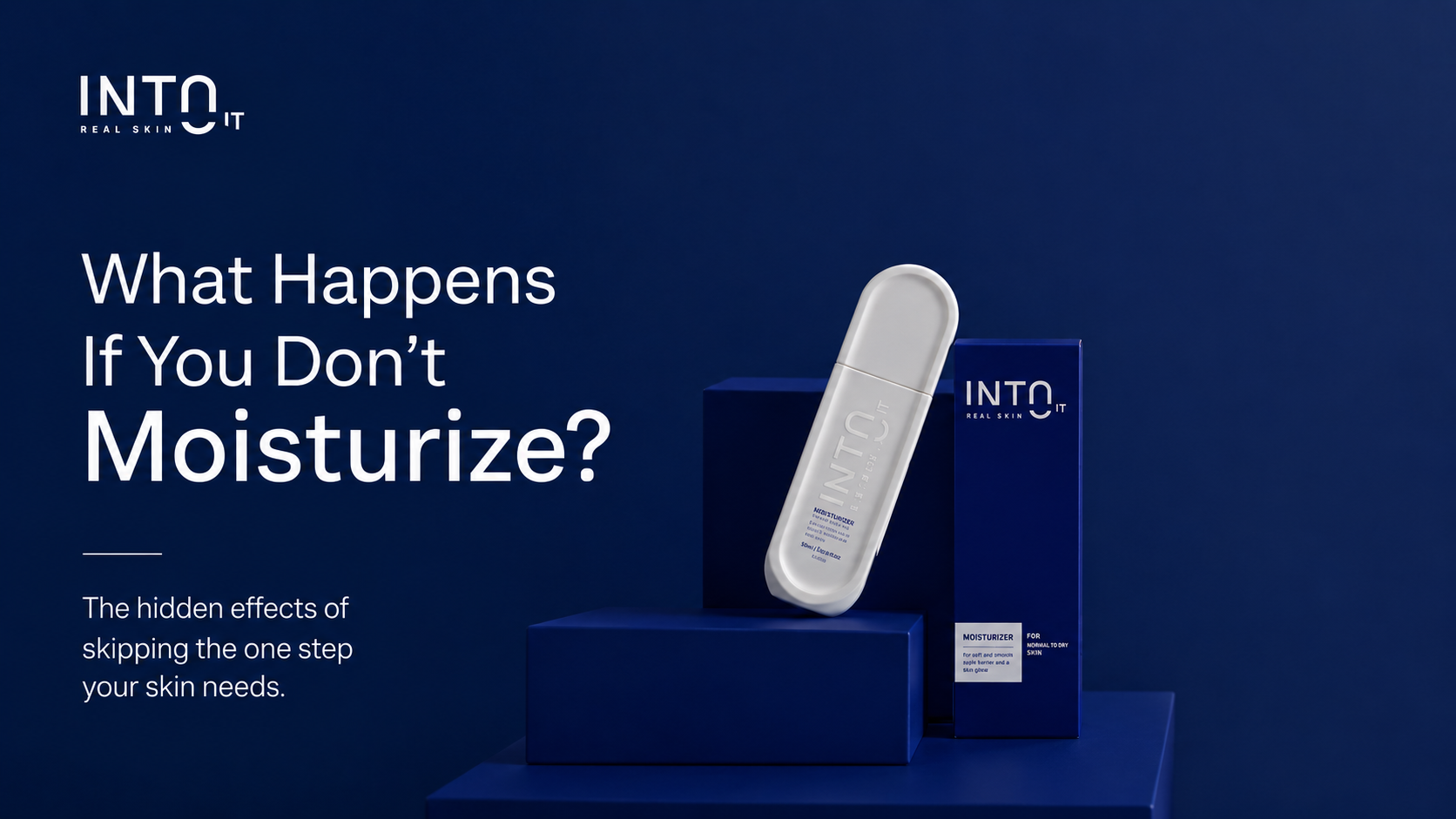
The INTOIT Maximalist Moisturizer addresses the specific consequences of skipping moisturizer through a combination of functions.
Barrier lipid replacement: Ceramide NP, AP, and EOP directly replenish the three ceramide types most critical to barrier function. Cholesterol and Phytosphingosine complete the structural lipid profile. Together these address the lipid depletion that not moisturizing allows to accumulate.
Sustained deep hydration: The Xylitylglucoside, Anhydroxylitol, and Xylitol complex provides water retention within the skin structure rather than just at the surface, giving the barrier adequate moisture content for the barrier to function and repair properly.
Active surface renewal: Glycolic Acid at 5 percent and Mandelic Acid at 2 percent maintain cell turnover, preventing the roughness and dullness that accumulate when the surface is not renewed consistently.
Brightening against cumulative pigmentation: Alpha Arbutin at 2 percent, Glutathione at 2 percent, and Kojic Acid at 1 percent address the melanin overproduction that UV and inflammation drive in skin that is not adequately protected by a maintained barrier.
Apply after the INTOIT 6x Complex Face Serum, which delivers Niacinamide to actively stimulate the skin's own ceramide synthesis, complementing the external ceramide replenishment from the moisturizer through a second, internal pathway.
Common Questions About Skipping Moisturizer
Will my skin adapt if I stop moisturizing?
Not in a beneficial way. Without barrier support, the skin does not build its own more robust barrier over time. Instead, the progressive depletion of the barrier lipid matrix increases TEWL, increases sensitivity, and in oily skin triggers compensatory sebum overproduction. There is no documented adaptation pathway that produces better skin health through consistent moisturizer avoidance.
Is moisturizer really necessary in humid Indian weather?
Yes. Humidity reduces the rate of surface moisture evaporation from the skin, which means the dehydration effect of high TEWL is slightly less pronounced in humid conditions than in dry, air-conditioned environments. However, the barrier lipid depletion from UV exposure, pollution, and hard water continues regardless of ambient humidity. The barrier-repairing function of ceramide-containing moisturizer is relevant year-round, even when surface hydration feels less urgent in humid months.
What if I just drink more water instead?
Internal hydration from drinking water supports the body's overall water content, which does contribute to skin moisture. However, it cannot compensate for the structural barrier lipid deficiency that results from not using a moisturizer. The barrier requires external lipid replacement because the skin does not regenerate ceramides from water intake. Both internal hydration and topical moisturizing contribute to different aspects of skin moisture and barrier function, and neither fully replaces the other.
My skin feels fine without moisturizer. Does that mean I don't need it?
How skin feels is not always an accurate reflection of what is happening at the barrier and cellular level. Early barrier compromise and increasing TEWL are not always felt as dryness, particularly by men with naturally oilier skin where sebum partially masks the dehydration happening in the deeper layers. The structural degradation of consistent TEWL accumulates gradually over months and years before it becomes visible as accelerated skin ageing and persistent sensitivity. The absence of an immediately noticeable negative sensation is not evidence that barrier function is unaffected.
Final Word
Not moisturizing is not neutral for your skin. It progressively increases water loss, depletes barrier lipids over time, triggers compensatory oil production in oily skin, increases sensitivity to the environmental stressors Indian men face daily, and accelerates the visible signs of skin ageing.
The habit of twice-daily moisturizing is not optional maintenance with marginal benefit. It is the step that supports the barrier's structural function, reduces the cumulative impact of daily UV and pollution exposure on the skin, and in oily skin specifically, helps regulate the oil production that skipping moisturizer often makes worse.
Apply the right moisturizer, consistently, morning and night. The benefits compound. The consequences of not doing so do too.
Shop the INTOIT Maximalist Moisturizer here.