
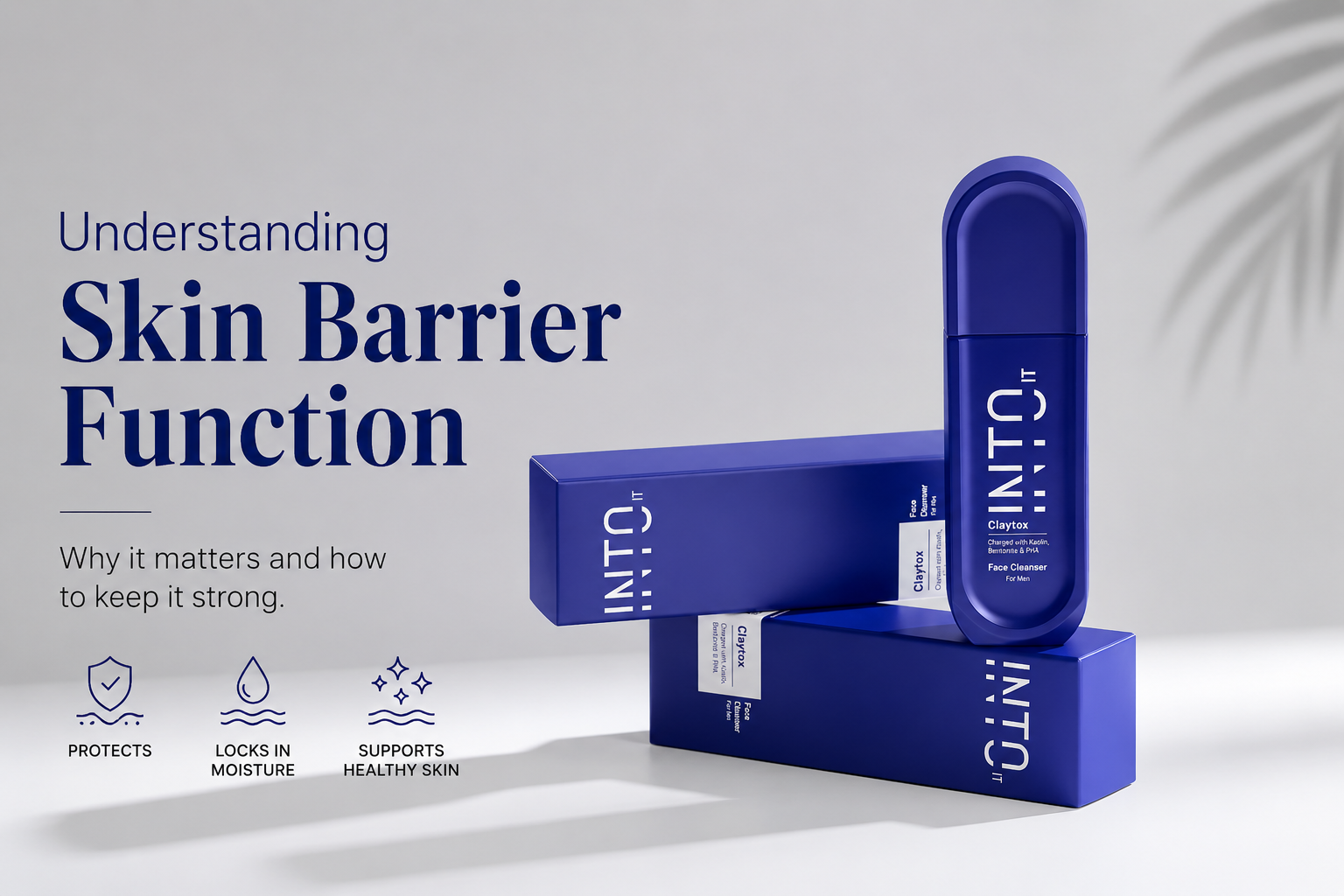
Understanding Skin Barrier Function
Almost every skincare concern men deal with, dryness, sensitivity, oiliness that will not regulate, breakouts that will not heal, dullness, comes back to one structure: the skin barrier. Yet most men have never had it properly explained to them. They know the term "barrier" gets used a lot in skincare marketing, but not what it actually is or why it matters this much.
This guide explains the skin barrier in real, scientific terms. What it is physically made of. How it is built. What damages it. And what the evidence actually shows works to repair and maintain it.
What the Skin Barrier Actually Is
The skin barrier, more precisely called the stratum corneum, is the outermost layer of the epidermis. It is the final product of a process where skin cells, called keratinocytes, are continuously produced in the deeper layers of the epidermis and gradually migrate upward over roughly two to four weeks. As they migrate, they undergo what is called terminal differentiation, flattening out, losing their internal cellular machinery, and becoming tough, interlocking plates filled with a structural protein called keratin. At this final stage, they are known as corneocytes.
The most widely used and scientifically established way to understand this structure is the "brick and mortar" model, first described in detail by dermatologist Peter Elias. In this model, the corneocytes are the bricks, flat, tough, dead skin cells stacked in multiple interlocking layers. The mortar holding them together is a complex matrix of lipids, primarily ceramides, cholesterol, and free fatty acids, packed in the spaces between the cells.
This is not a loose or approximate description. It reflects the actual physical and chemical structure of the tissue, confirmed across decades of dermatological research using increasingly advanced imaging and spectroscopy techniques.
The Bricks: What Corneocytes Actually Do
It would be easy to assume that because corneocytes are dead cells, they are simply inert debris on their way to being shed. The reality is more sophisticated. Corneocytes provide mechanical reinforcement against physical damage, protect the living cells beneath them from ultraviolet radiation, contribute to inflammation regulation, and maintain hydration by holding onto water within their internal keratin structure.
A single corneocyte is thin and structurally fragile on its own. But dozens of interlocking layers, stacked and connected together, create a composite material with genuine mechanical resistance to tearing, chemical penetration, and water loss, far exceeding what any individual cell could achieve alone.
Holding these cells together are specialised protein structures called corneodesmosomes, which function essentially as structural rivets connecting one corneocyte to the next. In healthy skin, these connections remain strong throughout the lower layers of the stratum corneum and only gradually break down at the very surface, allowing dead cells to shed in a controlled, regulated process known as desquamation. This is the biological mechanism behind natural skin cell turnover: not random shedding, but a precisely timed structural release happening only once cells have reached the outermost surface.
The Mortar: What the Lipid Matrix Actually Does
The lipid matrix between the corneocytes is what provides the stratum corneum's actual water-sealing function. Without it, the bricks alone would not form an effective barrier, since cells, however well structured, cannot prevent water from passing through the gaps between them.
Ceramides constitute approximately half of the stratum corneum's total lipid content, making them the single most significant lipid component by mass. Structurally, ceramide molecules consist of an amino acid containing a sphingoid base linked to a hydrophobic fatty acid chain. Beyond their structural role in forming the barrier and maintaining moisture, ceramides also function as second messengers inside cells for a broad range of biological processes, meaning their role extends beyond passive structural support into active cellular signalling.
Cholesterol makes up approximately one quarter of the stratum corneum's lipid content. It plays a critical role in the fluidity and organisation of the lipid bilayers, allowing the lipid matrix to maintain the right balance between rigidity and flexibility for the skin to function properly.
Free fatty acids make up the remaining significant portion, contributing to the overall structural integrity and the slightly acidic pH that the stratum corneum needs to maintain for proper enzymatic function and antimicrobial defence.
These three lipid types do not simply sit in the spaces between corneocytes. Advanced research using techniques including spectroscopy and molecular modelling has shown that they organise into precise, repeating lamellar structures, essentially highly ordered, stacked bilayer arrangements. This precise organisation is what gives the barrier its water-sealing capability, and disruption of this organisation, not just a reduction in total lipid quantity, is a key factor in barrier dysfunction.
What the Skin Barrier Is Actually Protecting Against
The stratum corneum performs what dermatologists describe as a dual function. First, it provides physical defence against external threats including free radicals, bacteria and other microbes, allergens, environmental toxins, and UV radiation, all of which are blocked from penetrating deeper into living skin tissue by this outer layer.
Second, and arguably the more critical function in day-to-day skin health, it prevents the escape of water from inside the body. This water-retention function is what keeps skin firm, hydrated, elastic, and resistant to the fine lines and wrinkling associated with dehydrated, poorly functioning skin.
When the barrier is intact and functioning properly, both of these functions operate simultaneously and effectively: external threats stay out, internal moisture stays in. When the barrier is compromised, both functions degrade together, which is why barrier damage tends to produce a combination of symptoms rather than just one isolated problem: increased sensitivity to irritants alongside increased dryness and water loss, occurring at the same time.
How the Skin Barrier Becomes Compromised
Understanding the specific mechanisms of barrier damage explains why certain habits and environmental factors are so consistently flagged across dermatological guidance as barrier-damaging.
Harsh surfactants and high-pH cleansers directly strip lipids from the mortar layer with each use. Bar soap, with a pH typically between 9 and 11 compared to the skin's natural pH of approximately 4.5 to 5.5, is particularly disruptive, both removing barrier lipids mechanically and shifting the skin's surface chemistry away from the range where its own protective and antimicrobial functions operate optimally.
Hot water increases the rate of lipid extraction from the barrier during cleansing compared to lukewarm water, contributing to faster barrier degradation over repeated exposure.
Over-exfoliation disrupts the corneodesmosome connections holding corneocytes together prematurely, essentially forcing desquamation before the cells and the barrier structure beneath them are ready, leaving a thinner, less protective outer layer.
UV exposure generates oxidative stress that damages both the lipid components of the barrier and the proteins involved in maintaining corneocyte structure, contributing to the barrier dysfunction that underlies much of UV-driven premature skin ageing.
Pollution exposure, particularly fine particulate matter, has been documented to disrupt barrier protein production and degrade lipid organisation, a particularly relevant mechanism for Indian men in high-pollution urban environments.
Environmental humidity changes, including the transition between humid outdoor conditions and dry, air-conditioned indoor environments common in Indian offices, place repeated stress on the barrier's ability to regulate water content, contributing to cumulative dysfunction over time even without any single dramatic damaging event.
What Barrier Damage Actually Looks and Feels Like
Recognising compromised barrier function helps in understanding when a skincare approach needs to shift toward repair rather than simply continuing a standard routine.
Increased sensitivity and reactivity: Products that previously caused no reaction begin to sting, burn, or cause redness, because the barrier's physical protection against irritant penetration is reduced.
Persistent dryness despite moisturising: As covered in detail in the dry skin routine guide, this is one of the clearest signs that surface-level hydration is being applied without addressing an underlying structural lipid deficiency.
A rough, uneven texture: Disrupted corneodesmosome function and irregular desquamation can leave the surface feeling rough or appearing flaky in patches rather than shedding in the smooth, controlled, invisible process that occurs with a healthy barrier.
Increased breakouts or irritation in previously stable skin: A compromised barrier allows bacteria and irritants easier access to deeper skin layers, which can trigger inflammatory responses in skin that previously tolerated the same exposures without issue.
Compensatory oiliness: As covered in the oily skin routine guide, barrier dysfunction that increases water loss can trigger the sebaceous glands to increase oil production in an attempt to compensate, producing skin that is simultaneously barrier-compromised and visibly oily.
How to Actually Repair and Maintain the Barrier
The scientific consensus on barrier repair is consistent and specific: it requires replenishing the same lipid types the barrier naturally contains, in a ratio that mirrors its native composition, applied consistently over a meaningful timeframe.
Stop Active Damage First
Before any repair product can be fully effective, the behaviours actively stripping the barrier need to stop. This means switching from bar soap or harsh, high-pH cleansers to a gentle, appropriately formulated face cleanser, reducing water temperature during cleansing to lukewarm rather than hot, and avoiding over-exfoliation, particularly with strong physical scrubs or high-concentration chemical exfoliants used too frequently.
The INTOIT Claytox Cleanser is formulated specifically to clean without this stripping effect. The Gluconolactone PHA at 2 percent provides genuinely gentle exfoliation, supporting the natural desquamation process without forcing it prematurely the way harsher exfoliants can.
Stimulate the Barrier's Own Lipid Production
This is a mechanism worth understanding specifically. Some active ingredients do not just sit on top of the barrier as external lipids. They stimulate the skin's own cellular machinery to produce more of its native lipids.
Niacinamide is the best-documented ingredient for this function. Research has confirmed that Niacinamide increases the biosynthesis of ceramides, along with other stratum corneum lipids, directly improving the epidermal permeability barrier from within the skin's own production process, not just through externally applied replacement.
The INTOIT 6x Complex Face Serum contains Niacinamide at 2 percent specifically for this barrier-supporting function, alongside its other documented benefits for sebum regulation and pigmentation.
Replenish the Lipid Matrix Directly
Alongside stimulating internal production, directly applying the same lipid types the barrier requires provides immediate structural support. The clinical standard for this is a formulation containing ceramides, cholesterol, and free fatty acids together, since research consistently shows that applying only one or two of these components delays full barrier recovery compared to providing all three in combination.
The INTOIT Maximalist Moisturizer contains the full ceramide complex, Ceramide NP, AP, and EOP, alongside Cholesterol and Phytosphingosine, directly providing the structural lipid components the native barrier requires, applied in a formulation designed to support the same physiological ratio research has identified as most effective.
How Long Barrier Repair Actually Takes
This is important to understand accurately, since barrier repair operates on a genuinely different and generally longer timeline than many men expect.
Clinical research on ceramide-based barrier repair shows measurable hydration improvement within 24 hours of initial application, but this reflects surface-level moisture retention rather than complete structural barrier restoration. More substantial improvement, reflecting genuine structural repair, has been documented in clinical studies after one to two weeks for more severely compromised skin, and specifically after four weeks of consistent treatment for milder dry skin presentations.
General dermatological guidance for barrier repair indicates most people notice meaningful improvement within a few days, with complete recovery typically taking two to four weeks depending on the severity of the underlying damage. This is consistent with the underlying biology: the stratum corneum itself takes roughly two to four weeks to fully regenerate through the natural process of keratinocyte migration and differentiation, meaning genuine structural barrier repair cannot meaningfully outpace this natural cellular timeline.
Common Questions About Skin Barrier Function
Is the skin barrier the same thing as the skin's pH balance?
They are closely related but not identical. The skin barrier refers to the physical structure of the stratum corneum, the bricks and mortar arrangement of corneocytes and lipids. The skin's pH, generally maintained around 4.5 to 5.5, is a chemical property of the skin surface that the barrier helps maintain and that, in turn, supports the enzymatic processes responsible for proper lipid processing and barrier function. Disrupting pH, for example through high-pH cleansers, contributes to barrier dysfunction, but pH and barrier structure are distinct, interrelated concepts rather than the same thing.
Can the skin barrier be permanently damaged?
For most men dealing with barrier dysfunction from external factors, harsh products, over-cleansing, environmental stress, the damage is not permanent and responds well to consistent barrier-supportive care over a few weeks. Genuinely chronic or severe barrier dysfunction, as seen in conditions like atopic dermatitis, can involve more persistent structural and even genetic factors, including mutations affecting proteins like filaggrin that are involved in barrier formation, which is why dermatological consultation is appropriate for severe, persistent, or worsening symptoms rather than relying solely on over-the-counter approaches.
Does everyone have the same baseline barrier strength?
No. Genetics plays a meaningful role in baseline barrier function, which is part of why some people are naturally more prone to dry or sensitive skin than others, even with similar skincare habits and environmental exposure. Age also affects barrier function, with natural lipid production and barrier repair capacity generally declining over time. This is why the same external stressor, the same harsh cleanser or the same hot shower, can produce visibly different effects on different people's skin.
Why does barrier damage cause both dryness and sensitivity at the same time?
Because both functions of the barrier, water retention and protection against external irritants, depend on the same underlying structure. When the lipid matrix and corneocyte arrangement are compromised, the barrier simultaneously becomes less effective at keeping water in and less effective at keeping irritants and allergens out. This is why barrier dysfunction so often presents as a combination of dryness and increased reactivity together, rather than as an isolated symptom.
Is moisturising enough to repair barrier damage, or do I need to change other habits too?
A good ceramide-based moisturizer is necessary but generally not sufficient on its own if the behaviours actively damaging the barrier continue unaddressed. Continuing to use harsh, high-pH cleansers or hot water while also applying a repair-focused moisturizer means the repair product is working against ongoing active damage rather than supporting a barrier that has the opportunity to actually recover. Addressing both, stopping active damage and actively supporting repair, produces meaningfully better and faster results than either approach alone.
Final Word
The skin barrier is not an abstract marketing concept. It is a specific, well-documented physical structure, the stratum corneum, built from layers of interlocking corneocytes held together and sealed by a precisely organised matrix of ceramides, cholesterol, and free fatty acids.
When this structure is intact, it performs two critical functions simultaneously: keeping moisture in and keeping external threats, irritants, pollutants, and pathogens, out. When it is compromised, through harsh products, environmental stress, or simply the natural decline that comes with age, both functions degrade together, producing the combination of dryness and sensitivity that so many men experience without understanding the underlying cause.
Repair requires addressing the actual structure: stopping active stripping, stimulating the skin's own lipid production through ingredients like niacinamide, and directly replenishing the ceramide-cholesterol-fatty acid matrix the barrier is physically built from. Understanding this is what separates skincare that genuinely repairs the skin from skincare that simply makes it feel temporarily better.
Shop the INTOIT range built to support skin barrier function here.