
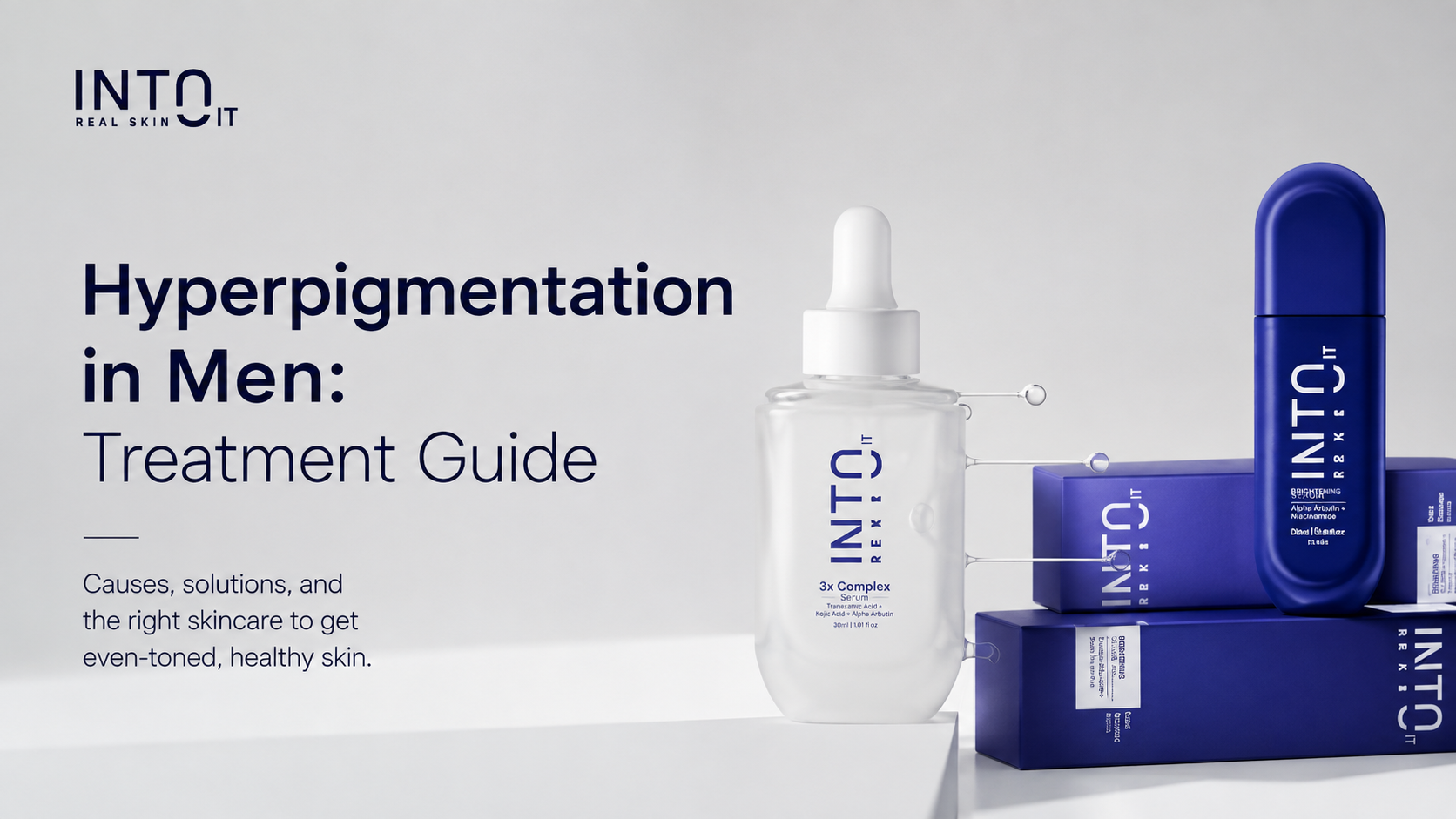
Hyperpigmentation in Men: Treatment Guide
Dark spots. Post-acne marks. Uneven patches of darker skin on the forehead, cheeks, and jawline. These are all forms of hyperpigmentation, and they are among the most common and most persistent skin concerns for Indian men.
Hyperpigmentation often feels impossible to shift. A spot from an acne breakout three months ago is still visibly darker than the surrounding skin. Marks from shaving irritation reappear as dark patches. UV exposure from daily commuting accumulates as uneven tone that gradually spreads across the face. The frustration is real, and it is compounded by the fact that Indian skin's higher melanin reactivity means hyperpigmentation tends to be more pronounced and more persistent than in lower-melanin skin.
This guide explains the different types of hyperpigmentation, the verified clinical evidence behind each treatment approach, and the exact INTOIT ingredients that address each cause with documented efficacy.
Understanding Hyperpigmentation: What It Actually Is
Hyperpigmentation is the overproduction and accumulation of melanin in specific areas of the skin, producing patches, spots, or areas that appear darker than the surrounding skin. It is not one single condition. It manifests through several distinct mechanisms, and identifying which type or combination of types you are dealing with determines which treatment approach produces results.
Melanin itself is not a problem. It is the pigment that gives skin its colour and provides partial UV protection. The problem is localised overproduction triggered by specific stimuli, producing deposits that the body's natural skin renewal cycle cannot clear as fast as new triggers continue to create them.
The Three Main Types of Hyperpigmentation in Men
Post-Inflammatory Hyperpigmentation (PIH)
This is the most common type for Indian men in the active years of their twenties and thirties. PIH occurs when any source of skin inflammation triggers melanocytes in the affected area to produce excess melanin as a protective response. The excess melanin deposits in the skin cells and remains visible as a dark mark long after the original inflammation has resolved.
Sources of inflammation that cause PIH include acne breakouts, including small whiteheads and blackheads, shaving irritation and razor burn, ingrown hairs, minor cuts and abrasions, and any form of skin injury including insect bites and scratching.
Research published in PMC confirms that post-inflammatory hyperpigmentation is a common dermatologic complaint affecting populations across skin types, but it is more prevalent and more pronounced in darker skin tones due to higher baseline melanin levels and more reactive melanocytes. For Indian men, a single significant breakout can leave a dark mark that takes three to six months to fade naturally, while ongoing acne or shaving irritation creates a continuously accumulating pigmentation load.
UV-Induced Hyperpigmentation
Also called solar lentigines or sun spots at their most established, UV-induced hyperpigmentation results from chronic, cumulative UV exposure stimulating melanocytes to produce excess melanin as a photoprotective response.
Unlike a single acne mark, UV-induced hyperpigmentation accumulates gradually from the aggregate of many small daily UV exposures. It often develops over years before becoming visible, which is why many Indian men in their thirties notice what seems like a sudden appearance of uneven tone that actually represents many years of accumulated UV response.
For Indian men, UV index levels that are very high to extreme for most of the year, combined with significant outdoor commute time, mean UV-induced melanin overproduction is a continuous, daily process rather than a seasonal or occasional one.
Melasma
Melasma is a chronic form of hyperpigmentation presenting as larger, symmetrical patches, typically on the cheeks, forehead, and upper lip. While significantly more common in women, particularly during hormonal changes, melasma does affect men, typically appearing as bilateral patches with a characteristic distribution.
Melasma is driven by a combination of UV exposure, genetic predisposition, and in some cases hormonal factors. It is the most treatment-resistant form of hyperpigmentation because the melanin deposits are often deeper and more diffuse than PIH or isolated solar lentigines.
Why Indian Skin Is More Prone to Hyperpigmentation
Several well-documented characteristics of Indian skin make hyperpigmentation more common, more pronounced, and more persistent compared to lower-melanin skin types.
Higher baseline melanin activity: Indian skin, across Fitzpatrick skin types III to VI which describes most of the Indian population, has more active melanocytes with a greater capacity to produce melanin in response to triggers. This is the same characteristic that provides Indian skin with more natural UV protection than lighter skin types, but it also means the inflammatory and UV triggers that cause hyperpigmentation produce a stronger melanin response.
Post-inflammatory hyperpigmentation frequency: The combination of higher melanin reactivity with the daily shaving that many Indian men practice, the high pollution levels in Indian cities that trigger skin inflammation, and the androgen-driven acne tendency in younger men, creates an unusually high frequency of PIH triggers for this population.
Depth of melanin deposits: In darker skin tones, melanin deposits from PIH can sometimes migrate into the deeper dermis rather than remaining in the epidermis, a condition called melanin incontinence. Dermal melanin is significantly more resistant to topical treatment than epidermal melanin, which is why some marks respond well to topical treatment while others are more resistant.
The Evidence-Based Treatment Ingredients
Hyperpigmentation treatment requires targeting melanin production at its source through multiple independent pathways. Clinical evidence consistently shows that combinations of complementary brightening actives outperform single-ingredient approaches because each targets a different point in the melanin synthesis and distribution process.
Alpha Arbutin: Tyrosinase Inhibition
Alpha arbutin is one of the most widely prescribed skin-lightening ingredients globally and is documented as effective in treating hyperpigmentation across multiple clinical contexts. It works by directly inhibiting tyrosinase, the primary enzyme responsible for the conversion of tyrosine to melanin. Without tyrosinase activity, melanin synthesis cannot proceed normally.
A PMC-published systematic review of arbutin confirms its mechanism as direct inhibition of tyrosinase catalytic activity, producing a measurable reduction in melanin synthesis. Clinical studies have demonstrated alpha arbutin to be effective with fewer side effects compared to stronger agents like hydroquinone, making it well-suited for daily use in a maintenance-oriented routine. It is water-soluble and well-tolerated across skin types, including sensitive skin.
The INTOIT Maximalist Moisturizer contains Alpha Arbutin at 2 percent. This is a clinically active concentration. Applied twice daily, it provides consistent inhibition of new melanin synthesis at the primary enzymatic pathway.
Kojic Acid: Complementary Tyrosinase Inhibition
Kojic acid also inhibits tyrosinase, but through a different binding mechanism than arbutin, which is why using both together produces more complete inhibition than either alone. Research published in PMC confirms that both kojic acid and hydroquinone are tyrosinase inhibitors and that their combination augments efficacy, with clinical studies showing kojic acid combined with glycolic acid providing measurable improvement in hyperpigmentation.
A comprehensive review in Taylor and Francis published in 2025 confirmed that among natural-derived brightening agents, kojic acid demonstrated comparable efficacy to hydroquinone when used in combination formulations, with 50 to 65 percent MASI (Melasma Area and Severity Index) improvement in studies requiring 12 to 16 weeks for visible results. This 12 to 16 week timeline is important for setting accurate expectations: hyperpigmentation treatment requires sustained, consistent use over this minimum period.
The Maximalist Moisturizer contains Kojic Acid at 1 percent alongside Alpha Arbutin, providing dual tyrosinase inhibition through two complementary mechanisms in a single application step.
Glutathione: Melanin Pathway Modulation
Glutathione is an antioxidant that also modulates melanin production through a pathway distinct from tyrosinase inhibition. It shifts melanin synthesis from the production of darker eumelanin toward lighter phaeomelanin, and its antioxidant function reduces the oxidative stress that acts as one of the triggers for melanocyte activation.
Multiple published studies have specifically documented glutathione's effectiveness for hyperpigmentation in South Asian skin, making it particularly relevant for Indian men. The Maximalist Moisturizer contains Glutathione at 2 percent.
Niacinamide: Melanosome Transfer Inhibition
As documented in the Niacinamide ingredient guide in this series, niacinamide does not inhibit melanin synthesis. Instead, it inhibits the transfer of melanosomes (the organelles containing melanin) from melanocytes to the keratinocytes where they become visible as pigmentation. The landmark Hakozaki et al. study published in the British Journal of Dermatology confirmed 35 to 68 percent inhibition of melanosome transfer and significant clinical lightening compared to vehicle after four weeks.
This mechanism is complementary to the synthesis inhibition of arbutin, kojic acid, and glutathione. By combining synthesis inhibitors with a transfer inhibitor, the Maximalist Moisturizer and INTOIT 6x Complex Face Serum together address the melanin pathway at two independent points simultaneously.
The 6x Complex Face Serum contains Niacinamide at 2 percent, delivered in a serum format that carries it deeper into the skin than a moisturizer-based delivery would achieve.
Oligopeptide-68: Melanin Synthesis Signal Inhibition
This brightening peptide addresses melanin production at the cellular signalling level, earlier in the pathway than tyrosinase activity. The 6x Complex Face Serum contains Oligopeptide-68 at 68.5 percent of the peptide complex, making it the primary brightening active in the serum formula.
AHAs: Surface Renewal and Pigmented Cell Removal
Alpha hydroxy acids accelerate the shedding of the melanin-containing surface skin cells, revealing less-pigmented cells below and increasing the rate at which the skin renews. Research confirms that glycolic acid in particular has documented efficacy in treating hyperpigmentation through this exfoliation mechanism. A PMC-published cosmeceuticals review notes that combining kojic acid with glycolic acid in a gel significantly enhanced hyperpigmentation treatment compared to formulations without glycolic acid.
The Maximalist Moisturizer contains Glycolic Acid at 5 percent and Mandelic Acid at 2 percent, providing consistent daily surface renewal that accelerates the removal of pigmented surface cells in addition to the synthesis and transfer inhibition of the brightening actives.
The Treatment Routine for Hyperpigmentation
This routine is built around the principle of addressing melanin at multiple points in the process simultaneously, which clinical evidence consistently shows produces faster and more complete results than any single-ingredient approach.
Step 1: Cleanse with the INTOIT Claytox Cleanser. The Gluconolactone PHA at 2 percent provides gentle daily exfoliation that removes surface cell buildup, including pigmented surface cells, with every cleanse. The dual clay formula removes the pollution and sebum that trigger the inflammatory response driving PIH.
Step 2: Apply the 6x Complex Face Serum. Niacinamide at 2 percent inhibits melanosome transfer. Oligopeptide-68 reduces melanin synthesis at the signalling level. Apply on slightly damp skin, two to three drops, press gently.
Step 3: Apply the Maximalist Moisturizer. Alpha Arbutin at 2 percent, Glutathione at 2 percent, and Kojic Acid at 1 percent provide triple tyrosinase/melanin pathway inhibition. Glycolic Acid and Mandelic Acid accelerate surface renewal. Apply as the final skin step.
Essential addition: Daily broad-spectrum sunscreen. This cannot be stated strongly enough for hyperpigmentation treatment. UV exposure is one of the primary ongoing triggers for melanin overproduction. Using brightening actives without daily SPF is working against the cause at the same time as treating the symptom. AHAs in the Maximalist Moisturizer also increase UV sensitivity, making sunscreen even more critical. Apply a broad-spectrum SPF 30 minimum after the moisturizer every morning.
Realistic Expectations for Hyperpigmentation Treatment
This is one of the areas where unrealistic expectations most commonly lead men to abandon effective routines prematurely.
Epidermal (surface) pigmentation: PIH that is relatively recent and sits in the upper layers of the epidermis typically shows visible improvement within 4 to 8 weeks of consistent brightening treatment. This is the most treatment-responsive type.
Established UV-induced spots: Older, more established UV-induced hyperpigmentation requires 8 to 16 weeks of consistent treatment to show significant visible improvement. The 12 to 16 week timeline documented in clinical studies for brightening actives reflects how long it takes for the skin cell turnover cycle to bring new, less-pigmented cells to the surface while the brightening actives reduce ongoing melanin production.
Dermal melanin deposits: Deeper melanin that has migrated into the dermis responds more slowly to topical treatment and may require professional dermatological intervention, including chemical peels, laser treatments, or prescription-strength actives, for meaningful improvement. For stubborn marks that do not respond to consistent topical treatment after 16 weeks, dermatologist consultation is appropriate.
Prevention during treatment: Results from brightening treatment can be reversed if new pigmentation triggers continue unaddressed. Consistent sunscreen use, gentle post-shave care to prevent PIH from shaving irritation, and managing breakouts reduce the new pigmentation load while treatment progressively clears existing deposits.
Common Questions About Hyperpigmentation Treatment for Indian Men
Why do my dark spots keep coming back even when they fade?
If the triggers for melanin overproduction, primarily UV exposure and skin inflammation, continue to stimulate melanocytes daily, new pigmentation forms at the same rate or faster than the brightening treatment clears existing deposits. Consistent sunscreen use is the most direct way to reduce UV-driven new pigmentation. Managing acne and shaving irritation reduces PIH formation. Without addressing these ongoing triggers, brightening treatment produces improvement that is continuously being partially reversed.
How is post-acne hyperpigmentation different from an acne scar?
Post-acne hyperpigmentation is a change in colour, not texture. It is melanin deposited in the skin at the site of previous inflammation. It responds to topical brightening treatment and fades over time, though more slowly in darker skin tones. An acne scar is a change in skin texture, either a depression or a raised area, caused by disrupted collagen repair. Scars do not fade with brightening actives and require different treatment approaches including professional procedures.
Can I use multiple brightening products for faster results?
Using complementary brightening actives that target different mechanisms is supported by clinical evidence and is more effective than using the same mechanism repeatedly. However, adding multiple products from different brands that overlap in their actives risks over-treating the skin and causing irritation, which itself triggers more PIH. The INTOIT combination of Niacinamide and Oligopeptide-68 in the serum, and Alpha Arbutin, Glutathione, Kojic Acid, and AHAs in the moisturizer, already provides comprehensive multi-pathway coverage without requiring additional products.
Does my skin type affect how well brightening treatments work?
Yes. Indian skin in the darker Fitzpatrick range, typically types IV to VI, tends to respond more slowly to topical brightening treatment due to higher melanocyte activity. This does not mean treatment is ineffective. It means the appropriate treatment period before meaningful visible results is longer than for lighter skin types, and that maintaining consistent treatment for the full 12 to 16 week minimum without prematurely concluding it is not working is particularly important.
Is it safe to use brightening actives daily on darker Indian skin?
Yes, with the right ingredients. Some historical brightening agents including high-concentration hydroquinone and certain exfoliants can cause a paradoxical worsening of hyperpigmentation in darker skin, called ochronosis, with prolonged use. Alpha arbutin, niacinamide, glutathione, and kojic acid at the concentrations used in the INTOIT formulas are considered safe for daily long-term use across skin types, including darker tones, without this risk.
Final Word
Hyperpigmentation in Indian men is common, persistent, and multi-causal. Post-shave marks, post-acne deposits, and cumulative UV-driven uneven tone all involve the same root mechanism, localised melanin overproduction, but through different triggers and at different depths.
The most effective topical treatment addresses melanin production from multiple independent pathways simultaneously: tyrosinase inhibition from Alpha Arbutin and Kojic Acid, melanogenesis modulation from Glutathione, melanosome transfer inhibition from Niacinamide, signalling-level inhibition from Oligopeptide-68, and surface renewal and accelerated pigmented cell removal from AHAs.
Results require consistency over a minimum of 12 weeks of twice-daily use, alongside daily broad-spectrum sunscreen to prevent ongoing UV-driven new pigmentation. Stopping sunscreen while using brightening actives is one of the most common reasons treatment produces incomplete or temporary results.
The combination works. Give it the time the biology requires.
Shop the INTOIT brightening routine here.