
Uneven Skin Tone: What Actually Works
Uneven skin tone is one of the most common reasons Indian men feel self-conscious about their skin. It shows up as a face that looks inconsistent, patchy in some areas, darker in others, lacking the clarity and uniformity that healthy skin naturally has. It makes skin look tired regardless of sleep, and aged regardless of actual age.
The reason it is so common and often so resistant to fixing is that uneven skin tone is not caused by one thing. It is the visible result of multiple simultaneous processes, and addressing only one of them while ignoring the others produces partial improvement at best. Understanding what is actually creating the unevenness is the foundation of treating it effectively.
What Creates Uneven Skin Tone
There are four distinct mechanisms that independently produce uneven skin tone. Most Indian men dealing with this concern are experiencing all four at the same time.
Uneven Melanin Distribution
Melanin, the pigment that gives skin its colour, is supposed to be distributed relatively evenly across the skin surface. When specific triggers cause localised melanin overproduction in certain areas, those patches appear darker against the rest of the skin, creating the patchy, uneven appearance associated with hyperpigmentation.
Triggers include UV exposure, which activates melanocytes to produce melanin as a protective response, skin inflammation from acne, shaving irritation, and other forms of irritation, and hormonal influences that affect melanocyte activity. For Indian men, all three of these triggers operate at above-average intensity: high UV index year-round, androgen-driven skin inflammation, and daily shaving creating micro-trauma.
Uneven Surface Texture
When dead skin cells accumulate unevenly on the skin surface, the result is not just rough texture. It is also visual unevenness, because dead cell buildup reflects light differently from fresh skin cells. Areas with thicker buildup look dull and flat. Areas where natural shedding has progressed normally look slightly clearer. The visual effect is a patchy, inconsistent appearance even when there is no meaningful difference in underlying pigmentation.
Pollution deposits, excess sebum, and slowed cell turnover, which happens naturally with age, all contribute to this surface unevenness for Indian men.
Vascular Changes and Redness
Post-inflammatory redness, from active acne, recent shaving irritation, or other inflammatory events, creates another source of unevenness that is not melanin-based. Redness reflects increased blood flow and dilated capillaries near the skin surface. It can appear alongside dark spots, creating a skin surface with multiple types of discolouration simultaneously.
Post-inflammatory redness tends to resolve faster than post-inflammatory hyperpigmentation, typically within days to a few weeks, while the PIH dark mark it may accompany persists for much longer.
Structural Changes from UV Damage
Beyond the melanin response, chronic UV exposure also degrades the collagen and elastin in the dermis at uneven rates, depending on which areas receive the most direct exposure and the condition of the barrier at different points. This structural variation produces textural differences across the skin surface that contribute to an uneven appearance at a deeper level than surface pigmentation alone.
What Does Not Work for Uneven Skin Tone
Before covering what does work, it is worth being specific about common approaches that produce minimal improvement.
Temporary brightening products without active ingredients: Many moisturizers and creams claim to brighten skin through light-diffusing particles or mild exfoliation. These products can produce a temporary visual improvement immediately after application, similar to foundation makeup, but this is optical rather than biological. The underlying unevenness is not addressed.
Single-ingredient approaches: Because uneven skin tone is produced by multiple simultaneous mechanisms, products that target only one pathway, only exfoliation, or only tyrosinase inhibition, treat only part of the problem. The remaining causes continue producing new unevenness at the same rate.
Inconsistent treatment: Clinical evidence for every effective brightening ingredient, from niacinamide to alpha arbutin to AHAs, shows meaningful results at 8 to 16 weeks of consistent twice-daily use. Inconsistent application resets the process rather than allowing the cumulative biological change to develop.
Treatment without sun protection: UV exposure is one of the primary ongoing drivers of uneven skin tone through daily melanin stimulation. Using brightening treatment without addressing this root cause is like trying to empty a sink while the tap is running.
What Actually Works: The Evidence-Based Approach
Multi-Pathway Melanin Reduction
The clinical evidence consistently supports combining brightening actives that work through different mechanisms rather than applying more of any single ingredient. Each additional pathway addressed produces incremental improvement beyond what prior pathways achieve alone.
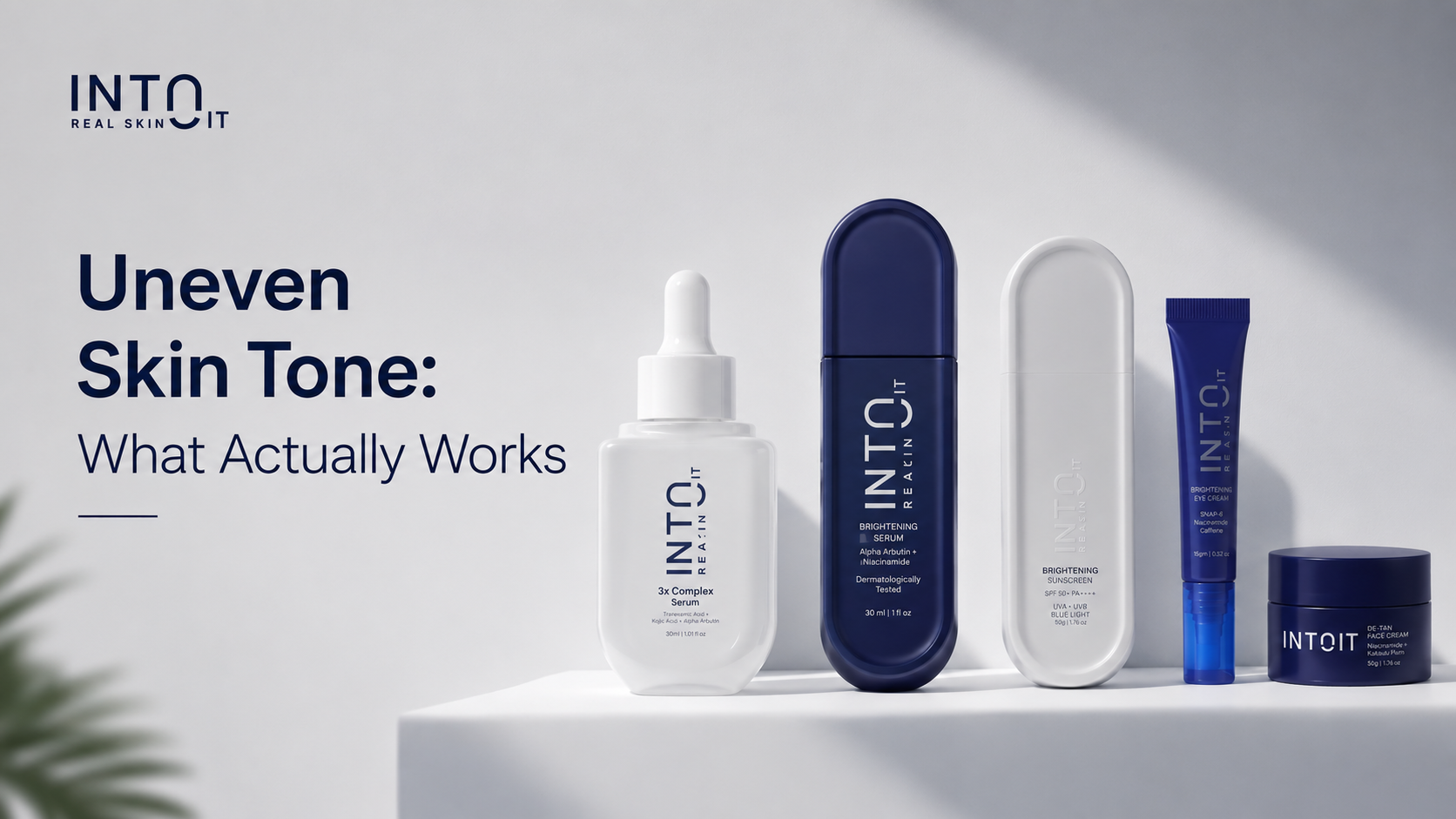
For the INTOIT range, this multi-pathway approach operates through five independent mechanisms across two products:
-
Niacinamide (2%) inhibits melanosome transfer from melanocytes to keratinocytes through a mechanism confirmed in the landmark Hakozaki et al. British Journal of Dermatology study, showing 35 to 68 percent inhibition of transfer and significant clinical lightening
-
Oligopeptide-68 (68.5% of peptide complex) reduces melanin synthesis at the cellular signalling level, earlier in the process than tyrosinase activity
INTOIT Maximalist Moisturizer:
-
Alpha Arbutin (2%) directly inhibits tyrosinase, the primary melanin synthesis enzyme
-
Glutathione (2%) modulates melanin production pathway and shifts synthesis toward lighter pigment types, with documented effectiveness specifically in South Asian skin
-
Kojic Acid (1%) inhibits tyrosinase through a different binding mechanism than arbutin, providing complementary coverage
Together, these five mechanisms address melanin production at signal initiation, enzyme activity (two binding sites), synthesis pathway modulation, and distribution to skin cells. This comprehensive multi-point approach is why clinical evidence supports combination brightening treatment over single-ingredient use for uneven skin tone.
Consistent Surface Renewal
Physical renewal of the skin surface removes pigmented and damaged cells progressively, revealing the less-pigmented cells below. This is not only about exfoliation. It is about maintaining a consistent cell turnover rate that counteracts the slowing of natural renewal that UV damage, age, and pollution accumulation cause.
INTOIT Claytox Cleanser: Gluconolactone PHA at 2 percent provides gentle daily exfoliation that removes surface cell buildup and pollution deposits without over-exfoliating. Used twice daily, it maintains a clean, renewed surface that allows the brightening actives in the serum and moisturizer to work on skin that is not obscured by dead cell accumulation.
Glycolic Acid (5%) and Mandelic Acid (2%) in the Maximalist Moisturizer: AHAs provide a deeper, more active level of cell renewal that the gentle PHA in the cleanser cannot achieve alone. Glycolic acid's small molecular size enables penetration to the level where cell renewal signalling occurs. Clinical evidence confirms glycolic acid as effective for skin tone normalisation alongside its exfoliating function.
Barrier Repair for Long-Term Tone Stability
A compromised skin barrier is both a cause and a consequence of uneven skin tone. When the barrier is functioning poorly, pollution and UV penetrate more deeply, causing more inflammatory melanin stimulation. When the barrier is strong, the inflammatory triggers that cause localised melanin overproduction are partially filtered.
The Maximalist Moisturizer's full ceramide complex, Ceramide NP, AP, and EOP alongside Cholesterol and Phytosphingosine, rebuilds the barrier lipid matrix over consistent use. A progressively stronger barrier means progressively less inflammatory trigger reaching the melanocytes, reducing the rate of new uneven tone formation at the same time as existing unevenness is cleared.
Daily UV Protection
This is the treatment step that determines whether everything else holds. Without daily broad-spectrum sunscreen, UV exposure continues stimulating daily melanin overproduction in the skin, partially reversing whatever brightening the active ingredients are achieving.
Apply a broad-spectrum SPF 30 minimum with PA++++ rating every morning as the final step after the Maximalist Moisturizer. The PA++++ rating addresses UVA protection specifically, since UVA penetrates more deeply than UVB and is the primary UV driver of chronic melanin overproduction in Indian skin. Apply it even on overcast days and near windows.
The Full Routine for Uneven Skin Tone
Morning
-
Claytox Cleanser: Remove overnight oil and dead cell buildup, gently exfoliate with PHA
-
6x Complex Face Serum: Deliver Niacinamide and Oligopeptide-68 to inhibit melanin production and transfer
-
Maximalist Moisturizer: Apply Alpha Arbutin, Glutathione, Kojic Acid, and AHAs in a barrier-repairing base
-
Broad-spectrum SPF 30 PA++++ sunscreen: Prevent ongoing UV-driven melanin stimulation
Night
-
Claytox Cleanser: Remove the day's pollution, sebum, and dead cell deposits
-
6x Complex Face Serum: Niacinamide and Oligopeptide-68 work at peak skin absorption during sleep
-
Maximalist Moisturizer: AHAs work on cell renewal overnight without UV interference; brightening actives continue melanin inhibition
How Long Before Visible Improvement
The timeline for uneven skin tone improvement depends on which mechanisms are contributing most to the unevenness.
Surface dullness from dead cell buildup: Visible improvement in skin clarity and freshness typically occurs within 7 to 14 days of consistent cleansing and AHA use, as the surface cell turnover rate improves.
Recent post-inflammatory hyperpigmentation: PIH marks that are within the past one to three months typically show visible lightening within 4 to 8 weeks of consistent multi-pathway brightening treatment.
Established UV-induced spots and older PIH: Clinical evidence documents 12 to 16 weeks as the appropriate treatment duration for meaningful improvement in established hyperpigmentation. This reflects the skin cell turnover cycle and the time required for progressive reduction in melanin synthesis to produce visible change at the surface.
Overall tone uniformity: The diffuse unevenness from the combination of multiple smaller spots, mild surface irregularity, and mild UV-driven tone variation improves progressively over the full 12 to 16 week period, often becoming noticeably different in photographs at monthly comparisons even when day-to-day changes feel imperceptible in the mirror.
Common Questions About Uneven Skin Tone for Men
Why does my skin look uneven in certain lighting but not others?
Uneven skin tone and surface texture are most visible in direct, flat lighting, similar to bathroom lighting, which eliminates the soft-focus effect that ambient or diffuse lighting produces. Photographs taken in direct light often show unevenness that is not obviously apparent in everyday environments. This does not mean it is not there. It means the reference environment for assessing your skin's actual improvement should be consistent, since comparing results across different lighting conditions is unreliable.
Is there a quick way to make skin look more even for an event or meeting?
Consistent skincare produces lasting change. For an immediate visual improvement, ensuring the skin is well-cleansed and moisturized maximises the light-reflection quality of the surface, which reduces the visual prominence of uneven tone. A lightweight SPF with a slightly mattifying or evening effect can also reduce the visible contrast between areas. However, these are surface-optical effects rather than treatment.
Does uneven skin tone affect all men or mostly men with darker skin?
Uneven skin tone affects men across all skin tones, but it tends to be more visible and more persistent in darker skin tones because higher melanin reactivity produces stronger localised responses to triggers and because the contrast between hyperpigmented areas and surrounding skin is more visible when the surrounding skin is already darker. Indian men are therefore among the most commonly affected by visually significant uneven tone.
Does stress make uneven skin tone worse?
Yes, indirectly. Stress elevates cortisol, which affects androgen levels and increases sebaceous activity and inflammatory potential in the skin. Higher baseline inflammation means more PIH from any given skin event, and more inflammation-driven melanocyte stimulation. Managing chronic stress through sleep, exercise, and appropriate stress management supports better skin tone alongside topical treatment.
Can I use vitamin C for uneven skin tone alongside the INTOIT range?
Vitamin C (ascorbic acid) is a well-documented antioxidant with some melanin-inhibiting properties through copper-ion chelation at the tyrosinase active site. It can complement the multi-pathway approach of the INTOIT range, particularly in the morning, if applied after the serum and before the moisturizer. Ensure it is properly stabilised in the formulation, as ascorbic acid is notoriously unstable, and introduce it gradually if your skin is sensitive.
Final Word
Uneven skin tone is not one problem with one solution. It is the visible sum of multiple simultaneous processes: localised melanin overproduction from UV and inflammation, surface dead cell accumulation, and the structural effects of UV-driven collagen damage.
What actually works is addressing all of these simultaneously, consistently, over the full treatment duration the clinical evidence specifies. Multi-pathway melanin inhibition through five complementary mechanisms. Daily surface renewal through PHA and AHAs. Barrier repair to reduce the ongoing inflammatory triggers that continue creating new unevenness. And daily SPF to stop the primary ongoing UV stimulus before it continues reversing the treatment's progress.
None of this works overnight. All of it works over 12 to 16 weeks of consistent twice-daily use with daily sunscreen.
That is the full picture of what actually works for uneven skin tone.
Shop the INTOIT brightening routine here.