
Ingredient Guide to Peptides
Peptides appear on skincare ingredient labels with increasing frequency but with very little explanation of what they actually do or why the specific type of peptide matters. Most marketing language around peptides defaults to "boosts collagen" and leaves the science there.
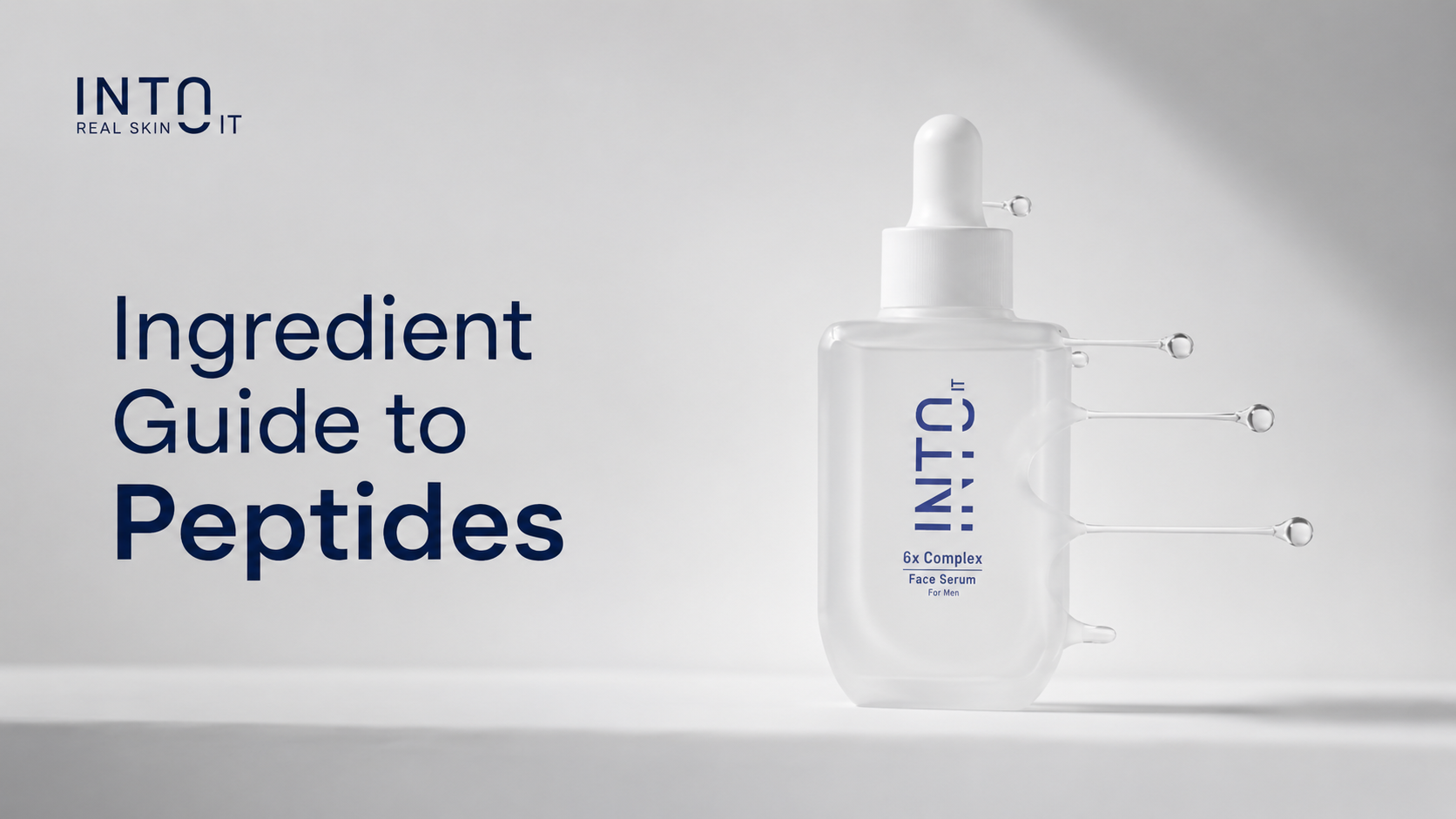
This guide goes further. It explains what peptides are at a molecular level, the four distinct categories of peptides used in skincare and what each actually does, the clinical evidence behind their efficacy, and a precise breakdown of the specific peptides in the INTOIT 6x Complex Face Serum and what each one is doing in the formula.
What Peptides Are
Peptides are short chains of amino acids, the same fundamental building blocks from which all proteins, including collagen, elastin, and keratin, are constructed.
A single amino acid is the smallest unit. Two amino acids joined together form a dipeptide. Three form a tripeptide. Up to approximately fifty form a polypeptide. Beyond that length, the molecule is classified as a protein rather than a peptide.
This size distinction matters significantly for skincare. Proteins like collagen are too large to penetrate the skin's outer barrier, the stratum corneum. Peptides, being substantially shorter chains of the same building blocks, are small enough to pass through this barrier and interact with the living cells beneath it. This is the foundational property that makes peptides useful in topical skincare: they carry signal information to skin cells at a depth that the protein molecules themselves cannot reach.
Research published in the journal Biomolecules in January 2025 confirms that peptides are emerging candidates for both the prevention and treatment of skin senescence, with signal peptides used to stimulate fibroblast cells to increase collagen production and improve skin elasticity, neurotransmitter inhibitor peptides relaxing facial muscles to minimise expression wrinkles, carrier peptides delivering essential trace elements to support skin repair, and enzyme inhibitor peptides reducing collagen breakdown and preserving the integrity of the skin.
The Four Types of Peptides in Skincare
Understanding peptide categories removes the confusion created by trademarked peptide names and marketing language. There are four functional categories, each doing a fundamentally different thing.
Type 1 - Signal Peptides: Telling Cells to Build More Collagen
Signal peptides are the most widely researched and clinically supported category of topical peptides. They work by mimicking or triggering the signalling sequences that the body uses to communicate between cells, specifically to instruct fibroblasts, the dermal cells responsible for producing collagen, elastin, and other structural matrix proteins, to upregulate their production activity.
The mechanism was first documented with the discovery that collagen breakdown produces specific fragment sequences that signal surrounding fibroblasts to increase collagen synthesis as part of the natural tissue repair process. Signal peptides in skincare replicate these sequences, providing the upregulation signal without the tissue damage that would naturally trigger it.
Research published in ResearchGate confirms that signal peptides were the most prevalent peptide category in anti-ageing formulations from market analysis, and that these ingredients have more scientific evidence supporting their efficacy than other peptide types.
Clinical evidence: A 2023 meta-analysis of 26 randomised controlled trials involving 1,721 participants found significant improvements in skin hydration and elasticity from peptide-enriched formulations. A study published in the American Journal of Clinical Dermatology found that argireline, a signal-inhibitory peptide, reduced wrinkle depth in a randomised, placebo-controlled study in Chinese subjects after 30 days of use.
In the INTOIT 6x Complex Face Serum:
-
Palmitoyl Tripeptide-1 (at 11% of the formula): A palmitoylated tripeptide where the palmitoyl chain improves skin penetration. Palmitoyl Tripeptide-1 mimics the collagen breakdown fragment sequence that signals fibroblast activation. Research has documented its ability to stimulate collagen and elastin synthesis in fibroblast cell cultures. The 11 percent concentration in the serum formula represents a meaningful active dose, not a trace amount.
-
Palmitoyl Tripeptide-38: Also known commercially as Matrixyl Synthe'6, this peptide stimulates the synthesis of six major components of the extracellular matrix simultaneously: collagen I, collagen III, collagen IV, fibronectin, hyaluronic acid, and laminin-5. Research has confirmed that Palmitoyl Tripeptide-38 visibly corrects wrinkle volume and reduces the depth of wrinkles through this comprehensive matrix synthesis stimulation.
Together, these two signal peptides target the collagen synthesis deficit that UV damage, pollution-driven MMP upregulation, and natural ageing progressively create in the dermis of Indian men.
Type 2 - Neurotransmitter Inhibitory Peptides: Reducing Expression Line Depth
This is a distinct mechanism from collagen stimulation. Neurotransmitter inhibitory peptides, sometimes called "Botox-like" peptides in marketing, work at the neuromuscular junction, the interface between nerve endings and facial muscles. They modulate the release of neurotransmitters, specifically acetylcholine, that trigger muscle contraction, reducing the force and frequency of the repeated muscle contractions that create expression lines over time.
To be precise about what this means clinically: these peptides do not paralyse muscles the way botulinum toxin does. They reduce the amplitude of muscle contraction modestly, which over consistent use reduces the depth of expression lines that form from repeated movement, without eliminating facial expression.
Clinical evidence: A randomised, placebo-controlled clinical study of argireline published in the American Journal of Clinical Dermatology confirmed a statistically significant reduction in wrinkle depth compared to placebo after 30 days in Chinese subjects. Research from Frontiers in Medicine confirms neurotransmitter-inhibitory peptides act by modulating neuromuscular activity to reduce dynamic wrinkles.
In the INTOIT 6x Complex Face Serum:
-
Acetyl Hexapeptide-8 (also known as Argireline): This is the most well-studied neurotransmitter inhibitory peptide in cosmetic skincare. It inhibits the SNARE complex formation that drives neurotransmitter release at the neuromuscular junction. The result with consistent application is a reduction in the depth of expression lines around the eyes and forehead, which are the primary sites of repeated high-amplitude muscle activity in facial expression.
This mechanism addresses the component of fine line formation that signal peptides and AHAs do not: the active mechanical contribution of repeated facial muscle movement to wrinkle depth over time.
Type 3 - Carrier Peptides: Delivering Trace Elements for Repair
Carrier peptides do not directly stimulate cells or inhibit enzymes. Instead, they stabilise and deliver specific trace elements that are required for enzymatic activity involved in skin repair and collagen synthesis. The most documented is copper-tripeptide-1 (GHK-Cu), which delivers copper to the skin, where copper is required as a cofactor for lysyl oxidase, an enzyme critical to the cross-linking of newly synthesised collagen into stable, functional fibres.
Without adequate copper availability, newly synthesised collagen chains cannot be properly assembled into the mature, stable collagen architecture that provides skin firmness. Carrier peptides ensure this cofactor is available where it is needed.
The INTOIT 6x Complex Face Serum's primary peptide focus is on signal and neurotransmitter-inhibitory peptides. The carrier peptide mechanism is worth understanding as a distinct category because it explains why not all peptides work the same way, and why the specific types present in a formula matter more than simply the presence of any peptide on the ingredient list.
Type 4 - Enzyme Inhibitory Peptides: Blocking Collagen Degradation
Where signal peptides stimulate fibroblasts to produce more collagen, enzyme inhibitory peptides work from the other side of the same equation: they reduce the activity of the enzymes that break down collagen.
Matrix metalloproteinases (MMPs) are the enzymes primarily responsible for collagen degradation. They are activated by UV exposure and pollution-generated free radicals through mechanisms covered in detail in the pollution ageing guide in this series. Enzyme inhibitory peptides specifically inhibit MMP activity, slowing the rate of collagen breakdown and shifting the balance toward net collagen accumulation rather than net collagen loss.
Research from Frontiers in Medicine confirms that enzyme inhibitor peptides protect the extracellular matrix by blocking enzymes such as collagenase and elastase that degrade the structural proteins giving skin its firmness and elasticity.
While not all four categories are represented in the INTOIT serum formula, understanding all four explains why different peptide products produce different results: the mechanism matters as much as the ingredient name.
Why Peptides Work Best in Serums, Not Moisturizers
This is a practical point that affects how much benefit any peptide formulation delivers.
Proteins are too large to penetrate the skin barrier. Peptides, being shorter chains, can penetrate, but their small size does not guarantee penetration, and the base formulation significantly affects how effectively they are delivered.
Research published by cosmetic chemist and formulation expert sources confirms that while proteins like collagen are too large to penetrate the skin surface, peptides are small enough to slip through and signal cells to perform specific functions. A serum's lightweight, low-viscosity, water-based base specifically facilitates this penetration by minimising the resistance the peptide encounters at the skin surface.
A moisturizer's heavier, lipid-rich base is designed to form an occlusive film on the skin surface, the opposite of what facilitates active ingredient penetration. Peptides formulated in a moisturizer base primarily work near the surface rather than at the depth where fibroblasts operate.
This is why the INTOIT 6x Complex Face Serum is the delivery format for the four active peptide complexes in the range, rather than the INTOIT Maximalist Moisturizer. The serum carries them to the depth where fibroblast signalling can occur. The moisturizer applied afterward seals them in and provides its own surface-level active treatment, creating a system where the two products complement rather than overlap.
The Other Actives Working Alongside the Peptides
The 6x Complex Face Serum earns its name from six distinct active complexes, not six individual ingredients. The two peptide categories (signal and neurotransmitter inhibitory) form four of the six complexes. The remaining two are:
-
Niacinamide at 2%: Inhibits melanosome transfer for brightening, regulates sebum, strengthens barrier ceramide synthesis, reduces inflammatory cytokines. As documented in detail in the Niacinamide ingredient guide in this series.
-
Caffeine at 0.5%: Antioxidant activity neutralising residual free radical damage from daily UV and pollution exposure. Mild de-puffing action through transient vasoconstriction. Particularly relevant for the eye area and for skin exposed to high pollution loads.
-
Dictyopteris polypodioides (marine algae extract): A marine-derived antioxidant and anti-ageing compound with documented effects on extracellular matrix health.
-
Black Pepper Oil (Piper Nigrum): Functions as an absorption enhancer, improving penetration of the active complexes through the skin barrier.
-
Sophorolipid: Natural biosurfactant with antimicrobial and skin-conditioning properties, contributing to overall skin health without interfering with the active complexes.
How to Use Peptides Correctly
Apply on Slightly Damp, Clean Skin
Peptides are typically water-soluble and absorb best on a clean surface with some residual moisture. Apply the 6x Complex Face Serum immediately after cleansing while the skin is still slightly damp. The slight dampness improves even distribution and provides a water environment that supports absorption.
Apply Before Moisturizer, Never After
Applying serum after moisturizer means the peptides encounter the moisturizer's occlusive surface film and cannot penetrate effectively. The correct order is always: cleanser, serum, moisturizer. This allows the serum's peptides to penetrate clean skin before the moisturizer seals them in.
Twice Daily, Consistently
Research confirms that with consistent twice-daily use, initial improvements in hydration and texture are noticeable within a few weeks. More substantial improvement in fine line depth and skin firmness from collagen synthesis stimulation requires 8 to 12 weeks of consistent use. The timeline reflects the biological reality: newly synthesised collagen takes time to accumulate to a level where it produces visible surface change.
Night Is the Best Session
Fibroblast activity, the cells that respond to signal peptides by producing collagen, peaks during deep sleep, when growth hormone release is highest and cellular repair processes are most active. Applying the serum at night ensures the peptide signal reaches fibroblasts during the window when they are most receptive to it.
Common Questions About Peptides
Are peptides safe for daily use?
Yes. Peptides are among the most well-tolerated active ingredients in skincare. They work with the skin's natural processes rather than forcing change through chemical reactions on the skin surface, which is why they rarely cause irritation even in sensitive skin. They do not require the gradual introduction period that AHAs or stronger actives typically need.
How do I know if a product actually has enough peptides to work?
Look for disclosed concentrations. A product listing peptides as the 25th ingredient in a long formula, without a percentage, likely contains a trace amount insufficient to produce the signalling effects documented in clinical research. Products that disclose concentrations, such as the INTOIT 6x Complex Face Serum specifying Palmitoyl Tripeptide-1 at 11 percent, are demonstrating that the peptide is present at a meaningful active dose.
Can I use peptides with other active ingredients?
Yes. Peptides are compatible with most other skincare actives including niacinamide, AHAs, antioxidants, and ceramides. There is no documented antagonistic interaction between peptides and the other active ingredients in the INTOIT range. The combination of peptides in the serum with AHAs and brightening actives in the moisturizer provides complementary treatment at different skin depths.
Do topical peptides produce the same results as injectable collagen or filler?
No. Injectables produce immediate, dramatic structural changes by adding volume or relaxing muscles directly. Topical peptides produce gradual, progressive improvement in skin quality through biological stimulation of the skin's own repair processes. The magnitude of change is less dramatic than injectables and develops over weeks to months rather than immediately. Topical peptides are a maintenance and prevention tool rather than a corrective intervention for advanced structural changes.
At what age should men start using peptides?
Natural collagen production begins declining from around the mid-twenties. For Indian men where UV and pollution exposure are accelerating extrinsic collagen degradation from early adulthood, starting peptide support in the mid-twenties provides the most preventive benefit, maintaining collagen levels before significant visible loss occurs. Men starting in their thirties or forties still see meaningful improvement from consistent peptide use, though the timeline for visible change is longer given the larger collagen deficit to address.
Why do some "peptide" products not seem to work?
Three common reasons. The peptide concentration is too low to produce meaningful signalling effects. The formulation is not designed for penetration, so the peptides sit on the skin surface rather than reaching fibroblasts. Or the wrong peptide type is being used for the expected outcome. For example, using only a neurotransmitter inhibitory peptide and expecting collagen synthesis stimulation will not produce the expected result, because that function requires signal peptides, which work through a completely different mechanism.
Final Word
Peptides are not a single ingredient category. Signal peptides, neurotransmitter inhibitory peptides, carrier peptides, and enzyme inhibitory peptides each address skin ageing through distinct and independent mechanisms. Understanding which type of peptide is in a formula, at what concentration, and in what delivery format determines whether a peptide product actually delivers on its claims.
The INTOIT 6x Complex Face Serum contains two signal peptides, Palmitoyl Tripeptide-1 at a meaningful 11 percent and Palmitoyl Tripeptide-38, targeting collagen synthesis from the most evidence-backed category. And one neurotransmitter inhibitory peptide, Acetyl Hexapeptide-8, addressing the expression line mechanism that signal peptides do not cover.
Applied consistently twice daily in a serum base optimised for penetration, these peptides reach the fibroblasts and neuromuscular junctions where they actually produce the improvements in firmness, line depth, and skin quality that the clinical evidence documents.
Find all four peptide complexes in the INTOIT 6x Complex Face Serum here.