
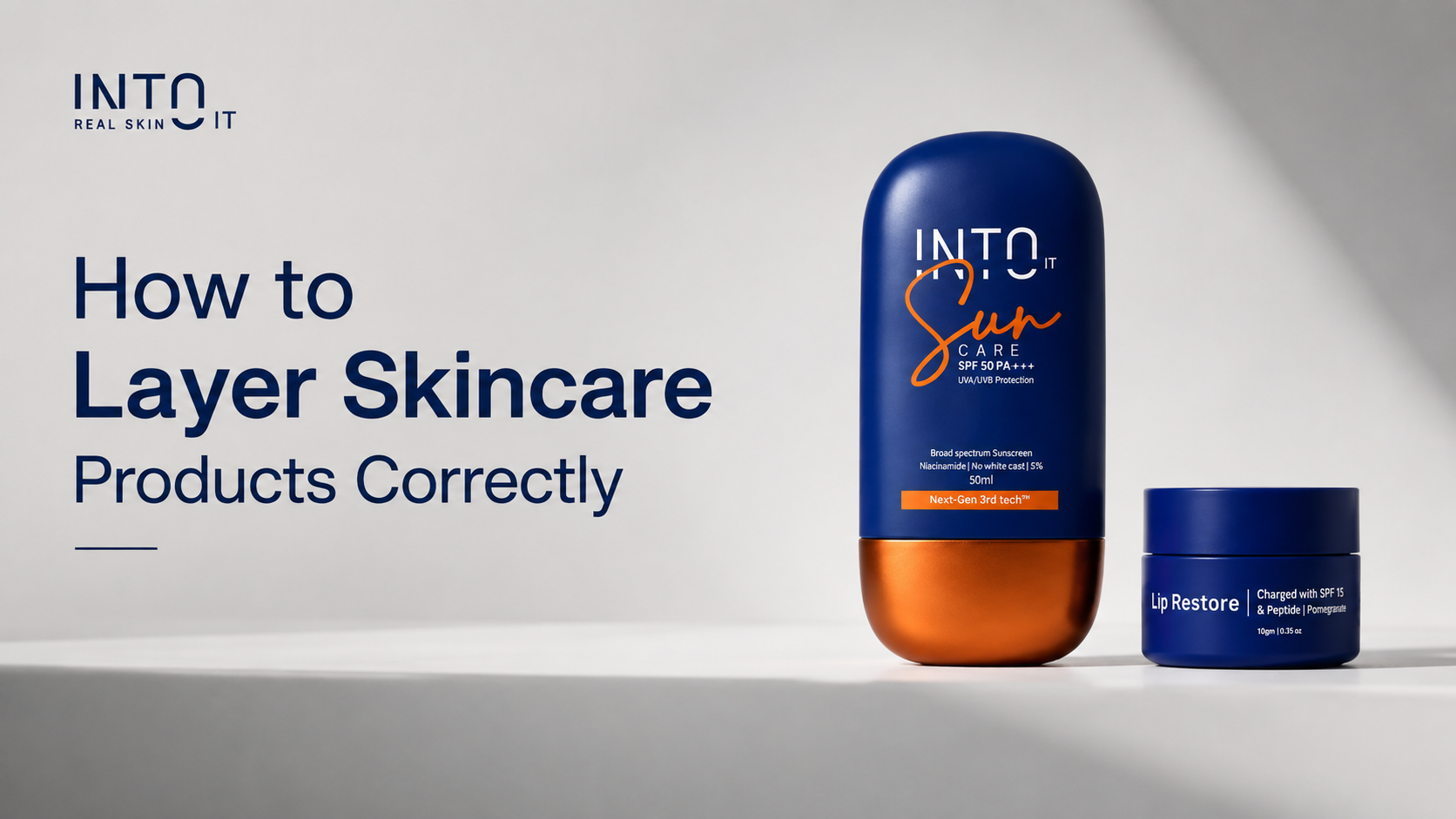
How to Layer Skincare Products Correctly
Most men think skincare is about which products you use. The science says it is also about the order you apply them in. Research published in Biomedical Dermatology confirms that improper product layering can reduce active ingredient absorption by up to 40 percent. That means a well-formulated serum applied after the wrong product delivers a fraction of its potential benefit.
This guide explains the physics and chemistry behind why layering order matters, the three core principles that govern correct sequencing, and the exact application sequence for the INTOIT routine morning and night
Why Layering Order Is Not Arbitrary
Skincare absorption is governed by the stratum corneum, the outermost layer of the epidermis, which functions as a selective barrier. Every product you apply changes the surface conditions for the next one: its viscosity, its pH, and the physical film it leaves behind all affect whether the next product's active ingredients can penetrate or are blocked.
A 2021 review published in the Journal of Cosmetic Dermatology confirmed that the vehicle, molecular weight, and pH of each product in a routine directly affects the absorption of subsequent layers, meaning sequence is not arbitrary but biochemically meaningful.
There are three core principles that together explain why the correct order produces better results than the wrong order.
The Three Principles of Correct Layering
Principle 1 - Thinnest to Thickest Consistency
Water-soluble active ingredients need direct contact with the stratum corneum to penetrate effectively. A heavy, oil-based or emollient-rich product applied before a lighter, water-based serum creates a surface film that blocks the serum molecules from reaching the skin. By applying thinnest formulas first and sealing with heavier ones last, each step can work without the previous one blocking it.
This is why the sequence is always: cleanse, then serum, then moisturizer. The serum, being thin and water-based, penetrates cleanly before the moisturizer's heavier base creates an occlusive seal. Applying moisturizer first and serum second means the serum cannot pass through the moisturizer's occlusive layer and never reaches the skin.
Principle 2 - pH Optimisation
Some active ingredients require a specific pH range to function properly. Alpha hydroxy acids including glycolic acid and mandelic acid operate optimally at low pH, typically around pH 3.5 to 4.5. Niacinamide functions across a broader pH range but is stable in the skin-compatible range of 5 to 7.
If an alkaline product is applied first, it temporarily raises the skin surface pH. Applying a pH-dependent active afterward into a disrupted pH environment reduces its efficacy. The correct sequence puts pH-sensitive actives on first, in the order of most sensitive, and allows them to work before subsequent layers further adjust the surface environment.
In the INTOIT routine, the AHAs are in the Maximalist Moisturizer applied last, which works because they are at concentrations designed for sustained daily release rather than requiring the extremely low pH needed by higher-concentration acid treatments. The serum's Niacinamide and peptides are pH-compatible with the skin's natural acid mantle and do not have narrow pH requirements.
Principle 3 - Active Ingredients Before Occlusives
Occlusive ingredients, including ceramides, heavier lipids, and moisturizing emollients, form partial physical films on the skin surface that reduce transepidermal water loss. This sealing function is their intended purpose. But applied before active ingredients, they seal those actives out rather than in.
The correct sequence ensures every active ingredient is applied to the skin before any occlusive layer. The serum delivers its actives first. The moisturizer then seals them in and allows them to continue working undisturbed.
The INTOIT Morning Layering Sequence
Step 1 - Claytox Cleanser
This is not a layering step in the traditional sense. It is the preparation that makes all subsequent layering work properly. The INTOIT Claytox Cleanser removes overnight oil, dead skin cell buildup, and any residual product, creating a clean surface that active ingredients can make direct contact with.
The Gluconolactone PHA at 2 percent also provides gentle exfoliation as you cleanse, removing the surface cell layer that would otherwise reduce serum absorption. Chamomile and Aloe Vera calm any overnight skin stress. After cleansing, pat gently and leave the skin slightly damp before applying the next step. Do not fully dry.
Why slightly damp matters: the residual moisture helps water-based serum ingredients spread evenly and begin absorption immediately, giving humectant components like Glycerin a water source to bind to from the moment of application.
Step 2 - 6x Complex Face Serum (Thinnest, Applied First)
The INTOIT 6x Complex Face Serum is the thinnest formula in the routine and carries the highest concentration of active ingredients that need to penetrate to depth. Apply two to three drops to the slightly damp face and press gently with fingertips across the full face, including the under-eye area margins. Do not rub.
Wait approximately 60 seconds. The serum should feel absorbed to the touch but slightly tacky. This wait time matters. Applying moisturizer too quickly, before the serum has absorbed, mixes the formulas at the skin surface and reduces the penetration of both. Applying too long after, once the serum has fully dried, creates a film that the moisturizer distributes less evenly over.
The serum's peptides, Niacinamide, and brightening Oligopeptide-68 are all reaching the epidermis and upper dermis during this window. The moisturizer seals their path in.
Step 3 - Maximalist Moisturizer (Thicker, Applied Second)
Once the serum has absorbed, apply a thin, even layer of the INTOIT Maximalist Moisturizer. This seals the serum's active ingredients in place and adds its own active treatment at the skin surface level. Ceramides rebuild the barrier. AHAs begin their surface renewal action. Brightening actives continue melanin pathway inhibition.
Thin layer is key, particularly in Indian humid conditions. A thick layer in humidity sits on the surface, mixes with ambient moisture and sebum, and is less comfortable and potentially more pore-blocking than a thin absorbed layer.
Step 4 - Lip Restore SPF Lip Balm (Final Skin Step Before SPF)
Apply the INTOIT Lip Restore SPF Lip Balm at this point. This is both a hydrating and UV-protective step for lip tissue, which has no oil glands and no natural melanin protection.
Step 5 - Sunscreen (Always Last in the Morning)
Sunscreen must be the absolute final step in the morning routine. Applying anything over sunscreen dilutes the UV filter film and reduces the effective SPF. The American Academy of Dermatology recommends sunscreen as the final step before any other morning activity. Apply a broad-spectrum SPF 30 minimum with PA++++ rating to the full face after the moisturizer has absorbed.
Allow 2 to 3 minutes between moisturizer and sunscreen application rather than the 30 to 60 second wait between other steps. This slightly longer window allows the moisturizer to settle and gives the sunscreen film a stable, non-wet surface to form on.
The INTOIT Night Layering Sequence
Step 1 - Claytox Cleanser
Night cleansing is more important than morning cleansing. The Claytox Cleanser removes the full day's accumulated pollution, sebum, dead cell deposits, and any residual sunscreen before the skin enters its peak repair window. Spend 60 seconds massaging it in to allow the clay adsorption to draw pollution from within pores.
Step 2 - 6x Complex Face Serum
Apply on slightly damp skin after cleansing, exactly as in the morning. At night, the serum's peptides work in alignment with peak fibroblast activity during sleep and the heightened skin permeability of the overnight rest period. The same 60-second wait applies before the next step.
Step 3 - IlluminEye Under Eye Serum
The INTOIT IlluminEye Under Eye Serum is applied at this point, after the face serum and before the moisturizer. The under-eye skin is the thinnest on the face and benefits from dedicated targeted ingredients that a general face serum, applied to the full face, does not deliver at the same concentration to this specific area.
Apply a small amount under each eye using the ring finger, pressing gently from outer corner inward. This step takes 30 seconds. Allow another 30 to 60 seconds before the moisturizer.
Step 4 - Maximalist Moisturizer (Final Skin Step at Night)
Apply as the last step. At night, this seals in both the face serum and the under-eye serum, preventing overnight TEWL from reducing the absorption of both actives. The AHAs and brightening ingredients work through the night without UV interference. The ceramides rebuild the barrier during the skin's primary repair window.
No sunscreen at night. SPF filters are designed to absorb and block UV radiation. There is no UV radiation during sleep. Applying SPF at night provides no benefit and adds unnecessary occlusion.
Why the Wait Time Between Steps Matters
This is a detail many men skip, and it has a measurable effect on efficacy.
When one product is applied before the previous one has absorbed, the two formulas mix on the skin surface. This reduces the penetration of both, since the combination creates a different surface condition than either product alone would. It can also cause physical incompatibilities between specific ingredients at the mixing point before they have the chance to stabilise in the skin.
The 30 to 60 second window between steps is validated by dermatological guidance from the American Academy of Dermatology: allowing each layer to settle gives each product the direct skin contact and brief absorption time it needs before the next layer changes the surface.
The exception is between moisturizer and sunscreen, where 2 to 3 minutes is appropriate because the moisturizer's heavier base takes slightly longer to settle than a serum's thin, water-based formula.
Common Layering Mistakes
Applying serum after moisturizer: The most common and most consequential error. The moisturizer's occlusive layer blocks the serum from penetrating. The serum's active ingredients sit on the moisturizer surface and are eventually wiped off rather than absorbed.
Not waiting between steps: Mixing formulas on the skin reduces the penetration of both. 30 to 60 seconds is the minimum functional wait between each step.
Applying too much product: More product does not penetrate more effectively. It creates a thicker surface film that is harder for subsequent steps to penetrate through. Two to three drops of serum and a thin even layer of moisturizer are the appropriate amounts.
Applying to completely dry skin: Serum absorbs better and distributes more evenly on slightly damp skin after cleansing. Letting the face dry completely before serum application is not necessary and slightly reduces efficacy.
Applying sunscreen before moisturizer: Sunscreen is always last. A product applied over sunscreen dilutes the filter film and reduces effective UV protection below the stated SPF.
Mixing products before application: Some men combine serum and moisturizer in their hand before applying both together. This defeats the purpose of separate layering and produces the mixing-on-skin problem in a more complete form.
Common Questions About Skincare Layering
Does the wrong order really make 40 percent less effective?
The research published in Biomedical Dermatology confirming up to 40 percent absorption reduction from improper layering refers to specific scenarios where an occlusive product blocks a subsequent active. The 40 percent figure represents the upper range of impact rather than a universal constant. Even a 20 to 25 percent reduction in absorption, which is more representative of common layering errors, represents a meaningful reduction in the value of well-formulated active products.
What if I add a vitamin C serum to my INTOIT routine?
Vitamin C (L-ascorbic acid) requires a low pH environment of approximately 2.5 to 3.5 to function optimally. Apply it after cleansing and before the 6x Complex Face Serum. Wait 1 to 2 minutes for it to absorb at its natural pH before applying the serum. The concern about niacinamide and vitamin C incompatibility producing niacin and causing flushing is considered outdated by current formulation research: under normal cosmetic conditions and application timings, this reaction does not occur at meaningful levels.
Does order matter less if I wait a long time between steps?
Somewhat. Extended waiting time between steps reduces the mixing issue but does not change the fundamental physics: an occlusive layer applied before a thin serum still blocks the serum regardless of how long it has been in place. The principle of thinnest to thickest is not just about timing. It is about the physical compatibility of layering lighter penetrating formulas before heavier occlusive ones.
Can I simplify to fewer steps without losing too much efficacy?
Yes. The two highest-impact steps are the serum and the moisturizer, in that order. If time requires simplification, cleanse, apply the serum, apply the moisturizer, and add sunscreen. Skip the under-eye step if needed and return to the full routine when time allows. A simplified routine done correctly and consistently outperforms a full routine done in the wrong order.
Final Word
Skincare layering is not a preference or a beauty convention. It is governed by the physical chemistry of ingredient absorption: molecular weight determining penetration, pH determining active ingredient function, and occlusive properties of heavier products determining what can and cannot pass through them.
The correct order for the INTOIT routine, morning and night, is derived from these principles. Cleanser to prepare. Serum first to deliver active ingredients at depth. Under-eye serum at night for targeted action. Moisturizer to seal. Sunscreen last in the morning, full stop.
Each step in the right order. Each one working for the next one rather than against it.
Shop the full INTOIT range here.