
Ingredient Guide to Hyaluronic Acid
Hyaluronic acid is one of the most recognised ingredients in skincare, and also one of the most misunderstood. Most men know it is associated with hydration. Far fewer understand why it works the way it does, why molecular size determines its effectiveness, or which products genuinely deliver on its potential versus which ones list it in trace amounts for marketing purposes.
This guide explains exactly what hyaluronic acid is, the verified science behind how it works, why molecular weight is the single most important factor in its effectiveness, and where it fits accurately within the INTOIT range.
What Is Hyaluronic Acid?
Hyaluronic acid, also called hyaluronan, is a glycosaminoglycan, a type of large carbohydrate molecule, that occurs naturally throughout the human body. It is found primarily in the skin, joint synovial fluid, and eyes, where it provides hydration, lubrication, and structural support.
It is classified as a humectant, meaning it attracts and binds water molecules to itself. Research published in the Journal of Clinical and Aesthetic Dermatology confirms that hyaluronic acid has the unique ability to hold up to one thousand times its mass in water, a property that makes it one of the most effective hydrating molecules used in skincare. This water-holding capacity is the foundation of nearly everything hyaluronic acid does for the skin.
Your body produces hyaluronic acid naturally throughout life, but production declines with age. Research confirms that chronological and photoaging lead to a significant decrease in HA concentration in the skin, resulting from both decreased production and increased enzymatic degradation. This decline contributes directly to the dryness, fine lines, and reduced skin elasticity that become more apparent with age and accumulated UV exposure.
How Hyaluronic Acid Actually Works
The Humectant Mechanism
As a humectant, hyaluronic acid hydrates the stratum corneum and epidermis by drawing water from the dermis below, as well as from the surrounding environment when humidity allows. This process brings both moisture and rigidity to the epidermal layers, which is why skin treated with hyaluronic acid looks plumper and more hydrated relatively quickly after application.
This mechanism is mechanical and chemical rather than biological in the sense that it does not require cellular signalling to take effect. The molecule binds water through hydrogen bonding directly, which is why its effects on surface hydration can be noticeable within a short time of application.
Why Molecular Weight Is the Critical Variable
This is the single most important and most commonly misunderstood aspect of hyaluronic acid in skincare. Not all hyaluronic acid behaves the same way, and the difference comes down to the size of the molecule.
Research published in PMC confirms that hyaluronic acid with a low molecular weight of 20 to 300 kDa (kilodaltons) is able to pass through the stratum corneum, while high molecular weight hyaluronic acid, in the range of 1000 to 1400 kDa, is largely impermeable and remains on the skin surface.
This means high molecular weight HA and low molecular weight HA do genuinely different jobs:
High molecular weight HA sits on the skin surface. It cannot penetrate the stratum corneum due to its large size. There, it forms a hydrating film that draws moisture to the outer skin layer and improves the appearance of the stratum corneum, providing the immediate plumping and smoothing effect most people associate with hyaluronic acid serums.
Low molecular weight HA is small enough to pass through the stratum corneum into the epidermis and, in some formulations, deeper. Research published in the European Medical Journal confirms that low molecular weight HA exhibits antioxidant, anti-tumour, and angiogenic (blood vessel forming) properties, and given its smaller size, has the ability to more fully penetrate the skin. Beyond surface hydration, LMW-HA has documented applications in wound healing, treatment of scars, enhancement of skin hydration at a deeper level, and reduction of enlarged pores and skin laxity.
A well-formulated hyaluronic acid product ideally uses a combination of molecular weights, sometimes called multi-weight HA, to address both surface hydration and deeper skin benefits simultaneously. Research published in the Journal of Clinical and Aesthetic Dermatology in 2024 specifically evaluated next-generation, multi-weight hyaluronic acid formulations and found that combining different molecular weights with targeted delivery technology enhanced skin rejuvenation beyond what single-molecular-weight formulations achieved, precisely because limitations in delivering HA beyond the surface had previously hindered leveraging the molecule's full biological capacity.
Cellular and Structural Roles Beyond Hydration
Beyond its humectant function, hyaluronic acid is involved in cell activation, inflammatory response regulation, and wound repair processes within the skin. Research published in ScienceDirect confirms that HA participates in the inflammatory phase, cell proliferation phase, and tissue formation phase of wound healing, supporting the skin's natural repair mechanisms beyond simply holding water.
Clinical studies have also explored HA-containing formulations for accelerating healing in compromised skin. A randomised controlled trial found that an HA-containing treatment significantly reduced the size of skin ulcers and improved healing rate compared to a neutral vehicle, demonstrating HA's functional role extends into tissue repair, not just surface hydration.
Why Hyaluronic Acid Matters Specifically for Lip Tissue
This is where the science becomes directly relevant to how INTOIT uses hyaluronic acid in its formulation.
Lips have no oil glands. They have no sebaceous function to provide the natural lipid barrier that facial skin has. This means lips rely entirely on humectant hydration, drawing water from the environment and underlying tissue, since they cannot produce their own protective oil layer.
This makes hyaluronic acid an unusually well-matched ingredient for lip tissue specifically. The humectant mechanism that draws and binds water is precisely what lip tissue needs given its complete lack of natural oil-based moisture retention. Combined with an occlusive ingredient that seals this moisture in, since lips have no natural seal of their own, hyaluronic acid addresses the fundamental structural vulnerability of lip tissue directly.
The INTOIT Lip Restore SPF Lip Balm contains Hyaluronic Acid alongside Squalane, a lipid that mimics the skin's natural oils and provides the occlusive sealing function that lips cannot generate on their own. Ceramide NP in the same formula supports the structural barrier integrity of lip tissue. Together, these three ingredients address lip hydration from three complementary angles: drawing moisture in, sealing it there, and supporting the underlying barrier structure.
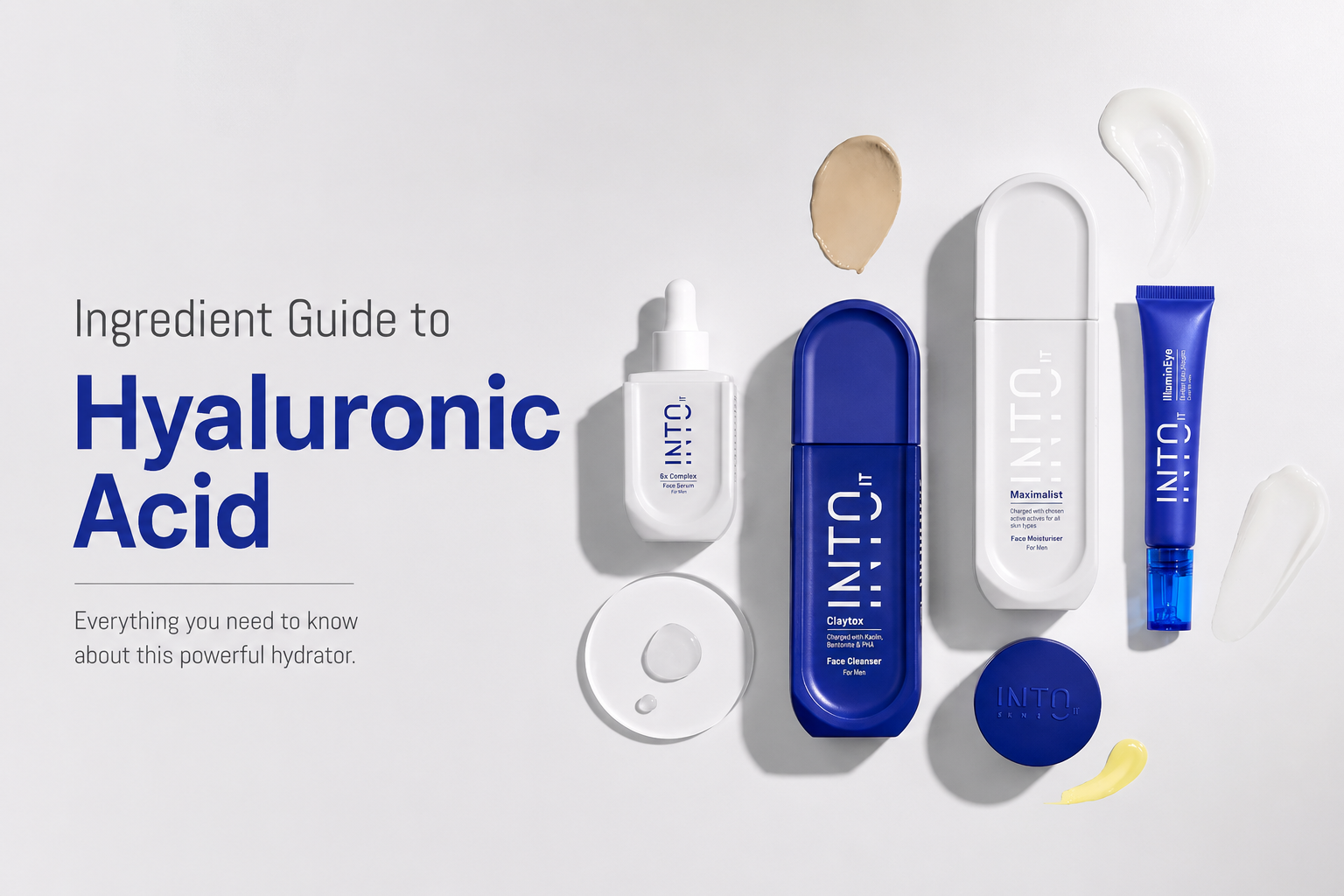
This is currently the only product in the INTOIT range that contains hyaluronic acid. The INTOIT 6x Complex Face Serum, INTOIT Maximalist Moisturizer, INTOIT Claytox Cleanser, and INTOIT IlluminEye Under Eye Serum achieve their hydration functions through other ingredients: Glycerin, Xylitylglucoside complexes, and ceramide-based barrier support, all of which are independently effective hydrating and barrier-supporting approaches but operate through different mechanisms than hyaluronic acid's specific humectant action.
How to Use Hyaluronic Acid Correctly
The effectiveness of hyaluronic acid depends significantly on how it is applied, regardless of which product contains it.
Apply to Damp Skin
Because hyaluronic acid is a humectant that draws water toward itself, applying it to completely dry skin in a low-humidity environment can cause it to draw moisture from the deeper layers of the skin rather than from the surrounding air, potentially worsening dehydration rather than improving it. Applying it to skin that is still slightly damp, immediately after cleansing, gives the HA molecules a ready water source to bind to from the moment of application.
For the Lip Restore SPF Lip Balm, this principle translates practically to applying it right after cleansing or when lips are not completely dry, maximising the humectant effect from the start.
Seal With an Occlusive Ingredient
A pure humectant without an occlusive sealing ingredient can, in very dry or air-conditioned environments, draw moisture from the skin's deeper layers and then lose it to the dry surrounding air, providing less net benefit than intended. This is why the most effective hyaluronic acid formulations pair it with an occlusive ingredient, as the Lip Restore formula does with Squalane.
Consistency Matters More Than Concentration Alone
A 2021 clinical study published in PMC evaluating a topical hyaluronic acid facial serum in photoaged skin found measurable improvements in smoothness, plumping, hydration, and fine lines and wrinkles with twice-daily use alongside sunscreen over the study period. This reflects the broader pattern across hyaluronic acid research: consistent daily application produces measurable, visible improvement, rather than the immediate but temporary plumping effect that a single application provides.
Common Misconceptions About Hyaluronic Acid
"More hyaluronic acid means better hydration"
Not necessarily. The molecular weight of the hyaluronic acid in a formula matters more than the raw percentage listed on the label. A product with a high percentage of large molecular weight HA will only hydrate the surface, while a lower percentage of well-formulated multi-weight HA can deliver more comprehensive benefit by reaching both the surface and deeper skin layers.
"Hyaluronic acid is an exfoliating acid like glycolic acid"
No. Despite the name, hyaluronic acid is not a chemical exfoliant. Alpha hydroxy acids like glycolic and mandelic acid work by breaking the bonds between dead skin cells to accelerate exfoliation. Hyaluronic acid has an entirely different function: water retention and structural support through its glycosaminoglycan properties. The shared word "acid" in both names refers to their chemical classification, not a shared mechanism of action.
"Hyaluronic acid alone is sufficient for dry skin"
Hyaluronic acid addresses water content, but dry skin caused by insufficient natural oil production benefits more directly from lipid-replenishing ingredients like ceramides. For dry skin specifically, a humectant like hyaluronic acid paired with barrier-repairing lipids produces better results than hyaluronic acid alone, since dry skin's core issue is barrier lipid deficiency rather than purely water deficiency.
"All hyaluronic acid products work the same way"
This is the most consequential misconception, given everything covered in this guide. The molecular weight, the presence or absence of complementary occlusive and barrier ingredients, and the overall formulation quality all significantly affect how much benefit a given hyaluronic acid product actually delivers, even at identical labelled concentrations.
Common Questions About Hyaluronic Acid
Why does the INTOIT range only use hyaluronic acid in the lip balm?
Hyaluronic acid is particularly well suited to lip tissue because lips have no oil glands and rely entirely on humectant-based hydration. For the face, the INTOIT formulations use other evidence-based hydrating and barrier-supporting ingredients, including Glycerin, the Xylitylglucoside hydration complex, and a full ceramide complex, each chosen for their specific role within the broader formulation of each product. This is a deliberate formulation choice based on what each area of skin specifically needs, not an omission.
Is hyaluronic acid safe for daily use?
Yes. Hyaluronic acid is one of the best-tolerated ingredients in skincare, naturally occurring in the body and associated with very low rates of irritation or sensitivity. It is suitable for daily use, including on sensitive skin, and there is no documented need for a gradual introduction period the way there is with actives like AHAs or retinoids.
Can hyaluronic acid cause purging or breakouts?
No. Hyaluronic acid is not comedogenic and does not have the cell-turnover-accelerating mechanism associated with purging from actives like AHAs or retinoids. It is generally considered safe for oily and acne-prone skin because it hydrates without adding oil to the skin surface.
How quickly does hyaluronic acid show visible effects?
The surface hydration and plumping effect from humectant binding is often visible within minutes to hours of application, particularly with high molecular weight HA on the surface. Deeper benefits from low molecular weight HA, including improvements in skin texture and fine lines, develop progressively over weeks of consistent use, as documented in clinical studies using twice-daily application over multi-week periods.
Does hyaluronic acid work in humid Indian conditions?
Yes, and in some respects it works particularly well, since the humectant mechanism draws moisture from the surrounding environment, and humid air provides more ambient moisture for this mechanism to use. In drier, air-conditioned indoor environments, which many Indian professionals spend significant time in, pairing hyaluronic acid with an occlusive sealing ingredient becomes more important to prevent the reverse-draw effect described earlier in this guide.
Will hyaluronic acid alone protect my lips from UV damage?
No. Hyaluronic acid addresses hydration but provides no UV filtering function on its own. This is why the INTOIT Lip Restore SPF Lip Balm combines hyaluronic acid with dedicated UV filters providing SPF 30 broad-spectrum protection, addressing hydration and sun protection as the two separate functions they actually are.
Final Word
Hyaluronic acid earns its place in skincare through genuine, well-documented biology. Its capacity to hold up to a thousand times its own weight in water makes it one of the most effective hydrating molecules available, and ongoing research into its low molecular weight forms continues to reveal applications beyond simple surface hydration, including roles in wound healing, barrier support, and skin structure.
The critical detail most marketing omits is that molecular weight determines what a given hyaluronic acid formulation can actually do. Large molecules hydrate the surface. Small molecules can penetrate further and contribute to deeper skin function. The most effective formulations use both, paired with occlusive ingredients that prevent the reverse-draw effect in dry conditions.
In the INTOIT range, this science is applied specifically to where it matters most: lip tissue, which has no oil glands and depends entirely on humectant-based hydration to stay healthy. Paired with Squalane for sealing and Ceramide NP for barrier support, hyaluronic acid in the Lip Restore SPF Lip Balm addresses the structural reality of lip biology directly, rather than being included as a label ingredient without a clear functional role.
Try the INTOIT Lip Restore SPF Lip Balm with Hyaluronic Acid here.