
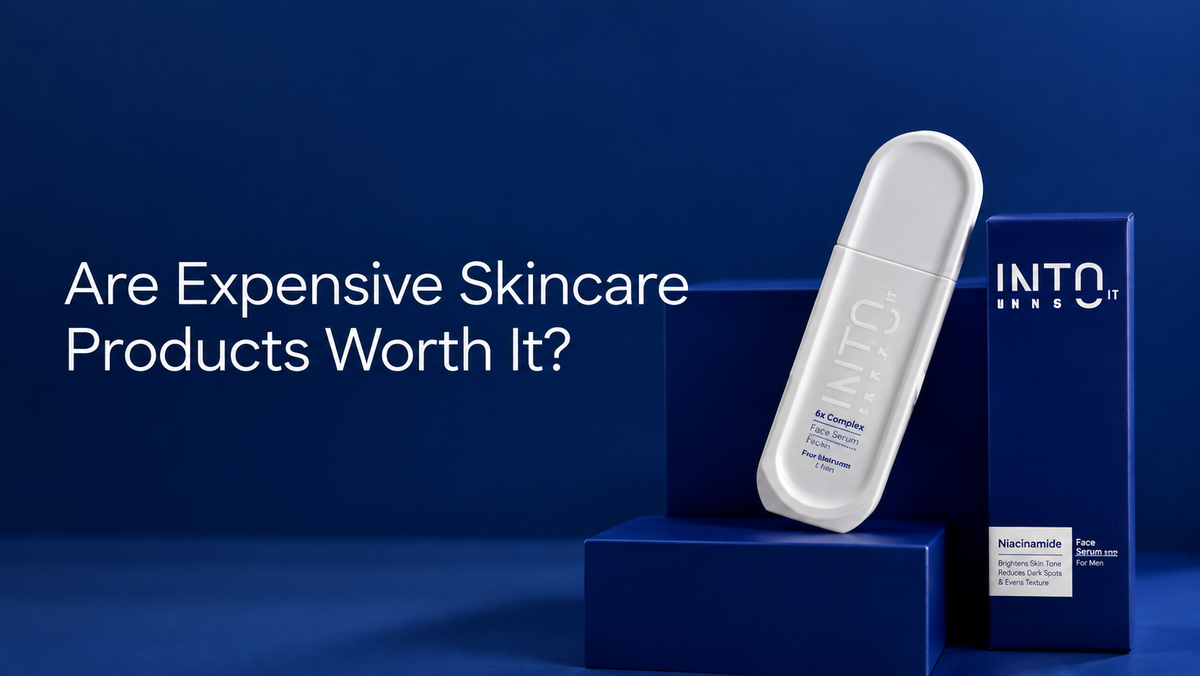
Are Expensive Skincare Products Worth It?
There is a persistent belief in skincare that a higher price means a better product. Men who are new to skincare often assume this is the case when navigating the market for the first time. Men who have been using skincare for a while sometimes encounter the same assumption when considering whether to upgrade products they are currently using.
The research says the relationship between price and performance is significantly more complicated than a straightforward correlation. Sometimes higher price reflects genuinely better formulation. Often, it reflects packaging, marketing, and brand positioning rather than the chemistry of the formula.
This guide explains exactly what determines skincare effectiveness, where price genuinely matters, where it does not, and how to evaluate a product's actual value rather than its cost.
The Research on Price vs Performance
Research on sunscreen, one of the most heavily studied skincare categories, has found that products with identical active ingredients and identical SPF protection can vary in retail price by more than tenfold. When the active ingredient is identical, the variation in price reflects everything other than the active chemistry: packaging, brand prestige, fragrance, and marketing spend.
Dermatologists addressing this directly frame it clearly. A product containing well-researched ingredients at effective concentrations may perform very well regardless of its price. Conversely, a high-end product with elegant packaging and luxury marketing that contains its active ingredients in concentrations too low to produce meaningful biological effects will underperform a straightforward, lower-priced product with the same active at an appropriate concentration.
The statement that most precisely captures the clinical consensus is this: for most patients, the missing ingredient is consistency, not luxury. The best skincare product is the one that is appropriate for the user's skin type and concerns and that they use consistently. These are properties determined by formulation suitability and habit formation, not by price.
What Actually Determines Skincare Effectiveness
Active Ingredient Identity
The first question about any skincare product is whether it contains an active ingredient with peer-reviewed clinical evidence behind it. This is the most fundamental determinant of whether a product can deliver what it claims.
Active ingredients with consistent, independently replicated clinical evidence include: niacinamide, glycolic acid and other alpha hydroxy acids, ceramides, peptide classes including signal peptides and neurotransmitter inhibitory peptides, retinoids, and vitamin C in its stable forms. Products built around these evidence-based actives at documented concentrations can produce meaningful results regardless of price point.
Products built around exotic-sounding ingredients with no clinical literature behind them, gold particles, rare plant extracts at trace concentrations, or conceptually appealing but scientifically unproven compounds, cannot produce results regardless of price because the active mechanism does not exist.
Active Ingredient Concentration
The presence of an active ingredient on a label is not the same as the presence of that ingredient at a concentration that produces documented effects. A product listing niacinamide as its twentieth ingredient in a long formula is almost certainly below the 2 percent threshold at which peer-reviewed clinical studies document sebum reduction and melanosome transfer inhibition.
This is where ingredient transparency matters enormously as an indicator of genuine formulation quality. Products that disclose the concentrations of their active ingredients, Niacinamide at 2 percent, Glycolic Acid at 5 percent, Caffeine at 5 percent, are demonstrating confidence that their actives are present at levels that the published research confirms to be effective. Products that list ingredients without percentages may be doing so because the concentrations would not be reassuring.
The INTOIT range discloses active ingredient concentrations specifically for this reason: Palmitoyl Tripeptide-1 at 11 percent in the 6x Complex Face Serum, Niacinamide at 2 percent, Glycolic Acid at 5 percent, Mandelic Acid at 2 percent, Alpha Arbutin at 2 percent, Glutathione at 2 percent, and Kojic Acid at 1 percent in the Maximalist Moisturizer. These are the concentrations at which the cited research shows meaningful results.
Formulation Stability and Delivery
Some active ingredients are difficult to stabilise. Vitamin C in its most effective form (L-ascorbic acid) is highly unstable and degrades rapidly in the presence of light, air, or improper pH. Properly stabilising and packaging L-ascorbic acid serum requires technology and quality control that does genuinely add cost.
Certain delivery systems that improve penetration or slow the release of actives to reduce irritation, particularly for sensitive skin, also represent legitimate added value that can justify higher price points.
The important distinction is between price increases that reflect genuine stability, delivery, or formulation improvements and price increases that reflect packaging, branding, and marketing spend. The former can improve results. The latter does not.
Formulation Suitability for Skin Type and Concerns
A product that is technically well-formulated for dry skin applied to oily skin will produce mediocre or negative results, not because the formulation is poor but because it is mismatched. Price does not resolve this mismatch. Correct product selection for the actual skin type and concern does.
When Paying More Is Worth It
When Stability Technology Requires It
Certain actives require genuinely expensive encapsulation, stabilisation, or anhydrous formulation to remain effective through a product's shelf life. Properly stabilised retinol, L-ascorbic acid vitamin C in truly effective form, and some peptides with difficult delivery challenges fall into this category. In these cases, paying more for a product where the brand has invested in genuine stability technology can be justified.
When Formulation Complexity Requires It
Products with multiple actives at clinically meaningful concentrations, properly balanced pH, and evidence of formulation optimisation for penetration and compatibility cost more to develop and manufacture than simple, single-active formulations. This additional cost can be genuine and reflected in results.
When You Are Paying for Proprietary Research
Some brands invest significantly in original clinical research on their specific formulations rather than simply using published research on known actives. If a brand has funded genuine independent clinical trials on its specific product and can demonstrate meaningful results, this research investment can legitimately justify higher pricing.
When Paying More Is Not Worth It
When the Premium Is in Packaging and Brand Prestige
Heavy glass bottles, luxury box packaging, retailer placement in premium sections, and brand marketing campaigns all contribute to retail price without contributing to the formulation's chemistry. Removing a formula from its luxury packaging and placing it in a functional container does not change its performance.
When the Premium Is for Exotic Ingredient Names
Gold particles, caviar extract, rare orchid compounds, and other exotic-sounding ingredients are often marketed at significant price premiums. The clinical evidence behind most of these ingredients' specific mechanisms is minimal to non-existent. A product with gold as a primary selling point and niacinamide at a trace amount will underperform a product with niacinamide at 2 percent and a basic, functional base regardless of price.
When the Same Active Is Available at Lower Price Points
Niacinamide is a well-studied, relatively inexpensive ingredient to produce. Ceramides are more expensive but increasingly available across price points. Glycolic acid is affordable. These evidence-based actives appear in products across a wide price spectrum, and the clinical research showing their efficacy does not change based on the price of the product they are in.
The Framework for Evaluating Any Skincare Product
These four questions cut through price bias and evaluate what actually matters.
Question 1: Does the product contain an active ingredient with peer-reviewed clinical evidence at a disclosed, meaningful concentration?
This is the primary test of whether a product can deliver what it claims. No evidence-based active, or evidence-based active at an undisclosed or trace concentration, means no meaningful clinical benefit regardless of price.
Question 2: Is the formulation appropriate for my skin type and the concern I am trying to address?
A perfectly formulated product for the wrong skin type or concern produces poor results. This is about selection, not quality.
Question 3: Is the price driven by formulation quality or by packaging, branding, and marketing?
Not always easy to determine, but ingredient transparency and disclosed concentrations are strong signals of brand confidence in actual formulation quality versus marketing-driven premium.
Question 4: Can I use this product consistently at this price point?
Consistency determines results more than formulation quality within the range of reasonably well-formulated products. A very good product used inconsistently because of budget pressure produces worse outcomes than a solid, affordable product used consistently every day. Price should be sustainable for the intended daily routine.
What This Means for the INTOIT Range
The INTOIT range is positioned as clinically formulated and reasonably priced for consistent daily use by Indian men. The positioning reflects a specific formulation philosophy: active ingredients at concentrations that clinical research supports, disclosed transparently, in multi-functional products that reduce the number of separate items needed.
The INTOIT Maximalist Moisturizer provides Glycolic Acid at 5 percent, Alpha Arbutin at 2 percent, Glutathione at 2 percent, Kojic Acid at 1 percent, and a full ceramide complex in one product. The INTOIT 6x Complex Face Serum provides six active complexes including Niacinamide at 2 percent, Palmitoyl Tripeptide-1 at 11 percent, and Oligopeptide-68 at 68.5 percent of the peptide complex.
The multi-functional approach reduces the number of products needed and the total cost of the routine while delivering the active ingredient coverage that single-function products would require multiple separate products to provide.
Common Questions About Price vs Performance in Skincare
My current expensive products seem to work. Should I switch?
If a product is working well for your skin type and producing visible results, there is no reason to switch on principle. The point is not that expensive products do not work. It is that performance does not scale reliably with price. If your current routine works, the relevant question is whether a better-value alternative with equivalent active ingredient profiles and concentrations could maintain those results at lower cost.
How do I know if a product has enough active ingredient to work?
Look for brands that disclose percentage concentrations of their active ingredients. The published research establishes what concentrations of common actives produce documented results: niacinamide at 2 to 5 percent for sebum and brightening effects, glycolic acid at 5 to 10 percent for surface renewal in a daily-use moisturizer, ceramides at meaningful amounts alongside the other structural lipids. A brand confident in its formulation will disclose concentrations. A brand that does not may be obscuring concentrations that would not be reassuring.
Is it worth buying high-end products for a special event or short-term use?
No. Skincare results develop over weeks to months of consistent use because the biological processes driving improvement, cell turnover, collagen synthesis, melanin reduction, all operate on timescales measured in weeks and months. A single or short-term application of any product, regardless of price, does not produce meaningful results different from consistent long-term use of a well-formulated basic routine. There are no miracle results for special occasions from skincare.
Should I pay more for products from dermatologist-owned brands?
Dermatologist involvement in formulation or recommendation can be a meaningful signal of formulation quality and clinical evidence focus, particularly if the dermatologist is publishing the research behind the formulation. However, the "dermatologist-developed" claim on packaging is not a regulated statement in most markets and can be applied to any product with minimal dermatological input. The actual measure remains active ingredient identity, concentration, and formulation suitability.
Final Word
Price and performance are not reliably linked in skincare. The performance of a skincare product is determined by its active ingredients, their concentrations, formulation stability and delivery quality, and suitability for the user's skin type. None of these factors correlate predictably with price across the market.
There are legitimate reasons a higher-priced product can outperform a cheaper one: genuine stability technology for difficult-to-stabilise actives, proprietary delivery systems, and original clinical research all represent real added value. Luxury packaging, exotic ingredient marketing, and brand prestige do not.
The most cost-effective skincare routine is one that contains well-formulated products with evidence-based actives at disclosed, meaningful concentrations, appropriate for your skin type, at a price point that makes consistent daily use sustainable over the weeks and months that results actually require.
That is the framework. Apply it to any product at any price point.
Explore the full INTOIT range here.