
Article: Minimal Skincare vs 10-Step Routine: What Actually Works Better
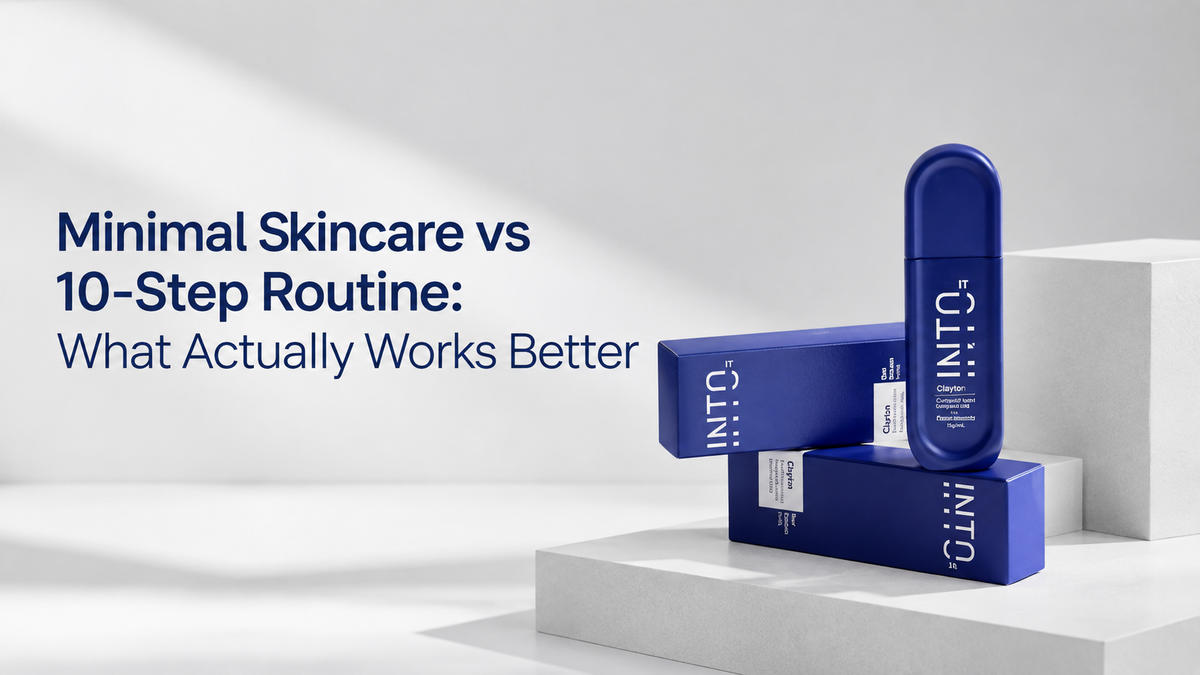
Minimal Skincare vs 10-Step Routine: What Actually Works Better
The ten-step skincare routine became a cultural phenomenon that spread from South Korean beauty culture to global skincare content. The appeal is intuitive: if three products can improve your skin, surely ten products, each targeting a specific concern, can do even more.
The dermatological research on this does not support the intuition. In fact, the evidence suggests the opposite in many cases. This is not a niche position. Multiple board-certified dermatologists and published clinical researchers have arrived at the same conclusion: for most people, a simpler routine with better-chosen products outperforms a complex routine with more products.
This guide explains why, what the research shows, and how to determine the right level of complexity for your specific skin.
The Case Against the 10-Step Routine
More Products Means More Ingredients, More Risk
Modern skincare products typically contain 15 to 30 individual ingredients. A ten-step routine means the skin is simultaneously exposed to potentially 150 to 300 different compounds. Many of these compounds are individually benign but create unexpected interactions at the skin surface when combined without careful formulation consideration. Research published in Biomedical Dermatology found that improper product layering can reduce active ingredient absorption by up to 40 percent.
Beyond absorption interference, the cumulative irritant and allergen exposure from many products is higher than from fewer. Scientific studies show that excessive product layering can increase transepidermal water loss and trigger inflammation. The additional products are not simply adding benefit: they are also adding risk.
The Barrier Over-Burden Problem
The skin barrier functions optimally when it is not overwhelmed by multiple active ingredients applied simultaneously. Multiple published dermatology reviews confirm this: over-cleansing and excessive layering can compromise the protective barrier, leading to increased sensitivity, dryness, and inflammation.
This is particularly relevant for the ten-step routines that became popular, which often include multiple active acids, retinoids, vitamin C, and other high-activity ingredients in a single session. Combining multiple strong actives without understanding their interactions can trigger chronic micro-inflammation, a low-grade inflammatory state that accelerates skin ageing rather than reducing it.
Consistency Is the Primary Driver of Results
Behavioural psychology research confirms that routines with more than four to five steps have lower adherence rates. The complexity of a ten-step routine creates multiple points of failure: running out of one product, being too tired for all steps, skipping the session when under time pressure.
A three-step routine done every single morning and every single night for twelve weeks produces better cumulative results than a ten-step routine done three to four times per week. The biological processes that produce visible improvement from skincare, cell turnover, collagen synthesis, melanin reduction, all require consistent daily stimulation over weeks to months. Inconsistency resets these processes rather than allowing the compounding improvement to develop.
The single most impactful change most men can make to their skincare outcomes is not adding more products. It is applying the right products consistently.
The Case For Some Complexity
The argument against ten-step routines is not an argument for using a single product. There are genuine functional reasons to have multiple steps.
Different Delivery Depths Require Separate Products
A cleanser cleans the surface but cannot deliver active ingredients to depth. A serum delivers actives to depth but cannot provide barrier sealing. A moisturizer seals and treats the surface but cannot penetrate as deeply as a serum. These three functions are genuinely distinct and require separate products because the formulation of each is optimised for its specific delivery goal.
Similarly, lips have unique biology that general face products are not formulated to address, and the under-eye area has specific concerns that benefit from targeted treatment with ingredients calibrated for the thinnest skin on the face.
The relevant question is not "fewer is always better." It is "does each step cover a function that the other steps cannot?" Every step that passes this test belongs in the routine. Every step that duplicates a function already covered, or that addresses a concern the person does not have, does not.
Multi-Functional Products Are the Solution
The synthesis of these two positions is multi-functional skincare: products that cover multiple functions through multiple independently researched mechanisms in a single step. This is different from both the minimalist "one product covers everything" approach and the "one step per concern" approach.
The INTOIT 6x Complex Face Serum covers six distinct active mechanisms (sebum regulation, melanin inhibition, collagen stimulation, expression line reduction, antioxidant protection, brightening) in a single serum application step. The INTOIT Maximalist Moisturizer covers surface renewal, multi-angle melanin inhibition, full barrier lipid replenishment, and deep sustained hydration in a single moisturizer step. Five distinct functions in two products, both applied after the cleanser.
This is more comprehensive than a basic three-product routine of generic cleanser, water and glycerin serum, and simple moisturizer. It is significantly simpler and more consistent than a ten-step routine of separate products each addressing one concern.
What the Evidence Supports
The dermatological consensus that emerges from the research is a specific, functional minimum rather than either extreme.
The minimum effective routine is: a cleanser, an active treatment serum, a moisturizer with barrier-repair ingredients, and daily sunscreen. This covers cleansing, deep active treatment, barrier sealing and surface treatment, and UV protection. Any skin concern that requires treatment beyond what these four steps cover generally benefits more from a dermatologist consultation than from adding a fifth, sixth, or seventh product.
Beyond this minimum, additions should pass the functional test: does this step cover a function none of the existing steps cover? An under-eye serum addresses the specific biology of periorbital tissue not covered by general face products. A targeted lip balm addresses the specific vulnerabilities of lip tissue not covered by face products. Both pass the test. A separate toner that does what the cleanser and moisturizer already accomplish does not.
The INTOIT Three Plus Two System
The INTOIT range embodies the multi-functional approach to this question. Three core products cover the foundational functions of the routine through multiple mechanisms each. Two optional additions address anatomically specific areas.
Three core products (every man):
-
INTOIT Claytox Cleanser: Cleanse + daily exfoliation (PHA) + active soothing
-
INTOIT 6x Complex Face Serum: Deep treatment (six active mechanisms)
-
INTOIT Maximalist Moisturizer: Seal + surface renewal + barrier repair + brightening + deep hydration
Two targeted additions (where specifically needed):
-
INTOIT IlluminEye Under Eye Serum: Targeted dark circle and puffiness treatment for periorbital biology
-
INTOIT Lip Restore SPF Lip Balm: Hydration, barrier repair, and UV protection for lip tissue
Total: three to five products covering what ten separate single-function products would otherwise require, at lower complexity, lower irritation risk, higher consistency potential, and with better-verified active ingredient concentrations.
Common Questions About Minimal vs Complex Routines
If 10 steps work for some people, why does that not mean more is always better?
People who follow ten-step routines and see good results are typically selecting compatible, appropriate products and applying them consistently. Their success is driven by product quality, compatibility, and consistency, not by the number of steps. The same results would typically be achievable with fewer, better-chosen multi-functional products. The ten-step routine is not wrong. It is often unnecessary and more difficult to sustain.
Korean skincare advocates say ten steps are necessary for the best skin. Is that true?
Korean skincare culture popularised multi-step routines based on a specific philosophy of gentle, gradual care with layered hydration. The clinical evidence does not support ten steps as a universal requirement for good skin outcomes. What Korean skincare philosophy correctly identified is that consistency, gentle care, and thorough hydration produce good skin. These principles can be applied in three to five steps as effectively as in ten, without the added risk of over-layering and irritation.
What if I have many different skin concerns? Do I need more steps to address all of them?
The multi-functional approach is specifically designed to address multiple concerns in fewer steps. A serum that addresses oiliness, pigmentation, collagen, and oxidative stress simultaneously does not require four separate serums. The question is whether the multi-functional products you use actually contain evidence-based actives at meaningful concentrations for each concern. If so, three to five steps can genuinely address five to six distinct concerns.
Should I start with more products and simplify, or start simple and add?
Start simple. Introduce the core three products first and use them consistently for four to six weeks. This establishes the habits and gives you a baseline to compare against. Any product added after this baseline can be evaluated against that baseline. Starting with many products simultaneously makes it impossible to identify what is working, what is causing any reaction, and what is providing genuine additional benefit.
Final Word
The ten-step routine was a cultural phenomenon, not a clinical recommendation. The research consistently supports a different conclusion: fewer products, each multi-functional, chosen based on active ingredient evidence and appropriate to the skin type, applied consistently, outperform an elaborate routine on the primary determinants of skincare success.
This does not mean ignoring the skin. It means choosing intelligently between things that genuinely address distinct functions and things that duplicate functions already covered.
Three to five products. Multiple mechanisms per product. Every morning and night. That is the formula the research supports.
Explore the INTOIT minimal routine here.