
Why Your Skin Breaks Out After 30
One of the most frustrating experiences in adult life is having managed acne reasonably well through your teens and twenties and then finding that your skin becomes problematic again in your thirties. The breakouts look and feel different from teenage acne. They appear in different places. They take longer to heal. And the products that worked for teenage acne often make no meaningful difference.
This is not a coincidence. Adult acne after 30 is a distinct clinical presentation with different underlying causes from teenage acne, and addressing it effectively requires understanding those causes rather than simply intensifying the approach that worked at 18.
Adult Acne Is Genuinely Common
Before covering why it happens, it is worth establishing that this is not unusual. Adult acne affects up to 50 percent of women and 25 percent of men in their thirties. According to the American Academy of Dermatology, acne is not only the most common skin condition globally but the number of adults experiencing it has been increasing, not decreasing, in recent decades.
For men specifically, adult acne in the thirties tends to be more persistent, more concentrated on the lower face, and more resistant to the broad-spectrum approaches that worked during the hormonal surge of puberty. Understanding why requires understanding how the acne mechanism works differently in adult skin compared to teenage skin.
Why Teenage Acne and Adult Acne Are Different
Teenage acne is primarily triggered by the massive androgen surge of puberty, which dramatically increases sebum production broadly across the face, chest, and back. This excess sebum combines with dead skin cells in the follicular ducts and creates the blocked pores that allow Cutibacterium acnes bacteria to proliferate and trigger the inflammatory response of an acne lesion. It tends to affect large surface areas, appear across the T-zone and beyond, and improve naturally as hormones stabilise through the early twenties in many people.
Adult acne in the thirties has a distinct clinical profile. It tends to:
-
Concentrate on the lower face, specifically the jawline, chin, neck, and around the mouth rather than the forehead and nose
-
Present as deeper, more painful lesions including cysts and nodules rather than the surface-level blackheads and whiteheads of teenage acne
-
Follow more predictable patterns, flaring during high-stress periods, and in some men, in correlation with dietary or lifestyle changes
-
Persist despite a consistent skincare routine, often because the routine is designed for the surface-level dynamics of teenage acne rather than the hormonal and cellular causes of adult acne
The lower facial concentration is particularly telling. Androgen-sensitive sebaceous glands are most concentrated on the jawline and chin. Adult hormonal shifts that affect androgen activity manifest most visibly in this zone precisely because the glands there are most sensitive to the relevant hormonal changes.
The Main Causes of Breakouts After 30 in Men
Cause 1 - Ongoing Androgen Activity
Androgens, the group of hormones that includes testosterone, are the single biggest factor behind adult acne in men. This does not change after 30. What changes is the context in which androgen activity operates on the skin.
By the mid-thirties, testosterone levels in men begin declining gradually, approximately 1 to 2 percent per year. But androgen sensitivity, the extent to which sebaceous glands respond to androgen signals, is genetically determined and does not decline at the same rate as circulating testosterone. Men with genetically higher androgen receptor sensitivity in their sebaceous glands can experience significant sebum overproduction at androgen levels that would produce no meaningful acne in men with lower receptor sensitivity.
This is why some men who were not particularly acne-prone in their teens develop significant adult acne, and others with the same testosterone levels do not. The issue is often not the hormone level itself but how sensitively the sebaceous glands respond to it.
Cause 2 - Stress and Cortisol
The stress component of adult acne works differently and more significantly than it does in teenage acne. By the thirties, many Indian men are in periods of peak career pressure, financial responsibility, and personal demands. Cortisol, the primary stress hormone, directly stimulates sebaceous glands to produce more sebum. It also increases inflammatory sensitivity, meaning the same level of follicular bacteria that would not produce a visible lesion in lower-cortisol conditions can trigger a significant cyst in the context of elevated chronic cortisol.
Adults experience more chronic, sustained stress than most teenagers, producing a more consistent cortisol elevation with more sustained sebum and inflammatory effects. A 2026 analysis of adult acne causes confirms that the stress component works differently in adults than in teenagers, with cortisol directly stimulating sebaceous function and amplifying inflammatory responses in adult skin.
Cause 3 - Slowed Cell Turnover
By the thirties, the natural skin cell renewal cycle has slowed from the approximately 28-day cycle of younger skin. Slower cell turnover means dead skin cells accumulate in follicular ducts for longer before being shed. This increases the time available for those cells to combine with sebum and create the blockage that starts the acne formation process.
Research confirms that aging itself can make the skin more prone to acne through this mechanism: slowed cell turnover causes dead skin cells to linger longer on the surface where they can trap oil and bacteria. This is paradoxical but well-documented: the same processes producing drier, less oily-feeling skin in some men in their thirties can simultaneously produce more acne because of the changed cellular dynamics.
Cause 4 - Changed Sebum Composition
Beyond the volume of sebum, its composition changes with age in ways that affect its role in acne formation. Adult sebum tends to be richer in certain lipids that are more conducive to the proliferation of C. acnes bacteria. Research has confirmed that as skin ages, the composition of sebum shifts, creating a more hospitable environment for the bacteria at the centre of inflammatory acne even when total sebum volume may be similar or even slightly reduced compared to teenage years.
Cause 5 - Pollution and Environmental Stress Accumulation
Indian men in their thirties have spent a decade or more of adult life accumulating environmental stress from pollution, UV, and hard water on their skin. This cumulative exposure progressively weakens the skin barrier and increases baseline inflammatory activity. A skin barrier that is consistently compromised by environmental damage provides less effective protection against the bacterial and biochemical factors that drive acne, even when those factors have not changed significantly from earlier years.
What Is Different About Adult Acne Treatment
The difference in the adult acne mechanism requires a different treatment approach. Treating adult acne with the same aggressive, drying, oil-stripping approach used for teenage acne is counterproductive for several reasons.
Aggressive drying of adult skin compromises a barrier that is already under more stress than teenage skin, increasing baseline inflammation rather than reducing it. Over-stripping sebum triggers the compensatory production cycle discussed throughout this series: the skin produces more oil to replace what was removed, creating more acne rather than less. And adult skin is simultaneously dealing with early signs of ageing, meaning the cell turnover support and collagen maintenance that an adult acne routine needs to provide are absent from routines designed purely for surface oil removal.
The evidence-based approach to adult acne after 30 combines gentle barrier-supportive cleansing with active ingredients that address sebum regulation, inflammation, surface renewal, and bacterial management simultaneously, without the aggressive stripping that worsens adult skin.
The INTOIT Approach to Breakouts After 30
Gentle pore-level cleansing without stripping:
The INTOIT Claytox Cleanser addresses the pore-level sebum accumulation that feeds adult acne through clay adsorption (Bentonite at 3 percent and Kaolin at 3 percent) rather than through aggressive surfactant stripping. The Gluconolactone PHA at 2 percent provides gentle daily exfoliation that removes the dead skin cell buildup that slowed adult cell turnover makes worse. Chamomile and Aloe Vera reduce the baseline inflammatory irritation rather than adding to it.
Sebum regulation at the cellular level:
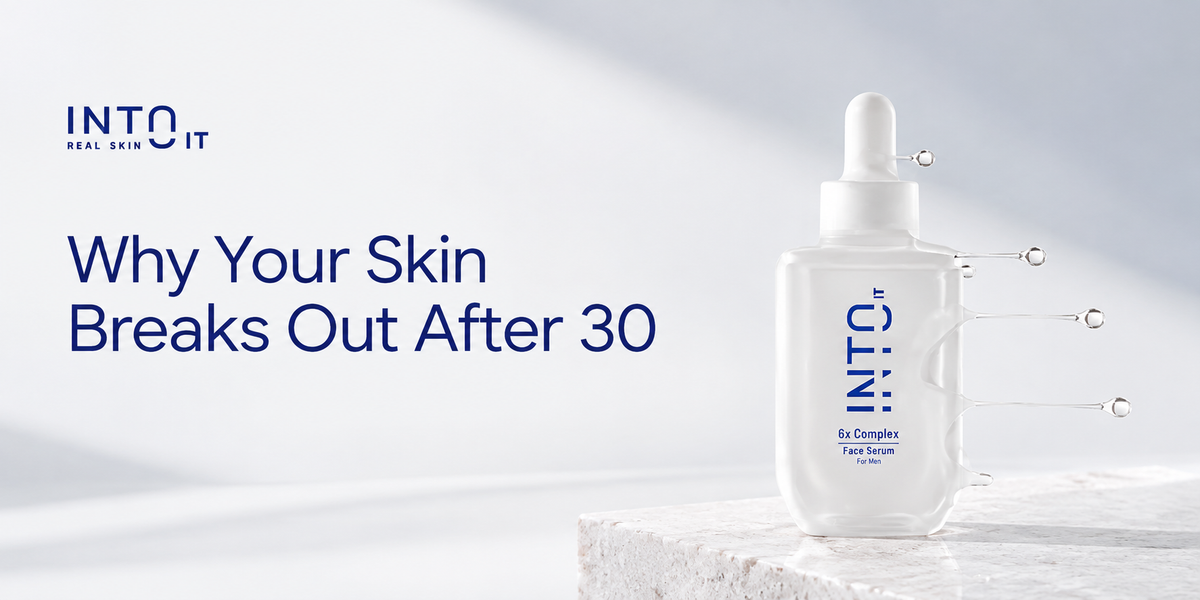
The INTOIT 6x Complex Face Serum contains Niacinamide at 2 percent, the most clinically validated ingredient for reducing sebum excretion rate at the cellular level in the sebaceous glands. It also contains anti-inflammatory activity through cytokine reduction, directly addressing the enhanced inflammatory response of adult skin. Caffeine at 0.5 percent provides antioxidant support against the oxidative stress that pollution accumulation has driven over years of exposure.
Surface renewal and anti-inflammatory barrier repair:
The INTOIT Maximalist Moisturizer provides Glycolic Acid at 5 percent and Mandelic Acid at 2 percent for accelerated surface cell turnover, directly countering the slowed renewal that makes adult skin more prone to follicular blockage. The full ceramide complex repairs and maintains the barrier that both stress and years of environmental exposure have compromised. Allantoin provides additional soothing support.
Lifestyle Factors That Significantly Affect Adult Acne
Stress Management
Because cortisol is such a significant driver of adult acne specifically, addressing the underlying stress through exercise, adequate sleep, and appropriate management of work and personal pressures has a more direct impact on adult acne outcomes than it does on teenage acne. Regular exercise reduces cortisol levels over time. Consistent seven to nine hours of sleep prevents the cortisol elevation that sleep deprivation causes. These are not peripheral suggestions. They are directly relevant to the hormonal mechanism driving the breakouts.
Diet
Research confirms a connection between high-glycaemic diet and increased androgen activity through insulin-mediated signalling. Diets high in refined carbohydrates, sugar, and processed foods increase insulin, which increases androgen synthesis and androgen receptor sensitivity in sebaceous glands. Reducing dietary glycaemic load alongside topical treatment produces better outcomes than topical treatment alone. This connection is particularly relevant for Indian dietary patterns where white rice, maida-based foods, and sweetened beverages are common.
Hydration
Adequate daily water intake reduces compensatory sebum overproduction from dehydration-triggered barrier compromise. This is a secondary factor, but consistent hydration throughout the day supports better skin outcomes alongside topical care.
When to See a Dermatologist for Adult Acne
Topical skincare, including the INTOIT routine described above, is appropriate for managing mild to moderate adult acne characterised by comedones, small papules, and moderate inflammatory lesions. A dermatologist consultation is appropriate when:
-
Acne is severe, cystic, or nodular, producing large, painful lumps under the skin
-
Breakouts are not responding to consistent topical care over 8 to 12 weeks
-
Acne is producing significant scarring (pitted or raised scars rather than flat post-inflammatory dark marks)
-
The breakouts are accompanied by other hormonal symptoms that suggest an underlying hormonal condition
Prescription-strength topical or oral treatments including retinoids, antibiotics, or hormonal therapies may be appropriate for these cases and are beyond the scope of over-the-counter skincare.
Common Questions About Breakouts After 30
Does adult acne mean my hormone levels are abnormal?
Not necessarily. Many men with adult acne have hormone levels within the normal clinical range on testing. The issue is often the sensitivity of the sebaceous glands to normal hormone levels, which is genetically determined and varies between individuals. Abnormally elevated hormones are one possible cause, but sebaceous gland sensitivity is the more common mechanism in most men with adult acne after 30.
Will my adult acne resolve on its own like teenage acne did?
Adult acne does not follow the same self-resolving trajectory as teenage acne. Teenage acne often improves as hormones stabilise through the early twenties. Adult acne in the thirties tends to persist until the driving causes, primarily stress management, dietary patterns, and appropriate topical care, are actively addressed. It can improve, but it requires intervention rather than waiting.
Why is my adult acne concentrated on my jawline when teenage acne was across my face?
The lower facial concentration reflects the higher concentration of androgen-sensitive sebaceous glands in this zone. Adult hormonal fluctuations, whether from stress-driven cortisol or changes in androgen sensitivity, manifest most strongly where receptor density is highest, which is the jawline and chin rather than the broad T-zone pattern of puberty-driven teenage acne.
Can my moisturizer be causing adult breakouts?
Yes. Certain moisturizer ingredients are comedogenic, meaning they block pores, and this effect is more consequential in adult skin with larger pores and potentially compromised barrier function. Rich, heavy creams designed for dry skin can contribute to follicular blockage in men with oilier skin. The Maximalist Moisturizer is formulated to be non-comedogenic: the active ingredients it contains including AHAs actually help prevent follicular blockage through accelerated surface cell renewal.
Is sun exposure helping my adult acne?
No. UV exposure temporarily dries the skin surface, which can create the appearance of improved acne in the short term. But the resulting sun damage causes dead skin cells to build up more quickly, the barrier to weaken, and inflammation to increase, all of which worsen acne over the following weeks. The temporary surface drying effect also drives compensatory sebum production. Using facial sunscreen daily during adult acne management is recommended, not contraindicated.
Final Word
Breaking out in your thirties is not a sign that something is fundamentally wrong with you. It is a common, biologically explicable response to a specific combination of ongoing androgen activity, chronic stress and cortisol elevation, slowed cell turnover, changed sebum composition, and accumulated environmental barrier stress.
Treating adult acne effectively requires an approach designed around these adult mechanisms rather than the oil-stripping approaches designed for teenage acne. Gentle barrier-supportive cleansing, cellular-level sebum regulation, accelerated surface renewal to counter slowed turnover, and consistent stress and lifestyle management together address the actual causes rather than just the visible symptoms.
Give it eight to twelve weeks of consistent, targeted care alongside the lifestyle adjustments that address the underlying hormonal drivers. The improvement is achievable. It just requires addressing the right problem in the right way.
Shop the INTOIT routine for adult acne here.