
The Science Behind SPF Protection
Most Indian men own a bottle of sunscreen. Very few use it daily. The reasons are familiar. Dark skin does not need it. It only matters at the beach. It feels heavy. It makes the skin oily. There is no immediate burn so the damage is not real.
Every one of these reasons is factually incorrect, and the science that refutes them is decades old and thoroughly documented. UV radiation is responsible for approximately 80 percent of visible facial ageing. It is the single most significant driver of dark spots, collagen loss, and premature skin ageing. And India, across most of the country, for most of the year, has UV index levels classified as very high to extreme.
This guide explains how UV damages skin at the cellular and molecular level, what SPF actually measures, why the SPF number alone is not the full picture, and why daily sunscreen use is not optional for any Indian man who cares about his skin.
The Two Types of UV Radiation That Reach Your Skin
Ultraviolet radiation from the sun exists in three wavelength bands. UVC, the shortest and most energetic, is almost entirely absorbed by the ozone layer and does not reach the earth's surface in meaningful amounts. The two types that reach your skin every day are UVA and UVB. They behave differently, penetrate to different depths, and cause different types of damage.
UVB: The Burning Ray
UVB radiation has a wavelength of 280 to 315 nanometres. It carries more energy per photon than UVA and is primarily absorbed in the outer layers of the skin, the epidermis.
UVB is the primary cause of sunburn. When UVB radiation is absorbed by skin cells, it directly damages their DNA, forming specific lesions called cyclobutane pyrimidine dimers (CPDs). Research published in the Journal of the American Academy of Dermatology confirms that these lesions result in structural damage to the DNA helix, inhibiting DNA replication and transcription. The same research confirms that relatively low and even sub-erythemal doses of UVB, meaning doses too low to cause visible redness, cause a high amount of DNA damage in the epidermis.
This last point is important. You do not need to burn for significant DNA damage to occur. UVB below the threshold that causes visible redness still produces substantial cellular damage with every exposure.
UVB intensity varies with the season, time of day, cloud cover, and altitude. It is stronger at midday and in summer months, and weaker at dawn, dusk, and in winter. However, UVA is a more consistent daily concern.
UVA: The Ageing Ray
UVA radiation has a wavelength of 315 to 400 nanometres. Due to its longer wavelength, it penetrates significantly deeper than UVB, passing through the epidermis and reaching the dermis, the layer where collagen and elastin are produced and maintained.
A comprehensive review published in Cureus and PMC in 2025, drawing on published dermatology research, confirms that UVA penetrates deep into the dermis, promoting collagen degradation, whereas UVB causes DNA mutations. Research published in Wiley Online Library's Experimental Dermatology confirms that UVA is the most prevalent component of solar UV radiation, deeply penetrating into the skin and inducing profound alterations of the dermal connective tissue.
The mechanism is through reactive oxygen species. UVA generates free radicals that activate matrix metalloproteinases, the same MMP enzymes that degrade collagen and elastin. Chronic UVA exposure through this pathway produces collagen fragmentation, loss of skin elasticity, fine lines, and deeper structural skin ageing at the dermal level.
UVA has two properties that make it a more insidious daily concern than UVB. First, UVA intensity is relatively consistent throughout the day and throughout the year, unlike UVB which varies significantly with season and time of day. Second, UVA penetrates glass. If you sit near a window in an office or commute by car, you are receiving UVA exposure even on overcast days and without direct sunlight.
Research from Wiley Online Library confirms that by broadening sunscreen absorption from UVB towards UVA, efficacy against photoaging significantly improves. This is the scientific basis for requiring broad-spectrum protection rather than SPF alone.
What SPF Actually Measures
SPF stands for Sun Protection Factor. Understanding exactly what it measures, and what it does not measure, prevents the most common misunderstandings about sunscreen efficacy.
SPF is primarily a measure of protection against UVB radiation. Specifically, it measures how much longer protected skin can be exposed to UVB before experiencing the same amount of erythema (redness) as unprotected skin.
Research published in the Journal of the American Academy of Dermatology confirms that SPF is mainly an index of UVB protection. Erythema, the skin reddening response to UV, is caused predominantly by UVB. The original SPF testing system was developed around this endpoint.
In practical terms:
- SPF 15 filters approximately 93 percent of UVB rays
- SPF 30 filters approximately 97 percent of UVB rays
- SPF 50 filters approximately 98 percent of UVB rays
The difference between SPF 30 and SPF 50 is 1 percentage point of UVB protection. The difference between SPF 15 and SPF 30 is 4 percentage points. This is why SPF 30 is widely recommended as the daily minimum. Beyond SPF 50, the marginal additional UVB protection is negligible, but marketing numbers continue to climb.
The critical thing SPF does not measure is UVA protection. An SPF 50 sunscreen with no UVA filters provides excellent protection against sunburn but no protection against the deep dermal UV damage that causes collagen loss, fine lines, and premature ageing. This is why broad-spectrum labelling is essential.
Understanding Broad Spectrum and PA Rating
Broad-spectrum sunscreens address both UVA and UVB. But in many markets, including India, UVA protection is further quantified by the PA rating system.
The PA system, developed in Japan and widely used across Asia, uses a plus notation to indicate UVA protection factor:
- PA+ - Some UVA protection
- PA++ - Moderate UVA protection
- PA+++ - High UVA protection
- PA++++ - Extremely high UVA protection
For daily use in India's UV environment, the recommended specification is SPF 30 or higher with PA++++ rating. SPF protects against UVB-driven sunburn and DNA damage. PA++++ protects against UVA-driven collagen degradation, pigmentation, and deeper photoaging.
Using a sunscreen with SPF 50 but no PA rating or only PA+ provides strong UVB protection while leaving the deeper, more ageing-relevant UVA damage largely unaddressed.
How UV Damages Skin at the Cellular Level
Understanding this in detail explains why consistent daily protection matters even when no burn occurs.
Collagen Degradation Through MMP Activation
Both UVA and UVB activate matrix metalloproteinases (MMPs) in skin cells. The Journal of the American Academy of Dermatology confirms that UVB-induced erythema predicts MMP-1 messenger RNA induction, establishing the link between UV exposure and MMP activation. UVA activates MMPs through reactive oxygen species generated by its photochemical interaction with skin chromophores.
MMPs are enzymes specifically responsible for breaking down collagen and elastin in the extracellular matrix. Under normal skin physiology, MMP activity is tightly regulated. Chronic UV exposure tips this balance, upregulating MMPs beyond the skin's natural regulatory capacity and producing net collagen degradation with every unprotected exposure.
The Cureus PMC review confirms that both UVA and UVB activate MMPs, and that both mechanisms suppress DNA repair pathways. This dual action, degrading existing structure while impairing the repair of new damage, is the biological basis for the statement that UV radiation accounts for approximately 80 percent of visible facial ageing.
DNA Damage and Mutation
UVB directly damages the DNA of skin cells through the formation of CPDs. These DNA lesions disrupt the normal reading of genetic information during cell division. When DNA damage outpaces the skin's capacity to repair it through the overnight peak of DNA repair activity, damaged genetic material is replicated. Over decades of accumulation, this contributes to the mutagenic changes that underlie skin cancer risk.
Research confirms that chronic UV exposure further accelerates skin ageing by promoting inflammation and immunosuppression. The immune suppression component is particularly important. UV exposure reduces the activity of Langerhans cells in the epidermis, which are responsible for immune surveillance. This is one mechanism by which UV-induced DNA damage can progress to precancerous changes without being effectively identified and cleared by the immune system.
Pigmentation from Melanocyte Activation
UV exposure triggers melanocytes to produce excess melanin as a protective response. As confirmed in the niacinamide ingredient guide and the sun damage repair blog, this excess melanin deposits unevenly as dark spots, post-inflammatory marks, and general uneven pigmentation.
The Cureus PMC review confirms that darker skin (Fitzpatrick types IV to VI, which includes most Indian skin) has a natural SPF estimated at approximately 13.4, while lighter skin (types I to III) has a natural SPF of approximately 3.3. This means the natural melanin protection in Indian skin provides meaningful but clearly insufficient protection against India's extreme UV levels, which require a minimum of SPF 30 for adequate daily protection.
Importantly, the same review confirms that darker-skinned individuals face elevated risk of post-inflammatory hyperpigmentation and delayed skin cancer diagnosis. The higher melanin that provides some protection also creates more reactive melanocytes that respond more intensely to UV and inflammation. For Indian men, this means both more pigmentation risk from UV and a reason for vigilance about skin changes that UV causes over years.
Oxidative Stress and Free Radical Cascade
Beyond direct DNA damage and MMP activation, UV radiation generates reactive oxygen species that attack cell membranes, proteins, and the genetic material of skin cells. UVA is particularly potent in this mechanism, as it is absorbed by endogenous chromophores in the skin that then release free radicals.
These free radicals do not stay at the site where they are generated. They trigger inflammatory cascades that affect cells beyond the initial site of UV absorption, amplifying the damage. Research confirms that antioxidants combined with sunscreens significantly reduce the risk of hyperpigmentation and preserve skin uniformity, because antioxidants neutralise the free radical component that SPF alone does not address.
The Correct Way to Use Sunscreen
Apply the Right Amount
The SPF rating on a sunscreen is tested at a specific application density of 2 milligrams per square centimetre of skin. Most people apply approximately 25 to 50 percent of this amount, meaning the real-world protection of SPF 30 applied lightly may be closer to SPF 10 to 15.
For the face, approximately one quarter to one third of a teaspoon is the appropriate amount for adequate protection. Apply it as the last step of your morning skincare routine, after the moisturizer has absorbed.
Reapply When Needed
Sunscreen efficacy degrades with time, sweat, and physical removal through touching, wiping, and eating. For office-based men with minimal outdoor time, morning application is generally sufficient for the face. For men who spend extended time outdoors, particularly during peak UV hours between 10 AM and 4 PM, reapplication every two hours maintains the protection level.
Apply Daily, Year-Round
UVA levels are consistent throughout the year in India. Clouds reduce UV by approximately 20 percent but do not eliminate it. Glass transmits UVA. The idea that sunscreen is only needed on sunny days or during outdoor activities is inconsistent with the biology of how UVA works. Daily application as part of the morning routine, every day without exception, is the approach that delivers the protection the research supports.
Apply Before UV Exposure
Sunscreen requires no activation time when applied. However, it should be the last step of the morning skincare routine to ensure it is on the skin surface before any UV exposure occurs. Applying moisturizer and serum after sunscreen reduces the sunscreen film's contact with the skin and reduces efficacy.
SPF and the INTOIT Routine
The INTOIT range does not include a facial sunscreen. This is a product category that warrants its own specific selection based on individual skin type, preferences, and daily UV exposure level. However, one INTOIT product does contain SPF protection.
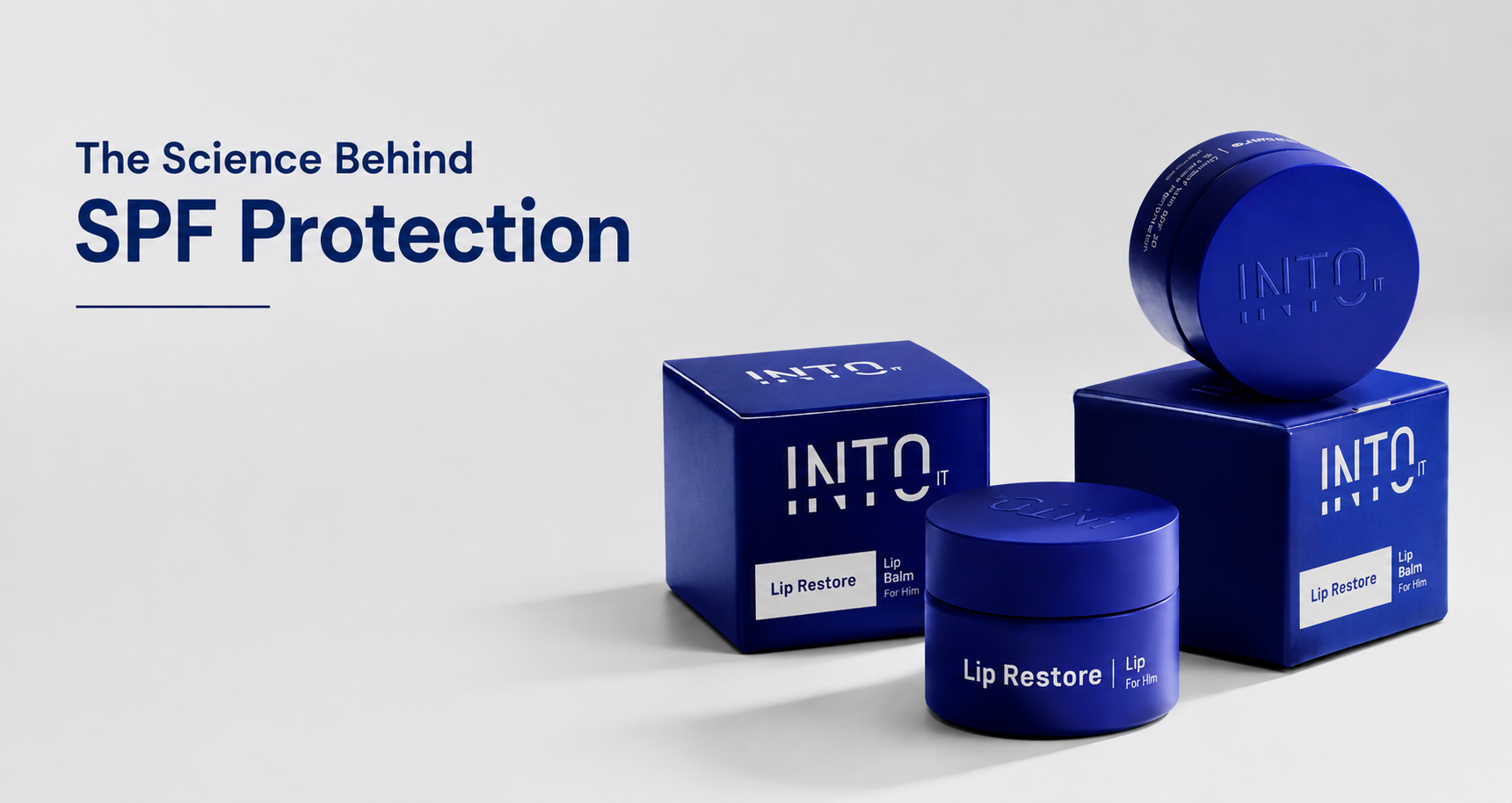
The INTOIT Lip Restore SPF Lip Balm contains three UV filters providing SPF 30 broad-spectrum protection:
- Ethylhexyl Methoxycinnamate - A UVB filter widely used in dermatologically approved sunscreen formulations
- Ethylhexyl Salicylate - A secondary UVB filter that complements primary UVB protection
- Bis-Ethylhexyloxyphenol Methoxyphenyl Triazine - A broad-spectrum filter covering both UVA and UVB, addressing the full spectrum of UV-driven lip damage
Lips have virtually no melanin and no oil glands, making them anatomically the most UV-unprotected area of the face. The Cureus PMC research confirms that darker skin has a natural SPF of approximately 13.4 at the cellular level. But this natural protection comes from melanin in skin cells. Lip tissue has almost none of this melanin, meaning lip skin is effectively unprotected from UV regardless of overall skin tone.
The three UV filters in the Lip Restore formula provide the broad-spectrum coverage that lip tissue specifically needs, alongside Hyaluronic Acid, Squalane, and Ceramide NP for hydration and barrier repair.
The AHA and Sunscreen Connection
This is a practical point specific to the INTOIT Maximalist Moisturizer and any AHA-containing product.
Alpha hydroxy acids, including the Glycolic Acid at 5 percent and Mandelic Acid at 2 percent in the Maximalist Moisturizer, accelerate the shedding of the outermost layer of dead skin cells. This outer layer provides a small amount of natural UV absorption. Removing it more quickly with AHAs temporarily increases the skin's UV sensitivity.
Research from multiple dermatological sources confirms that AHAs increase photosensitivity and that daily sunscreen use is essential when using any AHA-containing product. This is not optional. Using the Maximalist Moisturizer without daily sunscreen means exposing more sensitive skin to the same UV that is simultaneously degrading the collagen the moisturizer's peptide-triggering effect is trying to support.
Apply a broad-spectrum SPF 30 or higher sunscreen with PA++++ rating after the Maximalist Moisturizer absorbs, every morning, without exception.
Addressing the Myths
Dark skin does not need sunscreen
This is the most widespread and most consequential myth for Indian men. The natural SPF from melanin in darker skin is estimated at 13.4. India's UV index regularly reaches 8 to 11, classified as very high to extreme. Dermatologists recommend a minimum of SPF 30 for daily use. The natural protection from darker skin is real but leaves a significant gap that accumulates into real damage over years.
Additionally, the very melanin that provides partial protection makes Indian skin more reactive to UV-triggered melanin overproduction. UV exposure on darker skin produces more intense pigmentation, more persistent dark spots, and more pronounced hyperpigmentation than on lighter skin. SPF is not only about preventing sunburn. For Indian skin, it is primarily about preventing the UV-driven pigmentation and collagen damage that melanin reactivity amplifies.
Sunscreen is only needed outdoors
UVA penetrates glass. Research confirms that UVA intensity is relatively consistent throughout the day and year, unlike UVB. Men who sit near windows at work, commute by car, or spend time in spaces with natural light receive UVA exposure whether or not they are in direct sunlight. The collagen degradation and pigmentation that UVA drives happen regardless of whether sunburn is perceptible.
Sunscreen is only needed in summer
UVA levels in India do not drop significantly in winter, particularly in southern and western regions. Collagen degradation from UVA exposure is a year-round process. Daily sunscreen use is a year-round practice.
A higher SPF number means proportionally better protection
The difference between SPF 30 and SPF 50 is 1 percentage point of UVB filtration (97 percent versus 98 percent). The difference between SPF 15 and SPF 30 is 4 percentage points (93 versus 97 percent). The most significant jump in protection is from no sunscreen to SPF 15, and from SPF 15 to SPF 30. Above SPF 50, the marginal additional protection is minimal and the risk of over-relying on the number rather than reapplying appropriately increases.
Common Questions About SPF Science
Does SPF in a moisturizer or foundation replace a dedicated sunscreen?
In terms of the active UV filter chemistry, SPF in any product works the same way. The practical limitation is application amount. SPF is tested at 2mg per cm squared. Most people apply moisturiser with SPF very lightly, achieving far less protection than the stated SPF. A dedicated sunscreen is more likely to be applied at a protective amount. Using an SPF moisturizer as your only UV protection is better than nothing but typically provides less protection than the stated number suggests.
Can I use the same sunscreen year-round in India?
Yes. SPF 30 with PA++++ is appropriate for Indian UV conditions year-round. If you have periods of higher outdoor exposure such as outdoor work, sport, or travel to high-altitude or coastal areas with higher UV index, SPF 50 with PA++++ is appropriate for those periods.
Does sunscreen expire?
Yes. Most sunscreens have a shelf life of two to three years. After this point, the UV filter molecules may degrade and provide less protection than the label states. Check the expiry date and do not use expired sunscreen for protection in high UV conditions.
Does sunscreen prevent the body from producing Vitamin D?
Sunscreen does reduce UV-driven Vitamin D synthesis in skin. However, research confirms that typical daily sunscreen use does not eliminate Vitamin D production entirely because people rarely apply sunscreen perfectly to all exposed skin and do not reapply with perfect regularity. Dietary sources and supplements are more reliable ways to maintain Vitamin D levels than intentional UV exposure, which carries the documented costs to skin health described throughout this guide.
How does UV damage compound over time?
Each day's unprotected UV exposure adds incrementally to the total accumulated damage. Collagen degraded by one day's UVA exposure does not regenerate before the next day's exposure adds more. Melanin overproduction triggered by one day's UV adds to the deposits created the day before. DNA damage that is not fully repaired overnight accumulates across years. The compounding nature of UV damage is why a 40-year-old who has never used sunscreen in India has a very different skin outcome than one who has used it daily since their twenties, even if neither experienced significant sunburn.
Final Word
SPF is not a cosmetic preference. It is the primary topical intervention against the most significant driver of premature skin ageing and the most preventable source of skin DNA damage.
UV radiation damages skin through three parallel pathways: MMP-driven collagen degradation, direct DNA damage, and free radical oxidative stress. All three pathways operate every day with every unprotected UV exposure, regardless of whether the dose is sufficient to cause visible redness.
For Indian men, the natural SPF from melanin provides partial but insufficient protection against UV index levels that are among the highest in the world for most of the year. SPF 30 with PA++++ broad-spectrum coverage is the daily minimum that bridges this gap.
The INTOIT Lip Restore SPF Lip Balm provides SPF 30 broad-spectrum protection for the most UV-unprotected area of the face. For the rest of the face and body, choosing a separate dedicated sunscreen appropriate for your skin type and applying it correctly as the final step of your morning routine is the single most impactful skin health decision you can make.
Everything else in a skincare routine repairs. Sunscreen prevents. Prevention is always more effective than repair.
Try the INTOIT Lip Restore SPF Lip Balm here.