
How Serums Penetrate the Skin
The claim that a serum works "deeper than a moisturizer" appears on almost every serum in the skincare market. Most men using serums have a vague sense that this is true without knowing the specific mechanism behind it.
The answer is molecular physics. There is a specific, documented rule governing which molecules can and cannot penetrate the outermost layer of the skin. It determines whether an ingredient reaches the skin cells where it can produce change, or sits on the surface performing a different and more limited function. Understanding this is what separates choosing a serum intelligently from choosing one based on marketing language.
The Skin Barrier as a Size Selector
The stratum corneum, the outermost layer of the skin that functions as its primary protective barrier, does not block all molecules equally. Its selectivity is primarily based on molecular size.
Research published in the journal Contact Dermatitis in 2000 by dermatologists Bos and Meinardi, which became the foundational reference for skin penetration science, established what is now widely known as the 500 Dalton rule. A Dalton is the standard unit of molecular weight. The research demonstrated that molecules above 500 Daltons in molecular weight show a rapid decline in skin absorption effectiveness, with virtually all effective percutaneous compounds being under this threshold.
The argument for the rule is elegant in its evidence. Virtually all known contact allergens, substances that trigger immune responses by penetrating the skin, are under 500 Daltons. No substances above 500 Daltons are known as contact sensitisers, because they cannot penetrate to the immune cells in the skin that would trigger the response. The same size gate that limits allergenic penetration also limits skincare ingredient penetration.
For pharmaceutical development, the rule establishes a practical principle: developing new topical drugs targeting dermal or transdermal delivery should focus on compounds under 500 Daltons, because larger molecules cannot effectively penetrate through the corneal layer.
The Three Penetration Pathways
Drug molecules and skincare actives traverse the skin barrier through three potential pathways, each with different size constraints.
The Intercellular Route
The primary pathway for most effective skincare actives is through the lipid matrix between corneocytes, the dead skin cells that form the outer barrier. This requires molecules to be both small enough to fit through the lipid bilayer gaps and to have appropriate solubility characteristics for the lipid-rich environment. This route explains why the 500 Dalton rule applies most strictly: the intercellular lipid matrix is the tightest physical gate in the skin barrier.
The Transcellular Route
Molecules can also pass through the corneocytes themselves, crossing the cell membrane and exiting the other side. This route is less efficient than the intercellular route for most cosmetic actives but contributes to total penetration for small, appropriately soluble molecules.
The Appendageal Route
Hair follicles and sweat glands provide channels that extend into the dermis without requiring passage through the stratum corneum's lipid matrix. For molecules larger than 500 Daltons, this appendageal route provides the primary pathway for any skin penetration that occurs. Research from Les Nouvelles Esthétiques confirms that approximately 80 percent of skincare passes through the stratum corneum by the intercellular or transcellular routes, while 20 percent penetrates through follicles.
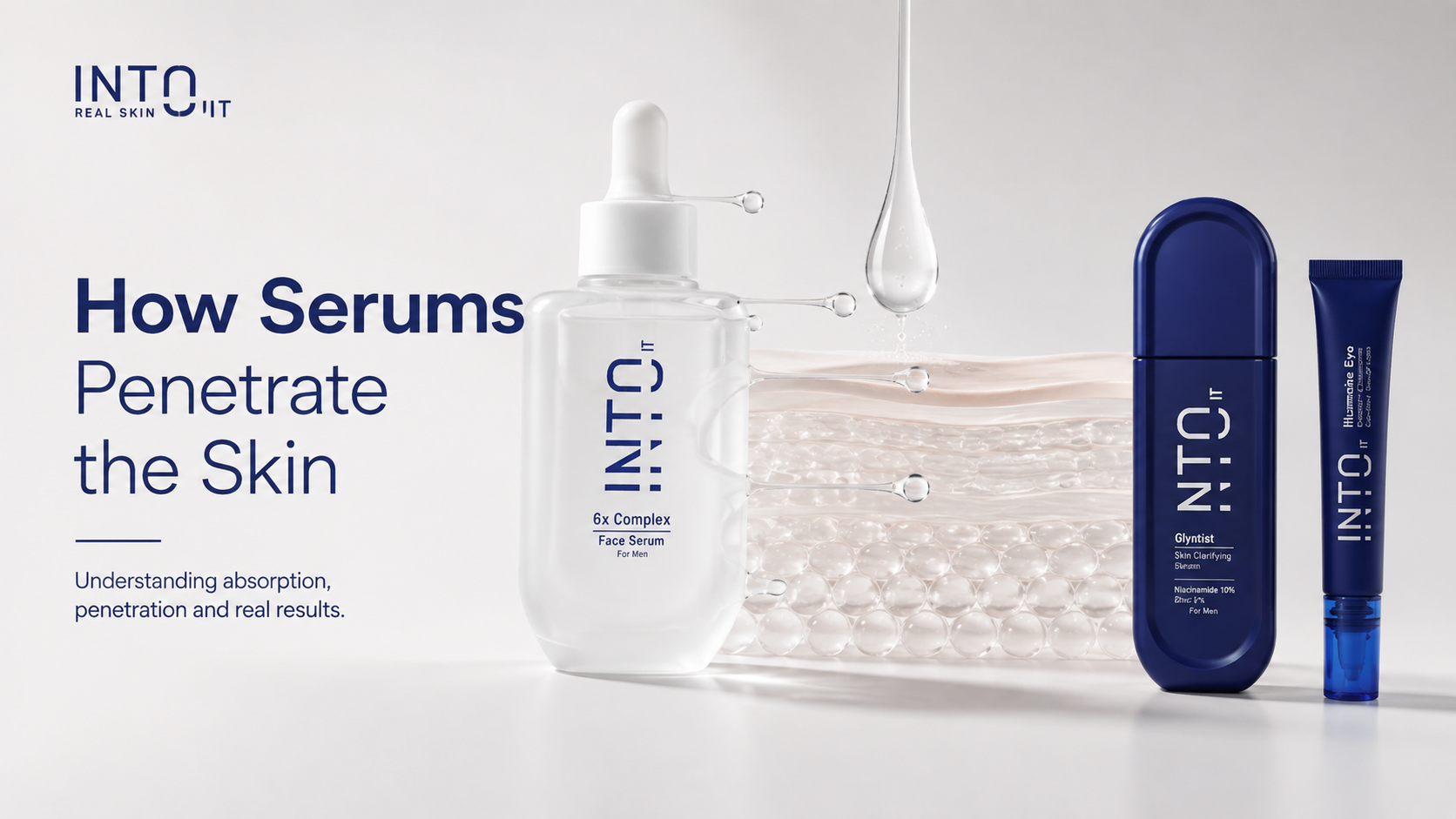
For the active ingredients in the INTOIT 6x Complex Face Serum, including Niacinamide, peptides, and caffeine, the intercellular route is the primary pathway for reaching the target cells in the epidermis and upper dermis.
Why Serum Formulation Determines Penetration
Molecular size determines whether penetration is possible. Formulation determines how effectively possible penetration is realised.
The key formulation variables are viscosity, base composition, and active ingredient concentration.
Viscosity: A serum's low-viscosity, water-based, thin liquid base has minimal surface tension resistance on the skin. It spreads easily, contacts the stratum corneum surface uniformly, and allows its molecular components to begin the diffusion process across the concentration gradient immediately. A moisturizer's heavier, emollient-rich base has higher viscosity, spreads into a thicker film, and is designed to form an occlusive layer rather than to facilitate penetration.
Base composition: Water-based serums carry water-soluble active ingredients (including Niacinamide, glycerin, and water-soluble peptides) in a vehicle compatible with the aqueous fraction of the skin surface. The slightly damp skin surface after cleansing further facilitates this compatibility. Research confirms that approximately 2 to 5 percent of skincare ingredients applied to the skin actually penetrates past the stratum corneum. Serum formulations, designed specifically for penetration, perform at the higher end of this range. Poorly formulated serums, or actives in incompatible vehicles, perform at the lower end or below it.
Concentration gradient: Diffusion across the stratum corneum follows a concentration gradient: molecules move from higher concentration outside the skin to lower concentration inside. A concentrated serum creates a steeper gradient, which drives more efficient diffusion of active molecules. Research from Les Nouvelles Esthétiques confirms that the more dense the serum's active concentration, the better the penetration rate, due to the osmosis principles governing diffusion across concentration gradients.
Why Different Ingredients in the Same Serum Penetrate Differently
This is a nuance that is important for understanding what the 6x Complex Face Serum is actually doing at the molecular level.
Not every ingredient in a serum penetrates to the same depth. The molecular weight and chemical properties of each individual active determine its behaviour independently of the others in the formula.
Niacinamide: Molecular weight approximately 122 Daltons. Well under the 500 Dalton threshold. Penetrates efficiently through both the intercellular route and the transcellular route. Reaches the epidermis and upper dermis where it can interact with melanocytes, sebocytes, and keratinocytes. This is why niacinamide at clinically meaningful concentrations in a serum produces more significant effects on sebum regulation and melanin transfer inhibition than the same concentration in a moisturizer.
Caffeine: Molecular weight 194 Daltons. Well under the threshold. Penetrates efficiently. Reaches the skin cells where it can exert antioxidant activity and the blood vessels in the dermis where it has vasoconstrictive effect relevant to dark circle reduction.
Palmitoyl Tripeptide-1 (at 11% of the serum formula): The palmitoylated version of a tripeptide. The palmitoyl chain (a fatty acid attached to the peptide) is a deliberate formulation strategy to improve penetration. Many peptides exceed the 500 Dalton threshold in their basic form. The palmitoyl modification improves the lipophilicity of the peptide, making it more compatible with the lipid-rich intercellular matrix of the stratum corneum and improving its penetration through this route. Signal peptides typically penetrate primarily through the follicular route rather than the transcellular route, reaching fibroblasts in the dermis via the follicular channel.
Oligopeptide-68: A signal peptide for brightening delivered similarly through the appendageal and intercellular routes, reaching melanocytes in the base of the epidermis to reduce melanin synthesis.
Black Pepper Oil (Piper Nigrum): Functions as a penetration enhancer for the other actives in the formula, improving the efficiency with which they cross the stratum corneum. Penetration enhancers are a standard formulation technique that temporarily modifies the barrier properties of the stratum corneum to allow improved diffusion of co-formulated actives.
What This Means for How You Apply Serum
The penetration science directly informs the application technique that produces the best results.
Apply to slightly damp skin: The aqueous surface of slightly damp skin improves the solubility and spread of water-based serum ingredients. Research on application to damp skin for humectant ingredients like Glycerin and other water-soluble actives in the serum confirms that residual surface moisture improves even distribution and reduces the resistance at the skin surface. Dry skin has a slightly higher surface tension that can impede even spreading of thin formulas.
Apply before moisturizer, never after: This is the most consequential practical implication of the penetration science. A moisturizer's heavier occlusive base, when applied first, creates a surface film that physically blocks serum molecules from accessing the stratum corneum. The serum cannot diffuse through the moisturizer layer to reach the skin. It sits on the moisturizer surface and is eventually wiped off without penetrating.
Serum applied first reaches clean stratum corneum directly. The moisturizer applied afterward seals the penetrating actives in, preventing them from being removed before absorption is complete, and provides its own surface-level treatment on top.
Press, do not rub: Rubbing creates friction that partially removes the serum from the skin before it can penetrate. Pressing gently with the fingertips over each area of the face allows the serum to remain in contact with the skin surface long enough for diffusion to begin. Two to three drops for the full face is sufficient. More product does not increase penetration rate because diffusion is driven by concentration gradient, not by physical volume.
Wait 30 to 60 seconds before the next step: Diffusion is not instantaneous. The 30 to 60 second window allows the serum molecules to begin their penetration pathway before the moisturizer is applied over them. Applying moisturizer too quickly reduces the window available for this initial penetration.
Why Moisturizers Cannot Replace Serums Despite Active Ingredients
This is the practical implication that most directly addresses the "do I really need a serum" question.
A moisturizer can contain many of the same active ingredients as a serum. Niacinamide in a moisturizer is the same molecule as niacinamide in a serum. So why does the serum deliver more significant effects?
The formulation difference changes the delivery depth. The moisturizer's heavier base is not optimised for penetration. It is optimised for surface film formation. The same active ingredient in this base is delivered primarily to the stratum corneum surface and very near surface rather than to the cells in the epidermis and dermis where the biological effects occur.
From an industry analysis perspective: approximately 2 to 5 percent of ingredients applied to the skin penetrate past the stratum corneum. A well-formulated serum is engineered to be at the upper end of this range for its active ingredients. A moisturizer's penetration for the same active is lower because the vehicle is not designed for this purpose.
The INTOIT formulation strategy reflects this directly. The Niacinamide, peptides, and brightening actives that require dermis-level delivery are in the INTOIT 6x Complex Face Serum. The AHAs, brightening actives, and ceramides that work at and near the skin surface are in the INTOIT Maximalist Moisturizer. Each product is designed around where its active ingredients actually need to be delivered.
The Formulation Transparency Point
This brings a practical point to the surface: if penetration depends on molecular size, base formulation, and active concentration, then the marketing claim that a serum contains an ingredient is not sufficient to evaluate whether that ingredient will reach its target.
The questions that matter are:
-
Is the active ingredient below 500 Daltons in its native form, or does it use a penetration-enhancing modification?
-
Is the formulation base designed for penetration or for surface film formation?
-
Is the concentration disclosed? A trace amount of an active cannot produce a meaningful concentration gradient for diffusion.
The INTOIT 6x Complex Face Serum discloses the concentrations of its primary actives. Palmitoyl Tripeptide-1 at 11 percent. Oligopeptide-68 at 68.5 percent of the peptide complex. Niacinamide at 2 percent. Caffeine at 0.5 percent. These are not estimated ranges or label-level disclosures without quantities. They are specific concentrations that reflect confidence in the formulation's ability to deliver them to where they need to go.
Common Questions About Serum Penetration
If only 2 to 5 percent of skincare penetrates, is a serum worth using?
Yes. The percentage refers to the proportion of applied ingredient that penetrates, not to whether the penetrated amount is biologically meaningful. A 2 percent penetration of a serum with Niacinamide at 2 percent concentration still delivers a meaningful dose to the target cells in the epidermis. The biological effects documented in clinical studies are achieved at these penetration rates. The comparison that matters is serum penetration rate versus moisturizer penetration rate for the same active, not serum penetration versus some theoretical 100 percent benchmark.
Does massaging a serum in help it penetrate better?
Gentle pressing is more effective than massaging. Massage creates friction that can remove product from the skin surface before penetration begins and can cause physical disruption to the serum film. The absorption process is driven by diffusion, which is a chemical process rather than a mechanical one. Gently pressing the serum into contact with the skin surface maximises contact area and gives the diffusion process a chance to begin. Vigorous rubbing is counterproductive.
Can the 500 Dalton rule be overcome?
Yes, but typically through approaches used in pharmaceutical rather than cosmetic contexts: microneedles, electroporation, and phonopheresis can create temporary channels or disruptions in the stratum corneum that allow larger molecules to penetrate. In cosmetic skincare, the primary strategies are palmitoylation of peptides (as with Palmitoyl Tripeptide-1) and encapsulation technology, which packages larger molecules in carriers that can penetrate and release the active inside the skin. The 6x Complex Face Serum uses palmitoylation as the strategy for its peptide actives.
Does the penetration process change with age?
Research suggests that aging affects stratum corneum function and may alter penetration rates somewhat, but the 500 Dalton size constraint remains the primary governing factor across age groups. What changes more significantly with age is the rate of cell turnover in the epidermis, which affects how quickly new, less-pigmented, and structurally healthier cells replace damaged ones at the surface, which is why the consistent use of actives over longer periods becomes more important rather than less as the skin's renewal rate slows.
Does skin type affect how well serum ingredients penetrate?
Somewhat. Thicker male skin means the penetration depth required to reach target cells is slightly greater, which is why formulations designed for thicker skin, using optimised delivery vehicles like a lightweight serum base, matter more for men than for women on average. Oilier skin can have a slightly different surface environment that affects early diffusion, but the fundamental penetration rules apply across skin types. Application technique, formulation quality, and active concentration remain the primary determinants of how effectively a serum delivers its active ingredients.
Final Word
The science of how serums penetrate the skin comes down to three factors: molecular weight determining whether penetration through the stratum corneum is possible, formulation base determining how efficiently that possible penetration is realised, and active concentration driving the diffusion gradient that moves molecules from the product into the skin.
Serums work differently from moisturizers not because they are more expensive or more elegantly packaged, but because they are engineered specifically around these three factors. A lightweight, water-based, high-concentration formulation in a serum carries active ingredients past the stratum corneum and to the cells where their biological effects occur. A moisturizer's heavier occlusive base does the opposite: it stays on the surface, where its barrier-sealing and surface-treatment functions belong.
Understanding this makes the routine sequence non-negotiable rather than arbitrary. Serum first, on clean damp skin, allowed to begin penetrating. Moisturizer second, to seal the penetrating actives in and add its own surface-level treatment. That sequence reflects the physics, and the physics determines the result.
Find the INTOIT 6x Complex Face Serum here.