
Enlarged Pores: Causes and Treatments
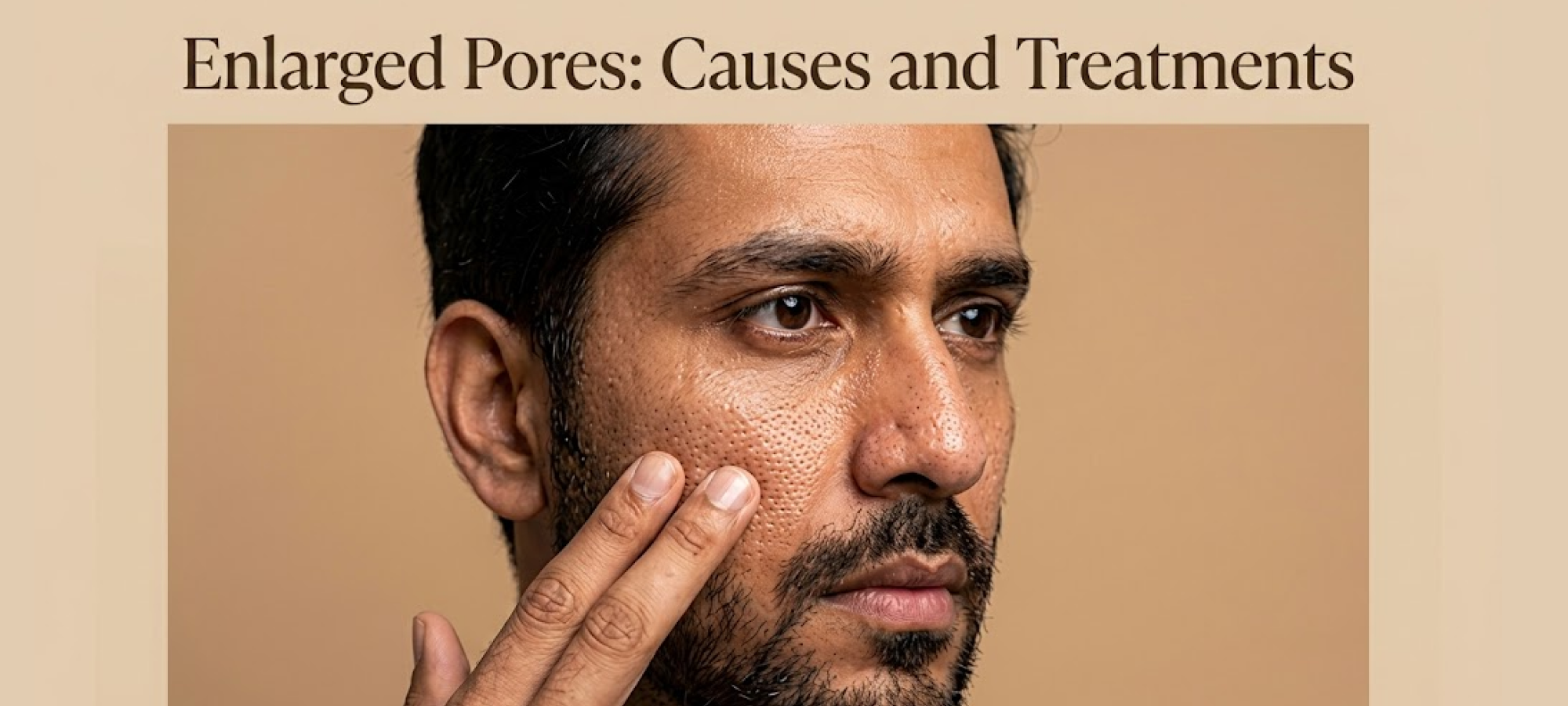
Enlarged pores are one of the most common skin concerns for Indian men. They are particularly visible in the T-zone, the forehead, nose, and chin, and they contribute to a skin texture that looks rough, uneven, and congested rather than clear and smooth.
Most men either ignore them, try to strip them with harsh products that make the problem worse, or reach for quick-fix products that do not address the actual cause. This guide takes a different approach. It explains the verified biology behind why pores enlarge, why Indian men are disproportionately affected, what topical treatment can and cannot do, and which ingredients the evidence actually supports.
What Pores Are and Why They Matter
A pore is the opening of a pilosebaceous unit, which consists of a hair follicle and its associated sebaceous gland. The pore is the channel through which both the hair shaft and sebum exit onto the skin surface. Every pore on your face is a functional part of the skin's anatomy, not an imperfection. The problem is not the pore itself. It is when the opening stretches and becomes visibly larger.
Research published in the Journal of Cosmetic Dermatology through Wiley Online Library confirms that skin pores are enlarged openings of the pilosebaceous follicles that can be affected by age, gender, genetics, exposure to UV light, ethnicity, and sebum secretion. This list of contributing factors is important because it tells you that enlarged pores are not caused by a single thing, and therefore cannot be fully addressed by a single intervention.
The Four Main Causes of Enlarged Pores
Cause 1 - Excess Sebum Production
This is the most directly relevant factor for men, and the most evidence-supported one.
A prospective, randomised controlled study published in PubMed, with 60 volunteers equally divided between male and female participants, found using multiple linear regression analysis that increased pore size was significantly associated with increased sebum output level, sex, and age. Among these variables, sebum output level correlated most strongly with pore size, followed by male sex.
The mechanism is mechanical. When sebaceous glands are highly active, the follicular canal fills continuously with excess oil. This ongoing pressure from excess sebum stretches the pore lining over time, making the opening physically wider and more visible on the skin surface. The more sebum produced, the more consistent the internal pressure, and the more the pore wall is stretched.
In men, this is driven primarily by testosterone and its conversion to dihydrotestosterone, which directly stimulates androgen receptors in sebaceous glands. As confirmed in previous research, men produce approximately twice as much sebum as women. The direct relationship between sebum output and pore size has been well established in dermatological literature, particularly in men who generally have higher sebum output levels than women due to testosterone-driven sebaceous activity.
For Indian men, this baseline is amplified by heat, humidity, and stress, all of which further stimulate sebaceous activity and increase the sustained pressure on pore walls throughout the day.
Cause 2 - Genetics and Skin Type
Skin type, including pore size, is genetically determined. Men with oily skin have larger sebaceous glands and more sebaceous activity, which directly correlates with larger pore size. This is established across dermatological sources. You cannot change genetic pore size any more than you can change skin colour. What topical treatment can do is manage the factors that make genetic pore size worse and reduce the visibility of pores through surface clarity and sebum management.
This is an important truth to establish early. No topical product can permanently shrink pores below their genetic baseline. What consistently effective treatment can do is prevent pores from stretching further, keep them clear of the sebum and dead cell congestion that makes them appear larger, and improve the surrounding skin clarity that reduces their visibility by contrast.
Cause 3 - Collagen Loss and Reduced Skin Elasticity With Age
Pores are supported structurally by the collagen and elastin fibres surrounding them in the dermis. When this structural support degrades, the pore walls lose the tension that keeps them taut and contracted around the opening. With reduced collagen and elastin, pores sag slightly open and appear visibly larger even without any change in sebum production.
A review of enlarged pore treatments published in MDedge (Cutis) confirms that loss of skin elasticity and tension is one of the most clinically relevant factors in enlarged pore pathogenesis. With increased age, facial pores expand in total area and number, particularly on the nose and medial aspect of the cheeks.
This collagen-driven enlargement is why men who had visibly controlled pore size in their twenties often see pores become more prominent in their thirties and forties even without significant changes in skincare habits. The structural support is diminishing independently of the sebum factor.
Cause 4 - UV Exposure and Photodamage
Chronic UV exposure is both an independent and a compounding cause of enlarged pores. UV radiation degrades collagen and elastin through MMP upregulation, which directly reduces the structural support around pore walls as described above. It also thickens the outer layer of the skin, the stratum corneum, through a process called UV-induced hyperkeratinisation. This thickening creates more dead skin cell accumulation around pore openings, making them appear wider.
The Journal of Cosmetic Dermatology review confirms that chronic UV light exposure is among the factors that affect enlarged pores. For Indian men exposed to very high to extreme UV index levels for most of the year, this mechanism operates daily, compounding over months into visible structural changes that worsen pore appearance independent of sebum production alone.
Why Indian Men Are Particularly Affected
The four causes described above all operate at elevated levels in Indian men compared to most populations.
Higher testosterone-driven sebum production creates consistently greater internal pore pressure. Indian heat and humidity amplify this further during most of the year. India's extreme UV index accelerates the collagen degradation that removes structural pore wall support. And pollution-driven free radical activity adds oxidative stress that further degrades barrier function and skin structural proteins.
A man in his early thirties in an Indian city is subject to all four enlarged pore drivers simultaneously and at above-average intensity. This is why enlarged pores are so prevalent among Indian men and why basic cleansing approaches that address only the surface oil are insufficient on their own.
What Topical Treatment Can and Cannot Do
Being accurate about this protects you from wasting time and money on approaches that cannot deliver what they promise.
What topical skincare can meaningfully do:
- Reduce sebum production rate over weeks of consistent use through ingredients like Niacinamide
- Remove excess sebum and dead cell congestion from pores through clay-based cleansing and AHAs, making pores appear smaller by keeping them clear
- Support collagen synthesis through signal peptides, which maintains the structural support around pore walls and slows age-driven pore enlargement
- Improve overall skin surface clarity and smoothness, which reduces the visual contrast that makes pores appear larger
What topical skincare cannot do:
- Permanently shrink pores below their genetic baseline
- Reverse significant collagen loss that has already caused structural pore wall sagging
- Completely eliminate the appearance of pores in skin with genetically high sebum production
For men whose enlarged pores are primarily driven by active sebum overproduction, consistent topical treatment with the right ingredients produces visible and sustained improvement. For men with significant age-related collagen loss contributing to pore enlargement, topical treatment slows further enlargement and partially improves appearance but more advanced cases benefit from professional dermatological procedures alongside topical care.
The Ingredients That Work
Niacinamide for Sebum Regulation and Pore Refinement
Niacinamide is the most clinically supported topical ingredient for pore appearance improvement through two complementary mechanisms.
First, it reduces sebum production. A double-blind, placebo-controlled study confirmed that topical 2 percent niacinamide significantly reduces sebum excretion rates after two and four weeks of consistent use. Reduced sebum means reduced internal pressure on pore walls, which prevents further stretching and allows pore appearance to improve as the congestion clears.
Second, Niacinamide strengthens the skin barrier and improves surface clarity. A clearer, more even skin surface makes pores less visually prominent even before any change in pore size itself. The skin around the pore looks healthier and more refined, which reduces how prominently the pore stands out by contrast.
The INTOIT 6x Complex Face Serum contains Niacinamide at 2 percent, the concentration validated by published research. Applied twice daily, it produces progressive sebum reduction and surface refinement that compounds over weeks of consistent use.
Clay for Pore-Level Sebum Adsorption
Surface-level cleansers remove the oil and debris sitting on the skin surface. Clay cleansers go further. Clay particles carry a negative electrical charge that attracts and binds positively charged sebum and pollution particles from within the follicular canal through a process called adsorption. This draws the sebum and congestion out of the pore itself rather than just rinsing what is on the surface around it.
Removing pore congestion has an immediate visual effect. Pores clogged with sebum and dead cells appear significantly larger than clean, clear pores of the same physical size. Consistent clay-based cleansing keeps pores clear of the buildup that makes them look larger, producing visible improvement in pore appearance without changing the underlying pore structure.
The INTOIT Claytox Cleanser uses:
- Bentonite (3%) - High cation exchange capacity makes it one of the most effective clays for drawing out sebum from within pores
- Kaolin (3%) - A gentler clay that absorbs excess sebum without over-stripping, making the formula well-suited for twice-daily use
- Gluconolactone (2%) - A PHA that gently exfoliates dead skin cells around pore openings, preventing the dead cell buildup that makes pores appear wider
- Chamomile extract and Aloe Vera - Soothe any inflammation, keeping the skin calm and the pore lining from swelling with irritation
- Sodium PCA - Maintains skin comfort and prevents over-drying that would trigger compensatory sebum production
- Use morning and night. Spend 60 seconds working the cleanser into the skin before rinsing, allowing time for the clay adsorption process to draw out pore congestion effectively.
AHAs for Cell Turnover and Pore Opening Clarity
- Dead skin cells that accumulate around and within pore openings contribute to both the visual enlargement of pores and to the congestion that stretches them. Alpha hydroxy acids break the bonds between dead skin cells and accelerate their removal from the skin surface and pore openings, keeping pores clearer and less visually prominent.
- Glycolic acid has been confirmed in multiple clinical studies to improve skin texture and normalise skin tone. By consistently removing the dead cell layer that collects around pores, it prevents the buildup that makes pore openings appear darker, larger, and more irregular.
The INTOIT Maximalist Moisturizer contains:
- Glycolic Acid (5%) - Accelerates cell turnover, removes dead cell accumulation around pores, and provides mild collagen synthesis support in the dermis
- Mandelic Acid (2%) - Complements glycolic acid with gentler exfoliating action and anti-bacterial properties that reduce the Cutibacterium acnes activity associated with congested pores
- Applied consistently morning and night, these AHAs maintain the surface cell turnover that prevents pore congestion from building up, keeping pores looking as refined as possible at their current size.
Peptides for Structural Pore Wall Support
- Because collagen loss is one of the primary age-related drivers of enlarged pores, stimulating collagen synthesis addresses this cause directly. Signal peptides communicate with fibroblasts in the dermis to upregulate collagen and elastin production, maintaining the structural tension around pore walls that keeps them taut and less visually open.
- The 6x Complex Face Serum contains:
- Palmitoyl Tripeptide-1 (11%) - A signal peptide that stimulates fibroblast activity and collagen production, supporting the structural collagen network surrounding pore walls
-
Palmitoyl Tripeptide-38 - Stimulates synthesis of both collagen and hyaluronic acid, addressing both structural support and moisture retention in the dermis
- For men in their thirties and beyond, where collagen-driven pore wall loosening is increasingly contributing to enlarged pore appearance, consistent peptide use is the only topical approach that addresses this specific cause. Applied at night when fibroblast activity peaks during sleep, these peptides work in alignment with the skin's own repair cycle.
Brightening Actives for Surface Clarity
- Enlarged pores are made more visually prominent by the uneven skin tone and pigmentation around them. Post-inflammatory hyperpigmentation around congested pores, UV-induced dark spots, and general uneven tone create a high-contrast background that makes pores stand out more prominently than they would on an even, clear skin surface.
- The Maximalist Moisturizer contains Alpha Arbutin at 2 percent, Glutathione at 2 percent, and Kojic Acid at 1 percent, three brightening actives targeting melanin overproduction from different points in the synthesis pathway. Improved skin tone uniformity reduces the visual contrast around pore openings, making pores less prominent even before any change in their physical size.
The Routine for Enlarged Pore Management
- This routine addresses all three treatable causes of enlarged pores simultaneously: excess sebum driving internal pore pressure, dead cell congestion making pores appear larger, and collagen loss reducing structural pore wall support.
Morning
- Start with the INTOIT Claytox Cleanser. Work it into the T-zone for 60 seconds to allow clay adsorption to draw out overnight sebum accumulation. Rinse thoroughly and leave skin slightly damp.
- Apply the INTOIT 6x Complex Face Serum immediately. Niacinamide at 2 percent begins its sebum-regulating work through the day. The collagen peptides start their structural support signalling. Two to three drops for the full face, pressed in gently.
- Apply the INTOIT Maximalist Moisturizer as the final step. The ceramide complex repairs the barrier and reduces the TEWL that triggers compensatory sebum overproduction. The AHAs and brightening actives improve surface clarity around pore openings throughout the day.
- Apply sunscreen. Non-negotiable. UV exposure accelerates both the collagen loss and the UV hyperkeratinisation that worsen pore appearance. AHAs increase UV sensitivity. Daily broad-spectrum SPF 30 minimum is required.
Night
- Cleanse again with the Claytox Cleanser. Night cleansing is more important than morning cleansing for pore management because it removes the full day's accumulation of sebum, pollution, and dead cell deposits from pores before the skin's repair cycle begins. Skipping this step means pores are congested during the peak repair window.
- Apply the 6x Complex Face Serum. At night, the collagen peptides work in alignment with peak fibroblast activity during sleep. Niacinamide continues its barrier and sebum regulation work.
- Apply the Maximalist Moisturizer. The AHAs perform their deepest cell turnover work overnight with no UV to interrupt. The ceramides seal the barrier. The brightening actives reduce the pigmentation contrast around pore openings.
Habits That Make Enlarged Pores Worse
- Understanding what aggravates pore appearance is as important as knowing what improves it.
- Over-cleansing: Washing the face more than twice daily strips the skin's natural oils, triggering compensatory sebum overproduction that increases the internal pressure that stretches pores. Twice daily with the right cleanser is the evidence-based frequency.
- Using pore strips: Pore strips physically pull sebum plugs from pores with adhesive. They remove what is visible immediately but do not address sebum production rate. The pore refills quickly. Repeated use can stretch pore walls further through the mechanical pulling action and cause irritation that worsens sebum production.
- Touching the face: Hands transfer bacteria and debris to pore openings, contributing to the congestion that makes pores appear larger. Men who touch their face frequently throughout the day consistently have worse congestion than those who do not.
- Skipping moisturizer to control oiliness: This worsens the dehydration-driven compensatory sebum overproduction that increases pore wall pressure. Using a lightweight, appropriate moisturizer is part of the solution, not the cause.
- Not removing makeup or sunscreen: For men who use tinted products or sunscreens that are not fully rinse-off, incomplete removal at night leaves pore-blocking residue. The Claytox Cleanser removes these effectively with the standard routine.
Common Questions About Enlarged Pores
Can pores actually be shrunk permanently?
No. Pore size is primarily determined by genetics and the size of the sebaceous gland it serves. No topical product can permanently shrink pores below their genetic baseline. What consistent topical treatment achieves is preventing pores from stretching further, keeping them clear of congestion that makes them appear larger, and improving the surrounding skin quality that affects how prominently they are visible. This produces real, visible improvement in pore appearance without changing the underlying anatomy permanently.
Why are my pores largest on my nose?
The nose is part of the T-zone where sebaceous gland density and androgen receptor expression are highest. More active sebaceous glands produce more sebum, which creates more internal pore pressure and physical pore enlargement. The nose also receives significant UV exposure due to its prominent facial position, which adds UV-driven collagen degradation to the sebum pressure factor. This combination makes the nose consistently the most prominent area for enlarged pores in men.
Do pores open and close with hot and cold water?
No. Pores do not have muscles and cannot open or close in response to temperature. Hot water causes the skin to look flushed and slightly swollen, which can temporarily make pores look less visible. Cold water causes vasoconstriction that temporarily tightens the skin surface. Neither changes the actual pore size. The advice to use cold water to close pores and hot water to open them is anatomically incorrect. Lukewarm water for cleansing is the evidence-based recommendation, as it avoids the sebaceous stimulation that hot water causes without the vascular shock of cold.
How long before I see improvement in pore appearance?
Clearing pore congestion through clay cleansing produces a visible improvement in pore appearance within the first one to two weeks as the accumulated sebum and dead cell buildup is consistently removed. Sebum production reduction from Niacinamide produces measurable improvement within two to four weeks. Surface texture improvement from AHAs typically shows clearly within three to four weeks of consistent use. Collagen support from peptides produces the slowest visible change, usually requiring eight to twelve weeks before structural improvement in pore wall support is noticeable.
Is there any point in treating enlarged pores if they are genetic?
Yes. Genetics determines the baseline pore size and the baseline sebum production rate. What topical treatment does is prevent the multiple aggravating factors, sebum overproduction, congestion, collagen loss, UV damage, from making genetically determined pores visibly worse. Men with genetically larger pores who do not treat them will have noticeably more prominent pores over time than men with the same genetics who manage them consistently. The genetic baseline does not dictate the outcome. It sets the starting point. Everything else is manageable.
What if nothing topical seems to be working?
If a consistent, well-formulated topical routine maintained for at least three months has not produced visible improvement, the cause of the enlarged pores may be primarily the structural collagen loss component rather than the sebum component. In this case, professional dermatological treatments including chemical peels, laser therapies, radiofrequency, or microneedling address the structural cause more effectively than topical products alone. A dermatologist can assess which component of enlarged pore pathogenesis is dominant for your specific presentation and recommend the appropriate intervention.
Final Word
Enlarged pores in Indian men are driven by a combination of testosterone-amplified sebum overproduction, genetic predisposition, progressive collagen loss with age, and daily UV and pollution exposure that compounds all of the above.
No topical treatment permanently shrinks pores. But consistent treatment with the right ingredients produces visible, sustained improvement in pore appearance by addressing the three manageable causes: keeping pores clear of sebum congestion through clay cleansing, reducing the rate of sebum production through Niacinamide, and maintaining the collagen structural support around pore walls through signal peptides.
The results compound over weeks and months of consistent use. Pores that were visibly congested and enlarged by accumulated sebum pressure look noticeably more refined when that pressure is consistently managed and the supporting collagen network is actively maintained.
This is not a quick fix. It is a sustained approach to the sustained problem that enlarged pores represent for most Indian men.