
Dehydrated Skin vs Dry Skin: What Is the Difference?
Your skin feels tight. It looks dull. It might be flaking in places. Or it is oily on the surface but somehow still uncomfortable underneath. You try a moisturizer and it helps temporarily, then the problem comes back. You drink more water. Still the same.
The reason many men cannot fix this problem is that they are treating the wrong thing. Dry skin and dehydrated skin look similar and feel similar. They are not the same. They have different causes, different mechanisms, and different fixes. Using the wrong treatment for the wrong condition will not work, no matter how consistently you apply it.
This guide explains exactly what each condition is, how to tell them apart, what causes each one in the Indian context specifically, and what you need to do to actually fix them.
The Core Difference
Understanding this one distinction is the foundation of everything else.
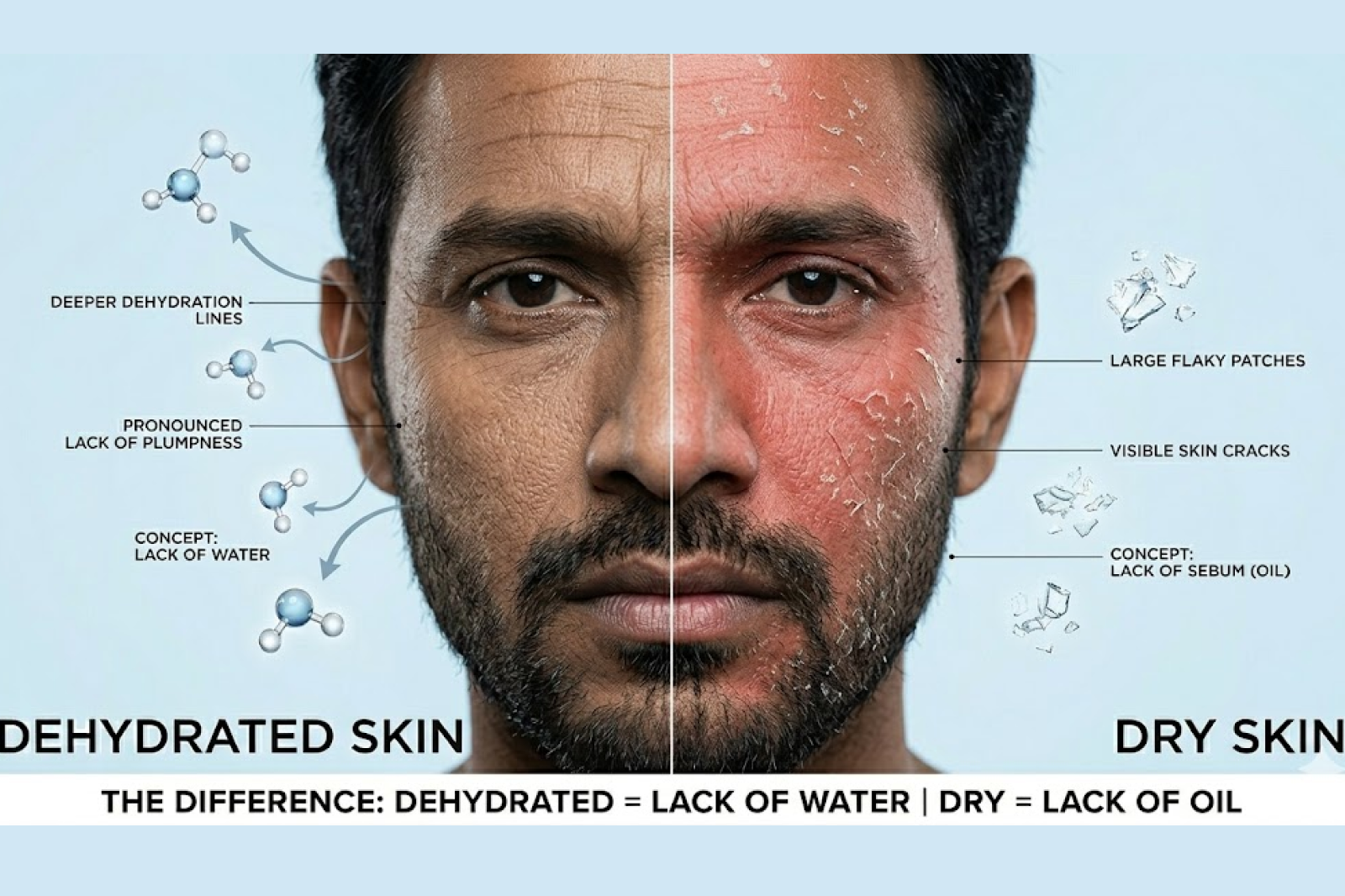
Dry skin is a skin type. It is about oil. People with dry skin have sebaceous glands that produce less sebum than normal. Sebum is the skin's natural oil. It plays a critical role in sealing moisture inside the skin and protecting the surface from environmental damage. When the skin does not produce enough of it, moisture escapes more easily and the barrier becomes compromised. Dry skin is primarily genetic and tends to be a long-term or lifelong condition. It often worsens with age as natural oil production declines further.
Dehydrated skin is a skin condition. It is about water. Dehydrated skin lacks water content in the upper layers of the skin, regardless of how much oil the skin is producing. According to the American Academy of Dermatology, dry skin is associated with reduced sebaceous activity while dehydration stems from external factors that increase water loss without affecting oil content. Crucially, dehydrated skin can happen to any skin type, including oily skin.
This is the fact that surprises most men. You can have oily, shiny, acne-prone skin and be significantly dehydrated at the same time. The oil you see on the surface is sebum. The dehydration is happening in the cells underneath. These are two different things happening in two different layers of the skin.
How Dehydrated Skin and Dry Skin Differ Biologically
To understand why the treatments differ, it helps to understand what is happening in each case at the skin level.
What Happens in Dry Skin
The skin barrier is made of skin cells held together by lipids, fats that include ceramides, cholesterol, and fatty acids. Think of it as bricks held together by mortar. In dry skin, there is not enough mortar. The sebaceous glands are not producing enough oil to maintain the barrier properly.
When the barrier has gaps, two things happen simultaneously. Water escapes through those gaps in a process called transepidermal water loss, or TEWL. And environmental irritants, pollution particles, and bacteria enter more easily through the same gaps.
This is why dry skin is not fixed simply by drinking more water. The problem is structural. The barrier cannot hold the water in, so it escapes regardless of how much is available. What dry skin needs is lipid replacement. Products that contain ceramides, fatty acids, and barrier-building ingredients that restore the mortar holding the skin barrier together.
What Happens in Dehydrated Skin
Dehydrated skin occurs when the skin loses more water than it takes in. The scientific term for this excess water loss is transepidermal water loss, the same process that affects dry skin, but triggered by different causes.
Healthy skin contains approximately 30 percent water in its upper layers. When water content drops below this, the skin loses elasticity, appears dull, and develops fine lines that look more prominent than usual. Light scatters unevenly off a dehydrated skin surface instead of reflecting evenly, which is why dehydrated skin looks flat and tired even when you are rested.
There is an important feedback loop that many men experience without understanding it. When skin is dehydrated, the body's sebaceous glands often produce more oil to compensate. The skin detects that its barrier is not functioning properly and responds by producing more sebum. This results in skin that is oily on the surface and tight or uncomfortable underneath. It is one of the most common and least understood patterns in men's skincare. Washing the face repeatedly to control the oiliness strips even more moisture, worsening the dehydration, which triggers even more oil production.
Causes of Dry Skin
Dry skin causes are primarily internal and long-term.
-
Genetics - The most common cause. Some people are simply born with fewer active sebaceous glands or glands that produce less sebum.
-
Age - Oil production naturally declines with age, particularly from the forties onward. Men who had normal or oily skin in their twenties may develop dry skin in their thirties and forties.
-
Hormonal changes - Shifts in androgen levels affect sebum production over time.
-
Medical conditions - Conditions like eczema and psoriasis directly affect the skin barrier and can cause or worsen dry skin.
-
Harsh cleansers - Bar soap and high-pH face washes strip the lipids from the skin surface repeatedly, mimicking the lipid deficiency of true dry skin.
Causes of Dehydrated Skin in Indian Men
Dehydrated skin has predominantly external causes, which is why it is so common and so fixable. For Indian men specifically, the combination of environmental and lifestyle factors creates an unusually high dehydration load on the skin every day.
The humid-to-AC cycle is one of the most significant. You sweat in the heat outside, which draws moisture from the skin. You walk into air-conditioned spaces where the humidity drops dramatically. This rapid cycle between humid and dry air stresses the skin barrier and accelerates TEWL significantly. Most Indian men experience this multiple times a day.
Hard water is endemic in most Indian cities. Hard water contains high concentrations of minerals including calcium and magnesium. When used to wash the face, it leaves a mineral residue on the skin surface, disrupts pH, and degrades the barrier lipids over time. The result is a consistently weakened barrier that loses water faster.
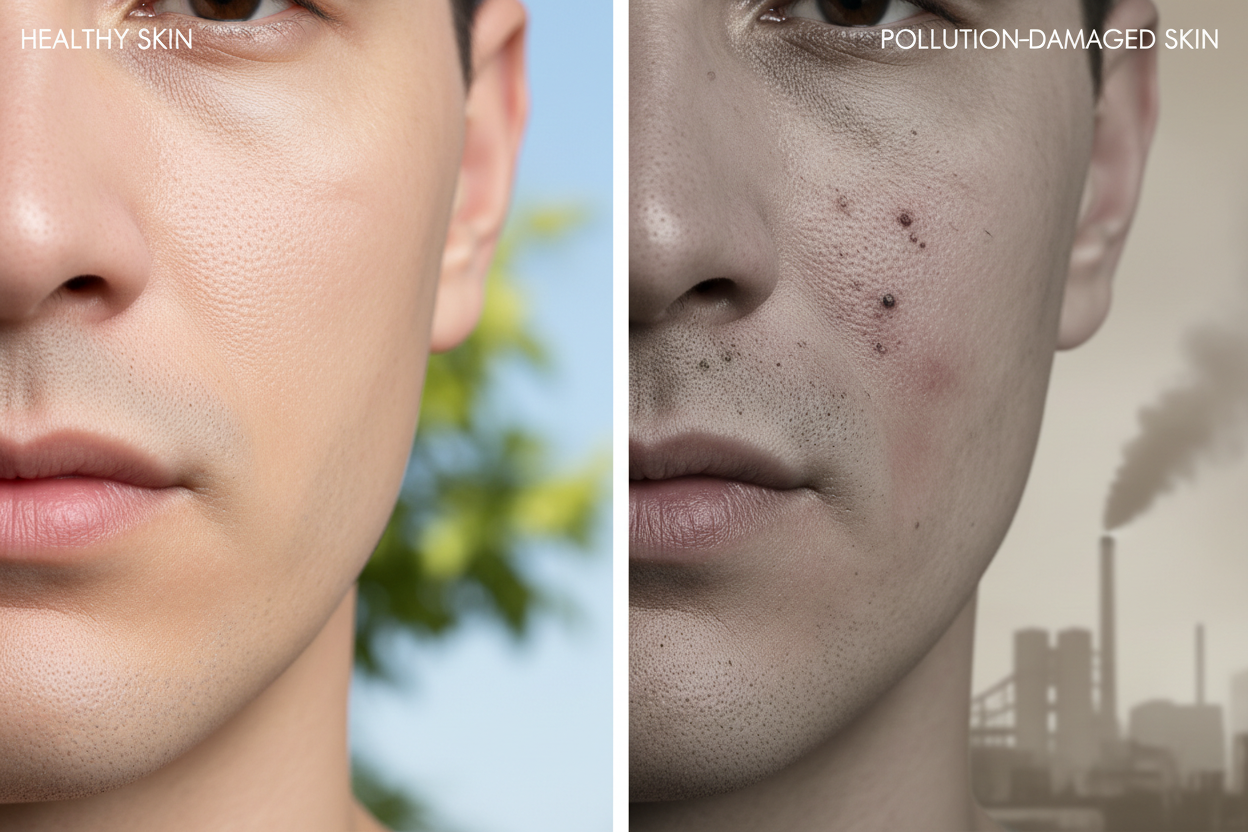
Pollution particles damage the skin barrier and generate free radical activity that compromises barrier function. In Indian cities with high particulate matter, this damage is ongoing and cumulative.
Over-cleansing is extremely common among Indian men with oily skin. Washing the face multiple times a day to control oil strips the acid mantle and barrier lipids repeatedly, directly triggering TEWL and dehydration while paradoxically making oiliness worse.
Inadequate water intake matters but is often overstated as a sole cause. Drinking enough water supports overall skin hydration but cannot compensate for a compromised barrier that is losing water faster than the body can replace it.
Alcohol consumption has a diuretic effect and reduces overall body water content, which shows up visibly in the skin as increased dullness and tightness.
How to Tell If You Have Dry Skin or Dehydrated Skin
These tests and observations are not medical diagnosis but they give reliable guidance in most cases.
The Pinch Test
Gently pinch a small amount of skin on your cheek and hold it for two seconds. Release and observe.
-
If the skin bounces back immediately and shows no lines while pinched, it is reasonably hydrated.
-
If it takes a moment to return to normal, or shows fine lines and wrinkles under the pinch that are not normally visible, your skin is likely dehydrated.
-
If the skin feels papery or rough under the pinch regardless of bounce-back, dry skin is more likely.
The Post-Wash Test
Wash your face with a gentle cleanser and do not apply anything afterward. Wait 30 minutes.
-
If your skin feels tight but returns to normal relatively quickly, especially around the T-zone, dehydration is more likely.
-
If your skin feels rough, tight, and uncomfortable all over for an extended period, dry skin is more likely.
-
If your skin feels tight initially but becomes shiny or oily within 30 to 60 minutes, you almost certainly have oily dehydrated skin, the most common pattern in Indian men.
Symptoms Side by Side
Dry skin signs:
-
Rough, flaky texture that is consistent regardless of the season
-
Tight, uncomfortable feeling even after moisturising
-
Tendency to crack in very dry or cold conditions
-
Little to no oiliness even by midday
-
Often present from a young age
Dehydrated skin signs:
-
Tight, dull feeling that fluctuates with environment and lifestyle
-
Fine lines that look more prominent when the face is not well hydrated
-
Skin that is oily on the surface but tight underneath
-
Dullness and flatness that does not improve with sleep
-
Worsens in air-conditioned environments
-
Can occur suddenly due to environmental changes, travel, or new skincare products
Important overlap: Both can occur simultaneously. When dry skin loses its barrier lipids, it also loses water faster, creating dehydration on top of dryness. This is common and requires addressing both the lipid deficit and the water deficit at the same time.
How to Treat Dry Skin
Dry skin requires lipid replacement and barrier repair. The goal is to rebuild the mortar between the skin cells so moisture can be retained properly.
What to use:
-
Ceramides - These are the primary lipid component of the skin barrier. Products containing Ceramide NP, AP, and EOP directly replace what dry skin lacks. The INTOIT Maximalist Moisturizer contains all three ceramides alongside Cholesterol and Phytosphingosine, which are the other major structural lipids in the skin barrier.
-
Gentle cleansing - Harsh cleansers worsen dry skin by stripping what little barrier lipid is present. The INTOIT Claytox Cleanser uses clay and a PHA (Gluconolactone at 2%) to clean effectively without the stripping effect of high-pH soaps or sulphate-heavy face washes.
-
Allantoin - A skin-soothing compound that accelerates cell renewal. Present in the Maximalist Moisturizer.
-
Avoid hot water on the face, alcohol-containing products, and over-exfoliation while the barrier is compromised.
Application approach:
Apply moisturizer on slightly damp skin immediately after cleansing. This seals in the residual moisture from washing before it evaporates. For very dry skin, apply a slightly thicker layer at night when the skin barrier is more permeable and absorption is better.
How to Treat Dehydrated Skin
Dehydrated skin requires hydration and barrier sealing. The goal is two-fold. Draw water into the skin. Then prevent it from escaping.
What to use:
-
Humectants - Ingredients that attract and bind water. Glycerin is the most widely used and well-tolerated. The INTOIT 6x Complex Face Serum contains Glycerin alongside its active peptide complexes. Apply after cleansing on slightly damp skin. The dampness gives the Glycerin a water source to draw from immediately.
-
Barrier sealers - After hydrating ingredients, a moisturizer is essential to prevent the water that has been drawn in from evaporating. Skipping this step makes humectants less effective, because in very dry environments like air-conditioned offices, humectants can draw moisture from deep skin layers and release it into the dry air. The INTOIT Maximalist Moisturizer seals with ceramides and a deep hydration complex containing Xylitylglucoside, Anhydroxylitol, and Xylitol, which retain water in the skin structure for sustained hydration.
-
Niacinamide (2%) - Present in the 6x Complex Face Serum. Niacinamide strengthens the skin barrier and reduces TEWL, addressing one of the root mechanisms of dehydration.
Lifestyle adjustments:
-
Reduce hot shower temperature for face washing. Hot water accelerates TEWL.
-
Reduce the frequency of face washing if you are currently washing more than twice daily.
-
Stay hydrated throughout the day. Body hydration directly supports skin water content.
-
Consider a small humidifier in heavily air-conditioned spaces where you spend long hours.
The Oily But Dehydrated Skin Problem
This deserves its own section because it is extremely common among Indian men and almost universally misunderstood.
If your skin is shiny and oily but still feels tight, uncomfortable, or looks dull, you almost certainly have dehydrated skin despite the oiliness. This is not a contradiction. It is a direct result of how the skin responds to water loss.
When the skin loses water faster than it should, the sebaceous glands respond by producing more sebum to compensate and try to seal the barrier. You get more oil on the surface, but the underlying dehydration continues. Over-washing to control the oil strips more barrier lipid and makes the dehydration worse, which triggers even more oil.
The fix is counter-intuitive for most men. You need to stop stripping the skin aggressively and start rehydrating it.
-
Switch to a gentle, clay-based cleanser and use it only twice daily
-
Apply a lightweight serum with humectant ingredients after cleansing
-
Seal with a lightweight, non-comedogenic moisturizer
-
Give the skin four to six weeks to regulate. Oil production will reduce as dehydration is resolved
The INTOIT Claytox Cleanser is well-suited for this. It cleans and gently exfoliates without stripping. The INTOIT 6x Complex Face Serum hydrates and treats with Niacinamide for barrier strengthening and pore refinement. The Maximalist Moisturizer seals without being heavy or greasy.
Common Questions
Can you have both dry skin and dehydrated skin at the same time?
Yes, and this is common. When the skin does not produce enough oil, it cannot retain water effectively. Lipid deficiency leads to increased TEWL, which leads to dehydration on top of dryness. Treating one condition without the other will produce incomplete results. You need barrier lipid replenishment and water-retaining hydration simultaneously.
Does drinking more water fix dehydrated skin?
Partially, but not fully. Adequate internal hydration supports skin water content from the inside. However, if the skin barrier is compromised, it will continue to lose water faster than drinking more can compensate. Topical products that seal the barrier and retain moisture are necessary alongside good hydration habits.
Why does my skin feel tight after washing even though it is oily?
This is the classic sign of dehydrated skin on an oily skin type. The tightness is water loss. The oiliness is sebum. They are separate. Your skin is producing oil but not retaining water. The fix is rehydration, not more stripping.
Is dehydrated skin permanent?
No. Dehydrated skin is a condition, not a skin type. It is caused by external and lifestyle factors that can be addressed. Most men see significant improvement in skin comfort and appearance within two to four weeks of consistently using hydrating products and reducing barrier-stripping habits. Dry skin as a skin type is longer-term and requires ongoing management.
How do I know if my moisturizer is addressing the right problem?
If you have dry skin and your moisturizer contains ceramides, fatty acids, and barrier-building lipids, it is addressing the right cause. If you have dehydrated skin and your moisturizer contains humectants like Glycerin alongside occlusive ingredients that seal moisture in, it is addressing the right cause. A moisturizer that is heavy but lacks humectants does little for dehydration. A light moisturizer that lacks lipids does little for dry skin.
Can the wrong skincare routine cause dehydration?
Yes, directly. Over-exfoliation, using actives at too high a frequency before the skin has adapted, using hot water, and using high-pH cleansers can all compromise the barrier and increase TEWL. If your skin became tight and uncomfortable after introducing new products, barrier disruption is likely the cause.
Does the Indian climate make dehydrated skin worse?
Yes, significantly. The combination of high UV levels breaking down barrier function, pollution generating oxidative stress on the skin barrier, the humid-to-AC cycle stripping moisture in both directions, and hard water in most cities creates a dehydration load on Indian skin that is higher than most skincare advice accounts for. Products and routines designed for the Indian climate need to prioritise barrier repair and sustained hydration more aggressively than routines designed for cooler, less polluted environments.
Final Word
Dry skin and dehydrated skin are not the same problem. They require different solutions. Treating one when you have the other either does nothing or makes things worse.
The core distinction is this. Dry skin lacks oil. Dehydrated skin lacks water. Oily skin can be dehydrated. Any skin type can be dehydrated. Dry skin is a type you are born with or develop with age. Dehydration is a condition caused by the environment, your habits, and the products you use.
Once you know which one you are dealing with, fixing it is straightforward.
For dry skin, restore the barrier lipids with ceramides and protect the skin from further stripping. For dehydrated skin, draw water in with humectants, seal it in with a moisturizer, and stop the habits that are accelerating water loss.
Both conditions improve significantly within two to four weeks of consistent, correct care.

Written by Chirag Jain