
Why SPF Lip Balm Is Important
Men spend time and money protecting their skin with cleansers, serums, and moisturizers. Most of them apply nothing to their lips. This is one of the most common and most consequential gaps in a skincare routine.
Your lips are the most vulnerable part of your face. They have no oil glands. They have virtually no melanin. And they face direct UV exposure every time you step outside. The damage accumulates the same way it does on unprotected skin but faster, because lips have far fewer natural defences.
This guide explains exactly why lips are uniquely vulnerable, what UV damage does to them over time, and why SPF is a non-negotiable part of lip care for anyone spending time outdoors in India.
Why Lips Are Different From the Rest of Your Face
The skin on your face has natural protective mechanisms. Oil glands produce sebum that forms a protective layer and slows moisture loss. Melanin, the pigment that gives skin its colour, absorbs and scatters UV radiation, providing some baseline protection.
Lips have neither of these. The skin on your lips contains virtually no melanin compared to the rest of your face. Multiple dermatology sources confirm this. Without melanin, lips have almost no natural UV protection. Every minute of UV exposure reaches the lip tissue directly, without any natural filtering.
Lips also have no oil glands. This means they have no mechanism to naturally retain moisture. Any hydration they have comes from products applied to them, or from saliva, which actually worsens dryness because it evaporates quickly and takes existing moisture with it. Without external protection, lips dehydrate faster than any other part of the face.
The lip skin itself is also thinner than facial skin. The outer layer of lip tissue is only three to five cell layers thick. Most areas of the face have significantly more. This means UV rays penetrate deeper into lip tissue, faster, with every exposure.
The lower lip is particularly at risk. Because of its angle and position relative to the sun when you are upright or looking forward, the lower lip receives significantly more direct UV exposure than the upper lip. This anatomical fact is reflected in dermatological data: approximately 90 percent of lip cancers occur on the lower lip.
What UV Exposure Actually Does to Lips
Immediate Damage
The most immediate effect of UV exposure on unprotected lips is sunburn. Because lip skin is so thin and lacks melanin, lips sunburn more easily than most skin. Sunburned lips crack, peel, blister, and take several days to recover. During recovery, eating, talking, and even drinking become uncomfortable.
Many men experience chronic lip dryness and chapping and attribute it to weather or dehydration. In many cases, cumulative mild UV damage is a significant contributor. Lips exposed to UV without protection every day gradually lose their ability to maintain moisture, crack more easily, and look increasingly dull and pale rather than healthy and defined.
Long-Term Structural Damage
Over months and years, unprotected UV exposure breaks down the collagen in lip tissue. UVA rays, which penetrate deeper than UVB, are primarily responsible for this structural degradation. Collagen gives lips their fullness, definition, and the clarity of their border with the surrounding skin. UV damage to collagen produces visible results over time:
-
Fine lines developing along the lip border and on the lip surface
-
Loss of lip volume as collagen degrades
-
Fading of the natural lip colour as pigmentation changes
-
Blurring of the lip border, making lips look less defined
These changes are often attributed entirely to ageing. In reality, much of this damage is photo-induced and significantly preventable with consistent daily SPF protection.
Actinic Cheilitis and Cancer Risk
Chronic unprotected UV exposure to the lips can cause a precancerous condition called actinic cheilitis. It typically presents as persistent dry patches, scaling, or a whitish discolouration on the lip, usually the lower lip. Left untreated, actinic cheilitis can progress to squamous cell carcinoma, a type of skin cancer that can spread beyond the lip if not caught early.
UV radiation is the leading risk factor for lip cancer. The lower lip, which faces the sun most directly, accounts for the majority of lip cancer diagnoses. While skin cancer is more commonly discussed in the context of fairskinned individuals, lip cancer can and does affect people with darker skin tones. The low melanin content of lip tissue makes this an area where melanin-based protection is largely absent regardless of overall skin tone.
Dermatologists recommend daily SPF lip protection as part of standard sun safety practice, consistent with the same rationale behind daily facial sunscreen use.
The Indian Context
For Indian men, the case for daily SPF lip protection is particularly strong.
India's UV index reaches very high to extreme levels across most of the country for most of the year. Cities close to the equator or at lower elevations maintain high UV indices year-round. Men who commute outdoors, work in open environments, or spend time near windows receive significant cumulative UV exposure even without extended outdoor time.
The Indian male lifestyle often involves significant outdoor exposure. Daily commuting, often on two-wheelers or on foot, means direct UV exposure to the face and lips on most working days. Construction workers, delivery workers, field sales professionals, and anyone working outdoors face even higher cumulative exposure.
Lip skin has no melanin and no oil glands regardless of your overall skin tone. The baseline advantage that higher melanin provides to the rest of Indian skin does not extend to the lips. Every Indian man, regardless of skin tone, has lips that are functionally unprotected from UV.
What Makes a Good SPF Lip Balm
Not all lip balms with SPF claims deliver meaningful protection. Understanding what the label needs to say is important.
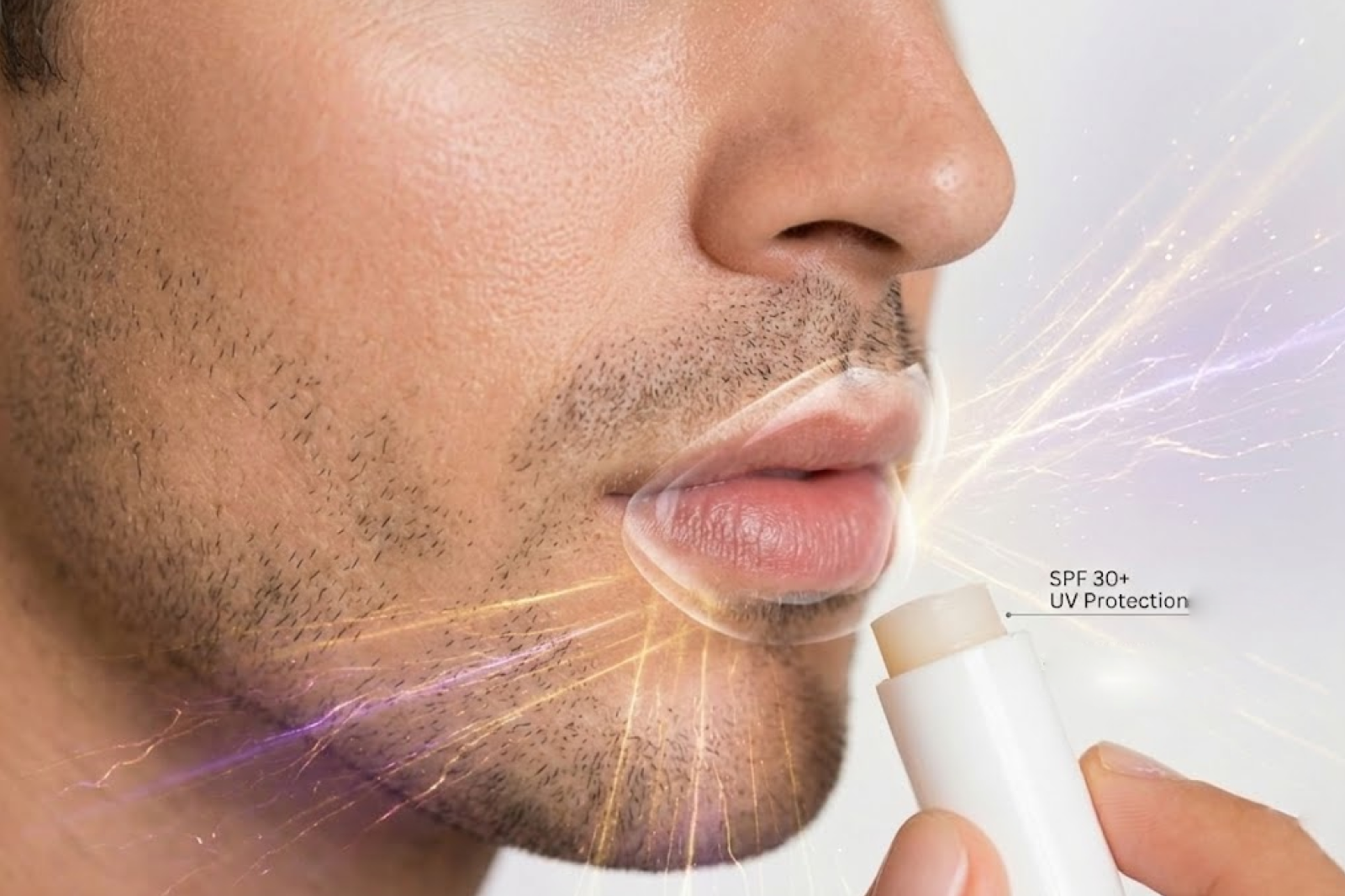
SPF 30 minimum. SPF 30 blocks approximately 97 percent of UVB rays. This is the minimum recommended by dermatologists for daily sun protection use. SPF 15 blocks around 93 percent. That 4 percent difference represents a meaningful amount of additional UV damage over daily use across years.
Broad spectrum protection. SPF measures protection against UVB rays only. UVB rays cause sunburn and contribute to cancer risk. UVA rays, which penetrate more deeply, cause the structural damage, collagen breakdown, pigmentation changes, and longer-term ageing effects. A product labelled broad spectrum addresses both UVA and UVB. This is essential because protecting only against UVB while leaving UVA unaddressed means protecting against the visible short-term effect while ignoring the deeper, cumulative damage.
Hydrating ingredients alongside UV filters. UV filters alone do not treat the underlying vulnerability of lip skin, which is the lack of oil glands and inability to retain moisture. A well-formulated SPF lip balm pairs UV protection with ingredients that actively hydrate and strengthen the lip tissue.
What the INTOIT Lip Restore SPF Lip Balm Contains
The INTOIT Lip Restore SPF Lip Balm is formulated to address all three needs simultaneously.
UV Protection:
-
Ethylhexyl Methoxycinnamate - chemical UV filter protecting against UVB
-
Ethylhexyl Salicylate - secondary UVB filter
-
Bis-Ethylhexyloxyphenol Methoxyphenyl Triazine - broad-spectrum filter covering both UVA and UVB
Together these three filters deliver SPF 30 with broad-spectrum coverage, providing daily protection from the UV exposure that causes both immediate dryness and long-term structural damage to lips.
Active Hydration:
-
Hyaluronic Acid - draws moisture into the lip tissue and holds it there, addressing the fundamental moisture vulnerability of lips that lack oil glands
-
Squalane - a lightweight oil that mimics the skin's natural lipids, filling the protective gaps that the absence of sebum creates and preventing moisture from escaping
Barrier Repair:
-
Ceramide NP - one of the key lipid components of healthy skin barrier. Applied to lips, it helps rebuild the structural integrity of lip tissue that daily UV exposure and dryness progressively degrade
Antioxidant Protection:
-
Tocopheryl Acetate (Vitamin E) - a fat-soluble antioxidant that neutralises free radicals generated by UV exposure. Vitamin E is particularly relevant for lip tissue because it protects the lipid-rich cell membranes that UV-generated free radicals preferentially attack
Soothing and Structure:
-
Peppermint Oil - provides a mild cooling effect that soothes irritated or chapped lips and supports local circulation
-
Hydrogenated Castor Oil, Helianthus Annuus Seed Wax, Rhus Succedanea Fruit Wax, Oryza Sativa Bran Wax - natural waxes that provide structure, create the physical film that holds the formula on the lips, and support barrier function
This combination addresses UV protection, moisture retention, barrier repair, and antioxidant defence in a single product. It is what makes the difference between a basic flavoured wax and a genuinely functional lip care product.
How to Use SPF Lip Balm Correctly
Apply every morning as the last step of your routine. Apply after cleansing, serum, and moisturizer. The lip balm is your final morning step before you leave the house, just as sunscreen is the final step of facial morning skincare. This ensures UV protection is in place from the moment you face outdoor exposure.
Reapply every two hours during extended outdoor exposure. UV filters degrade with sun exposure and are physically removed by eating, drinking, and speaking. For men spending significant time outdoors, reapplication is necessary for sustained protection. A small tube or stick is easy to carry in a pocket or bag.
Apply at night before bed as well. Night application does not deliver UV protection but it does allow the Hyaluronic Acid, Squalane, and Ceramide NP to absorb undisturbed overnight, repairing moisture and barrier damage from the day while you sleep.
Use the full lip area. Apply to the entire lip surface including the corners and the lip border where the skin transitions to the surrounding facial skin. The border of the lower lip is one of the most commonly damaged areas because it is exposed and often missed during application.
Do not lick your lips after applying. Saliva removes the product. If lips feel dry, reapply instead of licking.
Addressing Common Objections
I have dark skin so my lips are protected
This is incorrect. Lip skin contains virtually no melanin regardless of your overall skin tone. The baseline UV protection that higher melanin provides to darker facial skin does not extend to the lips in any meaningful way. All men, across all skin tones, have essentially unprotected lips from a UV standpoint.
I am mostly indoors so I do not need lip protection
UVA rays penetrate glass. If you sit near a window in an office or travel by car, your lips are being exposed to UVA radiation even in the absence of direct sunlight. UVA causes the deeper, structural damage including collagen breakdown and pigmentation changes. Cloud cover reduces UV by approximately 20 percent but does not eliminate it.
My lips are not dry so they do not need a balm
Dryness is not the only reason to use SPF lip protection. UV damage causes structural collagen breakdown and precancerous changes in lip tissue that are not visible as dryness. The protection is preventive. By the time UV damage becomes visibly apparent as loss of definition, lines around the mouth, or discolouration, years of cumulative harm have already occurred.
A normal lip balm is enough
A lip balm without SPF addresses moisture but provides no UV protection. It will reduce the dryness and discomfort from moisture loss but does nothing to prevent the structural collagen damage, pigmentation changes, and cancer risk from daily UV exposure. For daily use in a sunny environment like India, SPF is necessary alongside the hydrating ingredients.
Common Questions About SPF Lip Balm
Does SPF lip balm feel different from regular lip balm?
The INTOIT Lip Restore SPF Lip Balm uses chemical UV filters that are formulated into the base alongside the wax and hydrating ingredients. The texture is smooth and comfortable, not heavy or medicinal. Peppermint oil provides a light, fresh sensation without being overpowering.
How long does SPF lip balm protection last?
UV filters begin to degrade with UV exposure and are physically removed by eating, drinking, and speaking. In practice, reapplication every two hours during active outdoor exposure provides sustained protection. For indoor days with limited sun exposure, morning application is generally sufficient.
Can I use facial sunscreen on my lips instead?
Facial sunscreens are formulated for the skin on the face, not for the mucous membrane tissue of the lips. Most facial sunscreens are not safe for accidental ingestion, which is unavoidable with lips. A lip-specific SPF product uses UV filters that are safe in the context of a product that will be on the lips throughout the day.
Does SPF lip balm help with dark or pigmented lips?
UV exposure worsens lip pigmentation by stimulating excess melanin production in the lip tissue. Daily SPF protection reduces the ongoing UV stimulus for this pigmentation. Over time, consistent SPF use prevents new pigmentation from forming and allows existing pigmentation to gradually fade without being reinforced daily by UV exposure.
Is it necessary to use SPF lip balm in the monsoon season?
Yes. Cloud cover reduces UV levels by approximately 20 percent but does not block UV radiation. Humid air during monsoon does not provide UV protection. Monsoon months in India often coincide with heavy UV levels because the reduction from cloud cover is partially offset by UV scattering through moisture-laden air. Year-round use is recommended.
Final Word
Lip skin has no melanin, no oil glands, and a fraction of the thickness of facial skin. It is the least protected area on your face and the area most men protect the least. The consequences of this gap accumulate gradually as collagen breakdown, moisture loss, pigmentation changes, and increased cancer risk.
SPF 30 with broad-spectrum coverage, combined with hydrating and barrier-supporting ingredients, addresses all of this in a product that takes three seconds to apply.
Daily lip protection is not a luxury step. For anyone spending time outdoors in India, where UV index levels are among the highest globally for most of the year, it is one of the most practical and genuinely necessary habits in a skincare routine.

Written by Chirag Jain