
Skincare Myths Indian Men Still Believe
Bad skincare advice spreads fast. Some of it has been around for so long that it feels like common sense. But common sense is not the same as accurate, and in skincare, believing the wrong thing means your skin pays the price over months and years.
This guide takes the myths that Indian men most commonly hold on to, examines the actual science behind each one, and explains what the truth means for your daily routine. Every claim here has been checked against published research and dermatology sources before being written.
Why Myths Survive
Skincare myths persist for a few specific reasons.
Some of them contain a grain of truth that gets exaggerated into a rule. Some were passed down by parents and relatives who genuinely believed them. Some are reinforced by advertising that uses fear or confusion to sell unnecessary products. And some myths survive simply because they are convenient. They give people a reason not to do something that requires effort or money.
The problem is that acting on false information damages your skin slowly and consistently. By the time the damage is visible, years of preventable harm have already accumulated. Understanding what is actually true costs nothing and protects a lot.
Myth 1 - Dark Skin Does Not Need Sunscreen
This is the most widespread and most damaging skincare myth among Indian men. It is also the one with the clearest, most well-documented refutation in science.
The thinking behind it is not completely baseless. Melanin, the pigment that gives Indian skin its colour, does provide some natural UV protection. Research published in peer-reviewed literature confirms that melanin functions as a broadband UV absorbent and has antioxidant properties. Dark skin is genuinely better protected against UV-induced sunburn than fair skin.
But here is what the same research confirms. The natural SPF provided by melanin in darker skin tones is estimated at between SPF 2 and SPF 13 at most. India's UV index regularly hits between 8 and 11, which is classified as very high to extreme by international standards. Most Indian cities experience these UV index levels for the majority of the year.
Dermatologists recommend a minimum of SPF 30 for daily use. That means even the highest estimate of melanin's natural protection leaves Indian men significantly underprotected every single day they step outside without sunscreen.
There is a second problem that melanin actually causes for darker skin. Indian skin has highly reactive melanocytes, the cells that produce melanin. When UV hits the skin, these cells produce excess melanin as a protective response. This is what causes hyperpigmentation, dark spots, uneven tone, and worsening of post-acne marks. The very mechanism that provides limited protection also makes Indian skin more prone to pigmentation when unprotected.
The conclusion from the science is unambiguous. Darker skin needs sunscreen. The reasons are different from why fair skin needs it, but the requirement is the same.
What this means for your routine:
Use a broad-spectrum sunscreen with at least SPF 30 every morning. Look for PA++++ rating alongside the SPF number. SPF measures UVB protection. The PA rating measures UVA protection. UVA rays are responsible for dark spots, pigmentation, and skin ageing. They penetrate glass and clouds. Without PA protection, you are only addressing half the problem.
Myth 2 - Oily Skin Does Not Need Moisturizer
Many Indian men with oily skin avoid moisturizer completely. The logic seems reasonable. Their skin already produces more oil than they want. Why add more?
The flaw in this thinking is confusing oil with hydration. They are completely different things. Oil is sebum, produced by the sebaceous glands to lubricate and protect the skin surface. Hydration is the water content within the skin cells. Your skin can be simultaneously oily on the surface and dehydrated underneath.
When skin is dehydrated, the body compensates. The sebaceous glands detect that the skin barrier is not functioning properly and produce more oil in response. Skipping moisturizer because you have oily skin often makes the oiliness worse over time by triggering this compensation response.
According to guidance from Harvard Health and the American Academy of Dermatology, all skin types require moisturisation to maintain balance. The key is not whether to moisturise, but which moisturizer to use. Oily skin needs a lightweight, fast-absorbing formula that hydrates without adding a greasy layer.
The INTOIT Maximalist Moisturizer is formulated for exactly this. It is lightweight and non-greasy. It contains Glycolic Acid at 5 percent and Mandelic Acid at 2 percent for cell turnover, three brightening actives for pigmentation, and a full ceramide complex for barrier repair. None of its ingredients make oily skin worse. All of them address the real problems Indian men with oily skin face.
What the myth costs you:
Skipping moisturizer leaves the skin barrier weakened. A weak barrier means more moisture loss, more oil production to compensate, and more vulnerability to pollution and UV damage. The result over months is skin that is simultaneously shiny and dull, oily and dehydrated.
Myth 3 - Soap Is Fine for Washing Your Face
Bar soap is cheap, available everywhere, and most Indian households have it. Using it on your face seems harmless. It gets the job done.
Here is what it is actually doing. Bar soap has a high pH, typically between 9 and 11. Healthy skin has a pH of between 4.5 and 5.5. Every time you wash your face with bar soap, you are disrupting this balance significantly. This disrupts the skin's acid mantle, the natural protective layer that controls bacterial growth, regulates moisture loss, and keeps the skin barrier intact.
The American Academy of Dermatology confirms that excessive cleansing and the use of harsh cleansers can trigger dryness, irritation, and inflammation. For Indian men dealing with pollution, hard water, and high UV exposure, a face that is also being stripped by alkaline soap every day is a face whose barrier is in constant damage mode.
A face-specific cleanser uses surfactants that clean without disrupting pH. The INTOIT Claytox Cleanser goes further. Bentonite at 3 percent and Kaolin at 3 percent draw out pollution and sebum from pores. Gluconolactone at 2 percent provides gentle daily exfoliation. Chamomile extract and Aloe Vera soothe while cleansing. Sodium PCA maintains moisture during the process. It cleans the face properly without making things worse in the process.
The difference in practice:
After using bar soap, skin often feels tight. That tightness is not cleanliness. It is your skin's natural oils and protective barrier being stripped away. A good face cleanser leaves skin feeling clean and comfortable, not stripped.
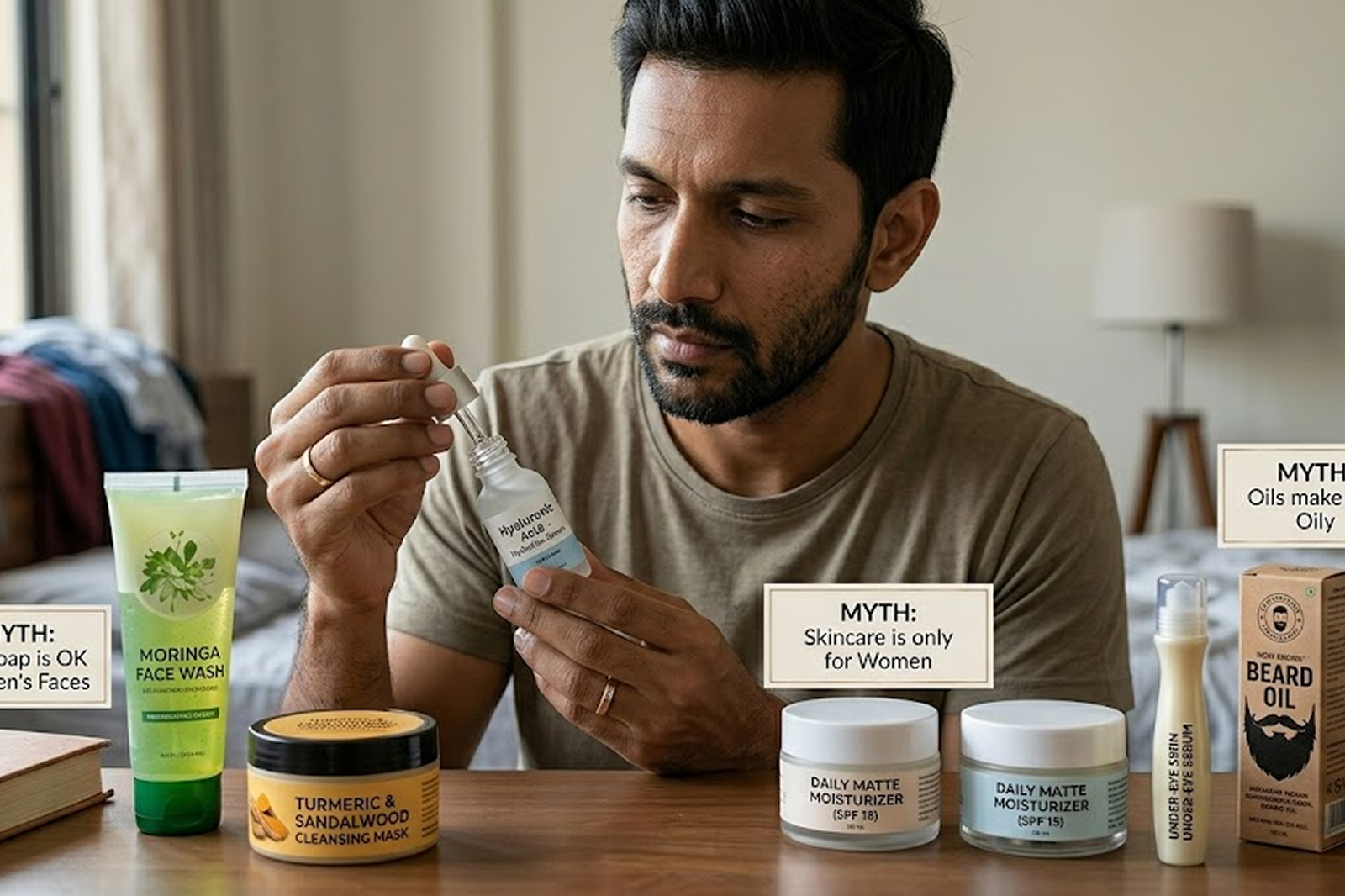
Myth 4 - Skincare Is Only for Women
This myth is largely cultural in India and it is shifting, but slowly. The idea that skincare is feminine or that men who take care of their skin are somehow less masculine has kept a significant number of Indian men away from basic habits that would genuinely improve their skin and health.
The biological reality is that men's skin has different characteristics and faces different challenges than women's skin. Men's skin is approximately 20 to 25 percent thicker. It produces more oil. It has larger pores. It is subject to daily shaving which creates micro-abrasions and weakens the skin barrier with every pass. It is exposed to the same UV, pollution, and environmental stress as women's skin but typically with less protection.
These are not cosmetic concerns. Unprotected daily UV exposure leads to cumulative skin cell DNA damage, hyperpigmentation, early loss of collagen, and increased long-term risk of skin conditions. None of these outcomes are gender-specific.
A basic skincare routine, a cleanser, a serum, a moisturizer, and daily sun protection, is maintenance. It is no different conceptually from brushing your teeth or using deodorant. The cultural association between skincare and femininity is a relatively recent and specifically Western marketing construction. Many of the world's oldest grooming traditions, from ancient Rome to historical South Asian practice, were gender-neutral.
The practical point:
Taking care of your skin is taking care of your health and your appearance. Both of those things matter regardless of gender.
Myth 5 - Expensive Products Work Better
Price and performance do not have a reliable relationship in skincare. A product's effectiveness is determined by its active ingredients, their concentrations, and how well they are formulated to penetrate the skin. None of these factors scale predictably with price.
Some of the most clinically validated ingredients in skincare, including Niacinamide, Glycolic Acid, and peptides, are inexpensive to produce. They are found in products at every price point. A moisturizer with 2 percent Niacinamide performs based on the Niacinamide content, not on whether the packaging is minimalist or the brand has a luxury positioning.
The guidance from dermatologists is consistent. Look at the active ingredients and their concentrations. That is what determines results. A product that clearly lists its actives with percentages and has a formulation built around those actives will outperform a product that relies on brand prestige and vague marketing language regardless of price.
What to look for instead of price:
-
Clearly listed active ingredients with concentrations
-
Formulation designed for your specific skin concern
-
Products made for Indian skin conditions, not reformulated for a different climate
-
Paraben free, petrolatum free formulations
Myth 6 - More Product Means Better Results
Applying more serum, more moisturizer, or more of any product does not accelerate results. It creates a different set of problems.
Skincare products are formulated to deliver a specific amount of active ingredient to the skin with each use. The concentration is set in the formula. Applying double the amount does not double the active ingredient concentration that your skin absorbs. It just means the excess product sits on the skin surface, can mix with sebum, and potentially causes congestion or breakouts.
For serums, two to three drops covers the full face adequately. For moisturizers, a thin even layer is sufficient. The key variable is not quantity. It is consistency. Using the right amount every day produces far better results than using double the amount irregularly.
Myth 7 - Skincare Results Happen Fast
Skincare is not a quick fix. This is not a drawback. It is the nature of how skin biology works.
The skin cell cycle, the process by which new cells form at the base of the epidermis, rise to the surface, and shed, takes approximately 28 days in younger men and longer with age. Most visible improvements from skincare require at least one full skin cycle to become apparent. Brightening results from ingredients like Alpha Arbutin and Kojic Acid take four to six weeks minimum. Collagen stimulation from peptides takes eight to twelve weeks to show visible change.
This is why consistency matters more than any single product choice. A routine done consistently for eight weeks with moderately good products will produce better results than an expensive routine done sporadically for a month.
The expectation of fast results is one of the main reasons men abandon good routines before they work. Give any new routine at least four weeks before evaluating it.
Myth 8 - Face Wash Controls Oily Skin
This one is related to Myth 2 but deserves its own explanation because it leads to a specific and very common harmful habit.
Many Indian men with oily skin wash their face three, four, or more times a day. The thinking is that washing removes the oil, so washing more frequently should produce less oil overall.
The opposite is true. Over-washing strips the skin's natural oils along with the dirt and sebum. This triggers the sebaceous glands to produce more oil to replace what was removed. The more frequently you wash with a harsh cleanser, the more oil your skin produces in response. You end up in a cycle of washing and oiliness that gets progressively worse.
The American Academy of Dermatology recommends cleansing twice daily for most skin types. Morning and night. Using a gentle, pH-appropriate cleanser designed for the face. That is all. Additional washes strip the barrier without addressing the root cause of oiliness.
Myth 9 - Natural Ingredients Are Always Safer
The appeal of natural ingredients is understandable. Familiar names feel less intimidating than chemical-sounding ones. But the category of natural versus synthetic is not a reliable indicator of safety or effectiveness.
Lemon juice is natural. Applied directly to the skin, it is too acidic for safe use, causes chemical burns with sun exposure, and can worsen pigmentation in darker skin tones. Coconut oil is natural. It is comedogenic for many skin types and can cause breakouts. Essential oils are natural. Many are potent irritants and allergens.
Meanwhile, many synthetic ingredients are molecularly identical to naturally occurring compounds. Lab-produced versions are often more stable, more consistent in concentration, and better studied than plant-derived equivalents.
The relevant question is not natural or synthetic. It is whether the ingredient is effective, at what concentration, and whether it is appropriate for your skin type and concern.
Myth 10 - Skincare Is Only Necessary When Problems Appear
Prevention is significantly easier than treatment. This is true in medicine broadly and in skincare specifically.
UV damage, collagen loss from ageing, and hyperpigmentation all accumulate gradually. By the time dark spots are visible, years of melanin overproduction have already occurred. By the time fine lines are prominent, collagen loss has been ongoing for a decade. The visible sign is the end stage of a long process, not the beginning.
Starting a basic routine early, cleansing properly, using active ingredients for your skin concern, and protecting against UV, prevents damage from accumulating to the point where it becomes difficult to reverse. A man in his mid-twenties who starts a consistent routine will have noticeably different skin in his forties than one who waits for problems to appear before addressing them.
The investment in time is small. The return over years is significant.
Final Word
Most of the myths covered here persist because they give people permission to do less. Darker skin does not need sunscreen. Oily skin does not need moisturizer. Soap is fine. Skincare is not for men.
Every one of these is false. The science is clear on all of them.
What Indian men's skin actually needs is straightforward. A face-specific cleanser that does not strip the barrier. Active ingredients that address the real concerns of Indian skin, pigmentation, uneven tone, pollution damage, and oil. Consistent daily use. And sun protection, every day, regardless of skin tone.
That is it. No complicated ten-step routine. Just the right products used consistently and a clear understanding of what is actually true.

Written by Chirag Jain