

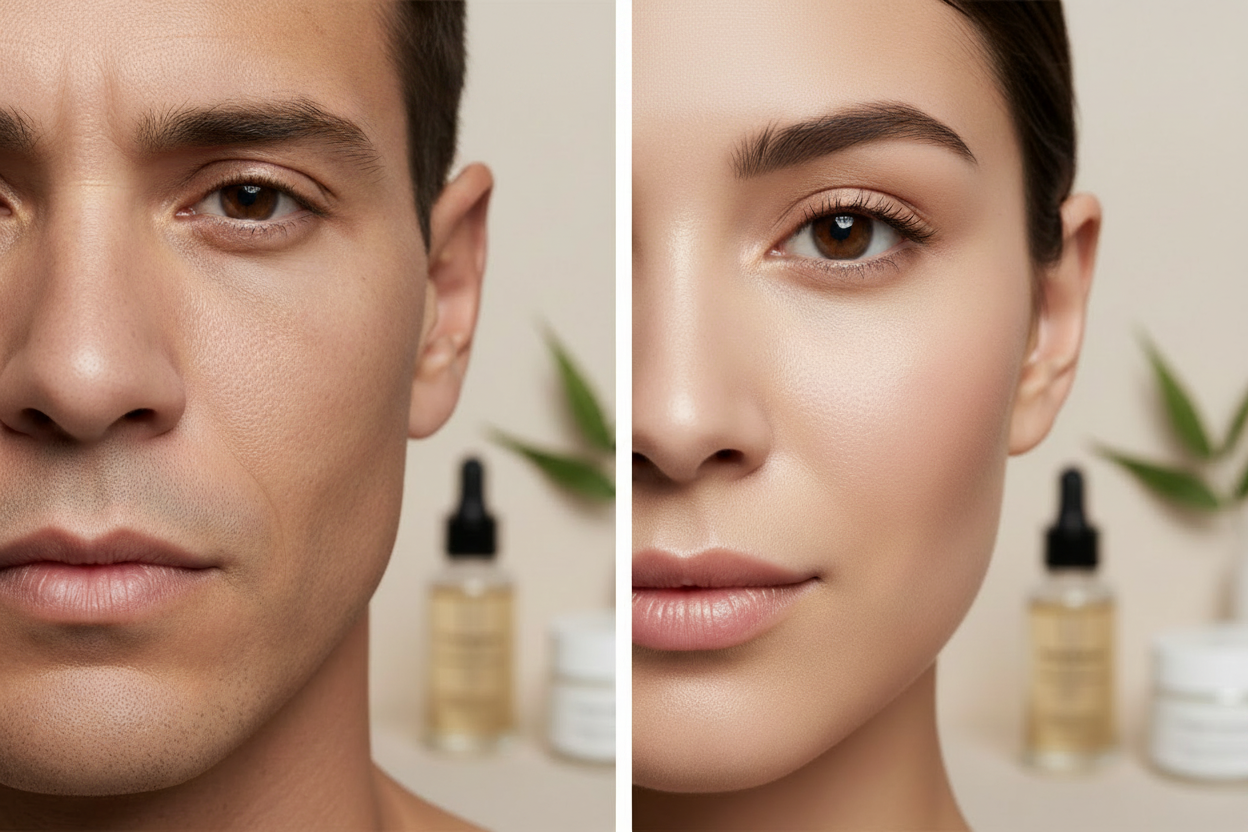
How Men's Skin Is Different from Women's Skin
The claim that men and women need different skincare is not marketing. It is biology. The differences between male and female skin are structural, hormonal, and functional. They affect everything from how oily the skin is, to how it ages, to how it recovers from daily damage.
Understanding these differences is what allows men to choose products and build routines that are actually matched to their skin. Using products formulated without accounting for male skin biology, which describes most of the skincare market, produces results that are incomplete at best.
This guide explains the documented biological differences between male and female skin, what those differences mean in practical terms, and how they should shape a skincare approach for men.
The Biological Foundation
Male and female skin are governed by different hormones. Male skin is primarily influenced by androgens, particularly testosterone and dihydrotestosterone. Female skin is primarily influenced by estrogen and progesterone. These different hormonal environments drive almost every structural difference between male and female skin.
A comprehensive review published in the International Journal of Women's Dermatology, covering 57 studies, confirmed that multiple physiological skin parameters including hydration, transepidermal water loss, sebum production, microcirculation, pigmentation, and thickness differ significantly between men and women. These are not superficial variations. They are fundamental biological differences that affect how the skin functions and how it responds to treatment.
Skin Thickness
The Science
Male skin is approximately 20 percent thicker than female skin on average. Research published in PMC from multiple studies confirms this consistently. This thickness difference is driven by androgens. Testosterone stimulates dermal fibroblasts, which produce the collagen that makes up the bulk of skin thickness. Higher androgen activity in male skin produces a thicker dermis with a denser collagen network.
The stratum corneum, the outermost layer of the epidermis, is also thicker in male skin. A peer-reviewed gender differences study published on ResearchGate describes male skin as having a thicker stratum corneum than female skin, contributing to a rougher surface texture.
What This Means Practically
Thicker skin is more structurally resilient. It is less prone to the fine surface lines that appear early in thinner skin. This is part of why men generally show the first signs of visible ageing later than women of the same age. The skin simply has more structural depth before the effects of collagen loss become visible at the surface.
However, when wrinkles do form in male skin, they tend to be deeper and more pronounced. Thinner female skin develops fine lines earlier. Thicker male skin resists them longer but produces more significant structural lines when ageing does manifest.
Thicker skin also means active ingredients in skincare need to penetrate a denser barrier to reach the layers where they can produce change. This is one reason why a serum, which is formulated to carry active ingredients more deeply, is more important for men than a moisturizer alone.
Sebum Production and Oiliness
The Science
Men produce significantly more sebum than women. Eucerin's dermatological research, drawing on multiple published studies, documents that sebum production in men is approximately double that of women. This is driven by androgens. After puberty, testosterone stimulates the sebaceous glands to produce more sebum. Male sebaceous glands are larger and more numerous on the face. A correlation between excessive sebum production and larger pore size is also documented in published research.
Male skin also has a slightly lower pH than female skin. Multiple studies in the International Journal of Women's Dermatology review confirm that male skin consistently has a lower pH, typically below 5, which enhances the acid mantle's barrier cohesion. Research published in PMC describes male skin as more acidic than female skin, which affects lipid metabolism and barrier homeostasis.
Sebum production in men remains relatively stable across the lifespan until testosterone declines in later decades. Women's sebum production peaks in reproductive years and declines more noticeably with age and through menopause. This means oiliness is a more sustained challenge for men across a longer period of their lives.
What This Means Practically
Higher sebum production creates a specific set of skin challenges that are more common and more persistent in men than women.
Larger, more active sebaceous glands mean larger visible pores on the face, particularly in the T-zone. Excess sebum mixes with dead skin cells and pollution particles to form the congestion that causes blackheads and breakouts. This is why adult acne is more persistent in men than women. The androgen-driven sebum production that starts at puberty does not taper off the way it does in many women.
Higher oiliness also means that products formulated for dry or dehydrated skin, which make up a large proportion of the skincare market, are not suited to male skin. Rich, occlusive creams that work well for dry female skin can sit on male skin, mix with sebum, and cause congestion. Male skin needs formulas that are lightweight enough to absorb cleanly without adding to the oil load.
The increased sebum production that creates oiliness is also what makes the Claytox approach effective for male skin. Clay-based cleansing specifically addresses sebum excess within pores in a way that standard surfactant cleansers do not.
The INTOIT Claytox Cleanser uses Bentonite at 3 percent and Kaolin at 3 percent, two clays that adsorb excess sebum and pollution from within pores through electrostatic attraction. This addresses the specific sebum management need that male skin biology creates. The Gluconolactone at 2 percent provides gentle daily exfoliation to prevent dead cell buildup from combining with excess sebum in the pores.
Collagen Density and Ageing
The Science
Men have a higher collagen density than women at every age. This is the ratio of collagen to skin thickness. The International Dermal Institute, citing multiple published studies, states that because collagen content is directly related to the visible signs of skin ageing, a woman's skin has been described as approximately 15 years older than a man's of the same chronological age when assessed for intrinsic ageing characteristics.
Both men and women lose approximately 1 percent of their collagen per year from around the age of 30. However, women experience a significant additional acceleration of collagen loss in the first five years after menopause, driven by declining estrogen. After this period, women's collagen loss stabilises at approximately 2 percent per year. Male collagen loss proceeds at a steady rate throughout adulthood without a comparable dramatic acceleration.
Estrogen, which regulates female skin, contributes to collagen synthesis, production of elastic fibres, and hyaluronic acid production in the skin. Research published in PMC confirms that estrogen improves skin barrier integrity and water-binding capacity. Male skin does not benefit from these estrogen-driven effects. Testosterone, by contrast, has been shown to have a negative effect on barrier function in some research, making male skin more vulnerable to barrier disruption than its thickness alone would suggest.
What This Means Practically
The collagen advantage that male skin has is real but often neutralised by behaviour. Men typically use less sunscreen, which means more UV-driven collagen degradation. Men are less likely to have established skincare routines, which means less active protection against the environmental oxidative stress that degrades collagen. And men in high-pollution environments like Indian cities are exposed to the same MMP-driven collagen degradation from pollution that affects all urban skin.
The result is that the biological collagen advantage of male skin is frequently erased by lifestyle and environmental exposure. Men who address UV and pollution damage consistently often do maintain a noticeable advantage in skin ageing over women of the same age. Men who do not often show premature ageing that exceeds what their female peers of similar genetics experience.
The peptide approach in the INTOIT 6x Complex Face Serum addresses this directly. Palmitoyl Tripeptide-1 at 11 percent and Palmitoyl Tripeptide-38 stimulate fibroblast activity and collagen synthesis. These ingredients actively support collagen production in male skin that is subject to daily degradation from UV, pollution, and the natural decline that begins in the thirties. Acetyl Hexapeptide-8 reduces the expression of fine lines formed from collagen loss. These work best when used consistently at night, when fibroblast activity peaks during sleep.
Shaving and Barrier Damage
The Science
This is the most significant skin challenge unique to male skin and one that has very little equivalent in female skincare.
On average, men who shave will subject their skin to approximately 16,000 shave passes over a lifetime. Research published in PMC confirms that shaving creates immediate damage to the stratum corneum. A single dry razor pass produces effects comparable to significant barrier disruption: increased epidermal proliferation, epidermal thickening, increased cytokine production, and impaired barrier function.
Twenty percent of the material removed during male facial shaving is skin itself. The remainder is hair. This means every shave removes a layer of skin along with the facial hair, leaving the skin beneath temporarily exposed and vulnerable.
The inflammatory response triggered by shaving is amplified in male skin. Research published through Longdom publishing and multiple dermatological sources confirms that androgens trigger an increased inflammatory response in male skin. When shaving causes micro-cuts, nicks, or follicular disruption, testosterone-amplified inflammation raises the risk of post-inflammatory hyperpigmentation, a condition where melanocytes in the inflamed area produce excess melanin that persists as a dark mark long after the original injury has healed.
Shaving also exposes skin that was previously shielded by facial hair to direct UV radiation, removing the incidental UV protection that facial hair provides.
What This Means Practically
Shaving is a daily or near-daily barrier disruption event for most men. Its effects accumulate. Skin subjected to daily shaving without appropriate care becomes progressively more sensitised. The barrier develops chronic low-level dysfunction that increases TEWL, makes the skin more reactive, and makes it more susceptible to pollution penetration.
Post-shave skin is more permeable. This is actually an opportunity. Applied immediately after shaving, active ingredients absorb more effectively. Peptides for collagen support and Niacinamide for barrier strengthening penetrate more readily into recently shaved skin than into intact unshaved skin.
The INTOIT 6x Complex Face Serum applied after shaving delivers its peptide complexes and Niacinamide at 2 percent into skin that is primed to absorb them. The Niacinamide specifically supports barrier repair, which directly addresses the barrier damage shaving creates. The INTOIT Maximalist Moisturizer seals the post-shave skin with ceramides that replenish the barrier lipids stripped by the razor, reducing the inflammatory response and TEWL that shaving triggers.
Pore Size and Congestion
The Science
Men have larger pores than women across all facial zones. This is driven by two factors. The larger, more active sebaceous glands that produce more sebum are also physically larger and open through larger pore apertures. And androgen-driven sebum production creates a higher volume of material moving through those pores, which over time can stretch and enlarge them further.
A correlation between excessive sebum production and larger pore size was described by Roh et al. in published research. Larger pores also collect pollution particles, dead skin cells, and bacteria more easily, creating the conditions for blackheads, congestion, and breakouts.
What This Means Practically
Pore management is a more significant ongoing concern in male skincare than female skincare. Niacinamide is one of the most well-supported ingredients for refining pore appearance and regulating the sebum production that drives pore enlargement. It is present at 2 percent in the 6x Complex Face Serum, applied twice daily.
Clay-based cleansing provides direct mechanical adsorption of the sebum and particulate matter that accumulates within larger pores. The Claytox Cleanser's dual clay formula addresses this at the pore level twice daily.
Skin Hydration and TEWL
The Science
Research in this area shows a nuanced picture. Up to approximately age 40, men have better-hydrated skin than women, driven partly by higher sebum production that slows moisture loss. Male skin also shows lower overall transepidermal water loss rates than female skin in multiple studies. The slightly more acidic pH of male skin supports barrier cohesion and lipid metabolism that maintains hydration.
However, testosterone has been shown to have a negative effect on barrier function in research published in the Journal of Investigative Dermatology, increasing vulnerability to TEWL in conditions that stress the barrier. In high-pollution, high-UV environments like Indian cities, this vulnerability becomes a real daily concern.
From around age 40, male skin hydration begins to decline more noticeably as testosterone levels decrease. The highest rate of TEWL in men occurs between age 50 and 59, corresponding to the period of most significant testosterone decline.
What This Means Practically
Male skin generally manages hydration better than female skin in younger decades. But this natural advantage is easily compromised by the specific factors Indian men face: hard water, pollution-driven barrier damage, AC-driven TEWL, and over-cleansing with harsh products.
The Xylitylglucoside, Anhydroxylitol, and Xylitol deep hydration complex in the INTOIT Maximalist Moisturizer provides sustained hydration that holds moisture in the skin structure rather than just adding surface moisture that evaporates. The full ceramide complex including Ceramide NP, AP, and EOP maintains the barrier integrity that prevents TEWL from accelerating in stressed male skin.
Pigmentation and Post-Inflammatory Response
The Science
Male skin has higher androgen levels that produce an increased inflammatory response compared to female skin. Research published through dermatological sources confirms that this testosterone-amplified inflammation triggers melanocytes to release more pigmented organelles, which darken the affected area. This produces a condition called post-inflammatory hyperpigmentation, or PIH, that persists long after the original cause of inflammation has resolved.
In Indian men, who already have highly reactive melanocytes due to higher baseline melanin levels, the combination of testosterone-amplified inflammation from shaving and acne with high UV exposure creates a significant PIH risk. Post-shave marks, post-acne spots, and sun-induced pigmentation are among the most common and most persistent skin concerns for Indian men.
What This Means Practically
Brightening actives that target melanin production are particularly relevant to male skin because the androgen-driven inflammatory response makes hyperpigmentation more common and more pronounced in men with higher melanin reactivity.
The INTOIT Maximalist Moisturizer contains Alpha Arbutin at 2 percent, Glutathione at 2 percent, and Kojic Acid at 1 percent, each working at a different point in the melanin synthesis pathway. The Oligopeptide-68 in the 6x Complex Face Serum adds a brightening peptide that reduces melanin production directly through a different mechanism. Used consistently, these target both the existing pigmentation and the ongoing melanin overproduction that daily UV and inflammation continue to drive.
Why Most Skincare Products Are Not Built for Male Skin
This is a practical point worth making directly.
The global skincare market is predominantly formulated for female skin. Products designed for drier, thinner female skin typically use richer, heavier bases, higher moisturising agent concentrations, and formulations suited to lower sebum environments. When these products are used on oilier, thicker male skin, they often sit on the surface, mix with sebum, congest pores, and feel uncomfortable.
Skincare products formulated specifically for male skin biology account for higher sebum production with lighter bases. They include ingredients like Niacinamide for oil regulation and pore refinement. They incorporate clay-based cleansing for sebum management within larger pores. They use peptide complexes that penetrate the thicker male dermis to support collagen where it matters. And they address the pigmentation concerns that are heightened in male skin by androgen-amplified inflammation.
The entire INTOIT range is formulated for Indian men specifically. It accounts for the biological realities of male skin alongside the specific challenges of the Indian environment.
Common Questions About Male and Female Skin Differences
If men's skin ages more slowly, do men really need to worry about anti-ageing?
Yes. The biological collagen advantage in male skin is real but conditional. It requires that the other factors driving extrinsic ageing, primarily UV exposure and pollution, are managed. Most Indian men do not use sunscreen regularly, which means UV-driven collagen degradation is consistently erasing the natural biological advantage. Men who protect against UV and pollution consistently do genuinely age more slowly. Men who do not often show premature ageing that exceeds their biological advantage.
Can men use products formulated for women?
Some ingredients are universal and effective regardless of sex. Ceramides, peptides, Niacinamide, and AHAs work the same way in male and female skin at the biological level. The problem is usually texture and formulation rather than the active ingredients themselves. Heavy, rich formulas designed for dry female skin tend to be too occlusive for oilier male skin. Lightweight formulas work better for most men even when using the same actives.
Why does male skin feel rougher than female skin?
Male skin has a thicker stratum corneum, which gives it a rougher surface texture. Higher sebum production can also mix with dead cells on the surface, creating an uneven texture. Consistent exfoliation, either through AHAs or PHAs, addresses this by maintaining regular cell turnover and preventing dead cell accumulation. The Gluconolactone PHA in the Claytox Cleanser and the Glycolic Acid in the Maximalist Moisturizer both contribute to keeping surface texture smoother with daily use.
Is sensitive skin less common in men?
Male skin is less commonly described as sensitive in dermatological literature, in part because of its greater thickness and more acidic pH. However, shaving sensitises male skin significantly. Men who shave regularly often experience sensitisation in the shaved areas that does not resolve without proper barrier support. This is a shave-induced sensitivity rather than genetic skin sensitivity, and it responds well to post-shave barrier repair with ceramides and soothing actives.
Does testosterone affect skin throughout life?
Yes. Testosterone drives the sebum production and skin thickness advantages of male skin. As testosterone levels decline from around the forties onward, male skin undergoes changes including reduced sebum production, faster TEWL rate increase, and some degree of skin thinning. Men who maintained a consistent skincare routine during their higher-testosterone decades tend to have better baseline barrier function when this transition occurs.
Final Word
Male and female skin are meaningfully different at the biological level. These differences are not marketing constructs. They are documented across multiple decades of dermatological research in peer-reviewed literature.
Male skin is approximately 20 percent thicker. It produces roughly double the sebum. It has higher collagen density that produces slower intrinsic ageing but deeper wrinkles when ageing does occur. It is subject to repeated barrier disruption from shaving. It has higher androgen-driven inflammation that makes post-inflammatory hyperpigmentation more common and more persistent. And it has a slightly more acidic pH that provides some advantages but also creates unique challenges.
Each of these differences has a direct implication for skincare. The cleanser needs to manage sebum at the pore level, not just the surface. The serum needs to deliver actives through thicker skin to support collagen. The moisturizer needs a lightweight texture that does not add to the oil load while still repairing the barrier that shaving and environment damage daily. The brightening actives need to address the melanin overproduction that androgen-amplified inflammation produces.
Understanding how your skin actually works is the foundation of a routine that actually works.

Written by Chirag Jain