
Do Men Really Need a Face Serum?
It is a fair question. Most men have spent their entire lives with a cleanser and maybe a moisturizer. Skincare worked fine. The skin was clean. The routine was simple. Now everyone is talking about serums and it is not clear whether they are genuinely useful or just another product being sold to people who do not need it.
The honest answer is that serums are not essential in the way food and water are essential. You can live without one. But if you have a skin concern, and most Indian men do, dullness, dark spots, oiliness, early lines, tired-looking eyes, then a moisturizer alone is not capable of addressing it properly. The reason is biological. A serum and a moisturizer work in different places and do different things. One does not replace the other.
This guide answers the question directly. What a serum actually does. Whether men specifically need one. What you are missing if you skip it. And what makes the difference between a serum worth using and one that is not.
What Most Men Are Getting Wrong
The most common misconception is that a serum is just a more expensive, smaller version of a moisturizer. Something that hydrates a bit more. Something marketed well but not fundamentally different.
This is wrong, and the difference matters practically.
A cleanser cleans the surface. A moisturizer protects the surface and hydrates. A serum treats. It delivers active ingredients into the deeper layers of the skin where actual biological change happens. This is not a marketing distinction. It is a formulation reality based on molecular size and skin absorption physics.
Dermatologists describe serums as precision treatments rather than general maintenance. The cleanser and moisturizer cover general maintenance. If that is all you are doing, your skin is being cleaned and protected but not treated. For men whose concerns stay mild and whose skin is exposed to minimal environmental stress, maintenance alone may be sufficient. For most Indian men dealing with pollution, UV, stress, oiliness, and pigmentation every day, maintenance is not enough.
The Biology Behind Why Serums Work Differently
The Penetration Difference
Skin has a selective outer barrier called the stratum corneum. It is designed to keep things out. Molecules above a certain size threshold face significant resistance penetrating through it passively. This is why not everything you apply to your skin actually reaches the layers where it can create change.
Moisturizers are formulated with larger molecules and heavier occlusive bases because their job is to stay on the surface. They form a protective film. They slow water evaporation. They sit where they are supposed to sit, which is at and near the skin surface.
Serums are formulated with smaller molecules in lightweight, water-based, low-viscosity bases specifically to maximise penetration through that outer barrier. Scientific sources confirm that serums are made up of smaller molecules that penetrate deeply into the skin and deliver a very high concentration of active ingredients where they are needed. They go where moisturizers cannot go.
This is why the same active ingredient in a serum produces a different, stronger result than the same ingredient in a moisturizer. Niacinamide in a serum reaches the deeper layers of the epidermis where it regulates sebum at the sebocyte level and inhibits melanin transfer to the surface. Niacinamide in a moisturizer primarily acts near the surface. The ingredient is identical. The formulation determines how deep it goes and therefore how significant the effect is.
What Active Ingredients Actually Do at Depth
This is where the real case for serums lies. Active ingredients delivered at depth trigger biological responses in the skin cells responsible for the changes men actually want to see.
Peptides are signal molecules. When delivered into the dermis through a serum, they communicate with fibroblasts, the cells that produce collagen. They instruct those cells to upregulate collagen synthesis. The result over weeks of consistent use is a measurable improvement in skin firmness and a reduction in the depth of fine lines. This cannot happen if the peptides do not reach the dermis. A moisturizer cannot carry them there.
Brightening peptides and ingredients like Niacinamide target melanocytes, the cells that produce melanin, and the mechanisms that transfer melanin to the skin surface. Delivered at depth, they reduce the rate of melanin production and transfer, progressively brightening the skin tone over weeks. Delivered only to the surface by a moisturizer, they cannot reach the cells that are producing the pigmentation in the first place.
Antioxidant ingredients neutralise free radicals generated by pollution and UV exposure. Free radical damage occurs in the skin cells at multiple layers, not just the surface. Antioxidants delivered deeper by a serum provide protection at the level where cellular damage from pollution and UV actually occurs.
The Specific Case for Men
Men's skin has characteristics that make a serum not just useful but more useful than it would be for most women's skin.
Thicker Skin Needs Deeper Delivery
Men's skin is approximately 20 percent thicker than women's skin, driven by higher testosterone levels stimulating dermal collagen. This is a genuine physiological advantage in terms of structural resilience and slower intrinsic ageing. But it also means that the outer barrier through which active ingredients need to penetrate is proportionally thicker and denser.
A moisturizer applied to thicker male skin has an even more limited penetration depth relative to the dermis than the same moisturizer on female skin. The active ingredients in a moisturizer formula are working against a thicker barrier. A serum's lightweight, low-viscosity formulation is better equipped to overcome this barrier and reach the depths where collagen production and melanin regulation actually occur in thicker male skin.
Oiliness Needs Cellular Regulation
Men produce significantly more sebum than women due to higher testosterone levels directly stimulating androgen receptors in the sebaceous glands. Managing oiliness effectively requires reducing the rate of sebum production at the cellular level, not just removing surface oil.
Niacinamide is the most clinically validated topical ingredient for this. A double-blind, placebo-controlled study confirmed that topical 2 percent Niacinamide significantly reduced sebum excretion rates after two and four weeks of use. This happens because Niacinamide inhibits lipid transfer within sebocytes, the cells that produce sebum, at the level where sebum assembly occurs.
This mechanism requires the Niacinamide to reach the sebaceous glands. A serum delivers it there. A moisturizer, sitting predominantly at the surface, provides a much weaker signal to the same cells.
The INTOIT 6x Complex Face Serum contains Niacinamide at 2 percent, the clinically validated concentration. Applied twice daily, it progressively reduces sebum production at its source rather than managing its consequences on the surface.
Pigmentation Is Driven from Depth
Post-acne marks, post-shave hyperpigmentation, and UV-induced dark spots are all caused by melanin overproduction in the melanocytes that sit at the base of the epidermis. Topical brightening treatments need to reach these cells to reduce melanin synthesis.
For Indian men, pigmentation is one of the most persistent and most common skin concerns. Higher baseline melanin levels make the skin more reactive to any inflammatory trigger, including shaving, breakouts, UV, and pollution. Every trigger deposits more pigmentation that takes months to fade naturally.
A serum with brightening ingredients that penetrate to the melanocyte layer addresses this at the source. The INTOIT 6x Complex Face Serum contains Oligopeptide-68 at 68.5 percent of the peptide complex, a brightening peptide that inhibits melanin synthesis at the cellular signalling level. This works because the serum carries it to the right depth. A moisturizer with a brightening ingredient works only at the surface, which reduces the visibility of existing pigmentation marginally but does nothing to reduce the rate of new melanin overproduction occurring in the melanocytes below.
Collagen Support Is Needed Earlier Than Men Expect
Collagen production begins declining from around the mid-twenties in both men and women. For men in Indian cities, this natural decline is compounded by daily UV exposure and pollution-driven MMP upregulation that degrades existing collagen.
Most men do not start thinking about collagen until they see visible fine lines or firmness loss. By that point, collagen loss has been ongoing for a decade. Addressing it with peptides delivered at the depth where fibroblasts operate produces real results, but the earlier the support begins, the more of the collagen advantage male skin starts with is preserved.
The 6x Complex Face Serum contains Palmitoyl Tripeptide-1 at 11 percent and Palmitoyl Tripeptide-38, both collagen-stimulating peptides that signal fibroblast activity in the dermis. These cannot be delivered effectively by a moisturizer. They require a serum's penetration depth to reach the cells they need to communicate with.
What You Are Actually Missing Without a Serum
If you currently use only a cleanser and moisturizer, here is a specific account of what your routine is and is not doing.
What a cleanser and moisturizer cover:
- Removing surface debris, excess oil, and pollution from the skin surface
- Protecting the skin barrier and slowing transepidermal water loss
- Providing surface-level hydration
- Some degree of surface brightening from moisturizer actives that work near the surface
What they cannot cover without a serum:
- Reducing sebum production at the sebaceous gland level
- Stimulating collagen synthesis in the fibroblasts of the dermis
- Inhibiting melanin synthesis in the melanocytes at the base of the epidermis
- Delivering antioxidant protection at the cellular layer where UV and pollution free radical damage occurs
- Progressive, sustained improvement in skin tone, texture, and firmness over weeks of use
A routine without a serum maintains the skin. A routine with a serum improves it. The distinction is between keeping things the same and producing visible change over time.
How to Know If You Need a Serum
The honest answer is that it depends on what your skin concerns are and what outcome you are trying to achieve.
You probably do not need a serum if:
- Your skin has no specific concerns beyond being clean
- You are in your early twenties with no pigmentation, oiliness, or early signs of ageing
- You are satisfied with the results your current cleanser and moisturizer routine produces
You almost certainly need a serum if:
- You have dark spots, post-shave marks, or uneven skin tone that does not improve with a moisturizer alone
- Your skin is consistently oily and conventional moisturizers have not made a meaningful difference to midday shine
- You are in your late twenties or older and want to address or prevent the collagen loss that environmental exposure accelerates in Indian cities
- Your skin looks dull, flat, or tired regardless of sleep and hydration
- You have noticed early fine lines and want to address them before they deepen further
For the majority of Indian men in their late twenties and older living in urban environments, at least three of these conditions apply. A serum is not a luxury addition for these men. It is the step that allows the rest of the routine to produce the results they are looking for.
What Makes a Serum Worth Using
Not all serums deliver what they claim. The difference between a serum that produces visible results and one that does not comes down to formulation quality and active ingredient concentrations.
Clinically meaningful concentrations: An ingredient listed at a trace amount for label appeal performs differently from the same ingredient at a concentration that has been shown in published research to produce measurable results. Check whether concentrations are disclosed and whether they match the evidence-based range for the ingredient's function.
Targeted active ingredients: A serum should be chosen based on your specific skin concern. Peptides for collagen support and firmness. Brightening peptides and Niacinamide for pigmentation and oiliness. Antioxidants for pollution and UV protection. A serum that lists twenty ingredients without a clear primary function is often doing nothing well.
Lightweight formulation: A serum that feels heavy, thick, or greasy is not formulated for penetration. It is formulated to feel like it is doing something. A serum that works absorbs quickly, leaves no residue, and feels like nothing within a minute of application.
Ingredient transparency: A brand that discloses active ingredient concentrations is demonstrating confidence in its formula. One that lists everything on the label without percentages is often hiding the fact that the active doses are too low to produce meaningful results.
The INTOIT 6x Complex Face Serum discloses the concentrations of its active complexes. Oligopeptide-68 at 68.5 percent of the peptide complex. Palmitoyl Tripeptide-1 at 11 percent. Niacinamide at 2 percent. Caffeine at 0.5 percent. These are not marketing ranges. They are the concentrations at which the published research on each ingredient demonstrates measurable effect.
How to Use a Serum Correctly
Getting the most from a serum requires applying it correctly. A well-formulated serum applied in the wrong order or on unprepared skin produces a fraction of its potential benefit.
Apply after cleansing, before moisturizer. Cleansing creates a clean, pH-balanced surface that is ready to absorb. Applying serum before moisturizer means the active ingredients penetrate before the moisturizer creates an occlusive layer that would block them. Reversing this order significantly reduces absorption.
Apply on slightly damp skin. After cleansing, pat the face gently and leave it slightly damp. The residual moisture on the skin surface helps the water-based serum spread evenly and begin absorption immediately. Completely dry skin creates more resistance.
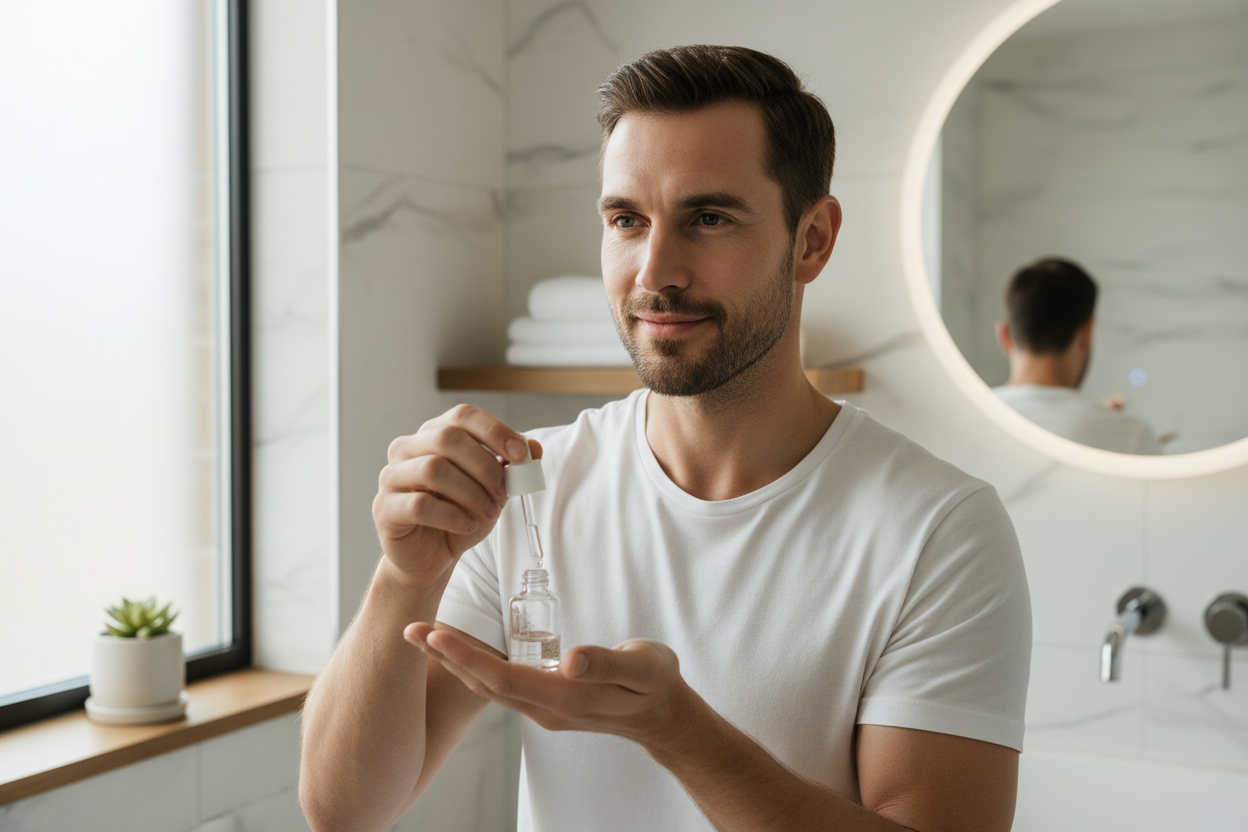
Use two to three drops for the full face. Serums are concentrated. More product does not improve results. Two to three drops spread evenly across the face is sufficient for full coverage. Pressing it gently in with your fingertips is more effective than rubbing.
Wait approximately 60 seconds before applying moisturizer. The serum needs this time to begin absorbing before the moisturizer is applied. The moisturizer then seals it in. Apply when the serum feels absorbed but slightly tacky, not completely dry.
Use consistently morning and night. Serums produce progressive improvement through the accumulation of daily active ingredient delivery. Irregular use produces irregular results. Twice daily, every day, for a minimum of four weeks is required before a fair assessment of what the serum is doing.
Common Questions About Whether Men Need a Face Serum
Can I just use a good moisturizer instead of a serum?
A moisturizer can contain active ingredients but is limited in how deep it delivers them. If your concern is basic hydration and surface protection, a good moisturizer is sufficient. If your concern is pigmentation, oiliness, collagen support, or progressive skin improvement, a moisturizer alone cannot address these adequately because the relevant biological processes happen at depths a moisturizer cannot reach.
At what age should men start using a serum?
Most dermatologists recommend starting in the mid-twenties, when collagen production begins its gradual decline. For Indian men, this timing is particularly relevant because daily UV and pollution exposure is accelerating extrinsic ageing from early adulthood. The earlier antioxidant and collagen-supportive ingredients are introduced, the more of the natural biological advantage of male skin is preserved. Starting later still produces real improvement but requires more time to achieve comparable results.
Will I see results quickly?
Surface changes including reduced dullness and improved skin texture are usually visible within 7 to 14 days. Meaningful brightening of dark spots takes 3 to 6 weeks. Improvement in skin firmness from collagen peptides takes 8 to 12 weeks of consistent use. These timelines are consistent with the biological processes involved. Skin cell turnover takes approximately 28 days. Collagen synthesis and reorganisation takes longer. Expecting results in a week is unrealistic. Expecting results in four to eight weeks of consistent use is accurate.
Is a serum suitable for oily and acne-prone skin?
Yes. Serums are lightweight and absorb fully without leaving residue. They are better suited to oily skin than heavy creams. The Niacinamide in the INTOIT 6x Complex Face Serum specifically addresses the sebum regulation and pore refinement that oily skin needs. The serum does not add to the oil load. Applied consistently, it progressively reduces it.
What happens if I skip a few days?
The benefits of a serum are progressive and cumulative. Skipping occasional days does not undo what has already been achieved but does slow the rate of improvement. Frequent skipping means the routine never builds enough cumulative effect to produce visible results. Consistent daily use over a sustained period is what produces outcomes that irregular use never achieves.
Is there any reason not to use a serum?
For men with very sensitive or reactive skin, introduce the serum gradually, starting every other day and building to daily use. Some serums with active ingredients at high concentrations cause initial adjustment responses including mild sensitivity, particularly if the skin is not accustomed to actives. This is usually temporary and resolves within the first one to two weeks of consistent use. If a genuine allergic reaction occurs including significant redness, swelling, or itching, discontinue and consult a dermatologist.
The Direct Answer
Do men really need a face serum?
Need is the wrong framing. You do not need a serum the way you need a cleanser to remove pollution or a moisturizer to protect the barrier.
But if you have a skin concern that is not improving with just a cleanser and moisturizer, a serum is the step that addresses those concerns at the biological level where they originate. Not the surface. Not near the surface. At the depth where the cells responsible for pigmentation, oil production, and collagen production actually are.
For most Indian men dealing with daily UV, heavy pollution, oily skin, post-shave marks, dark spots, or the early signs of environmental ageing, skipping the serum means doing two thirds of the work and wondering why the results are incomplete.
Cleanser. Serum. Moisturizer. In that order. Every day.
That is the complete system. The serum is the part that does the treating.